Saturday, April 14, 2007

Loving the Land of the Pyramids

I was in Egypt for a couple of days this past week; not enough to really get around, but just enough to be able to see the Pyramids from the hotel in the daytime, and then attend the sound & light show in the evening. Work constraints meant that I could only attend the show that's done in French. End result is that I spent minutes listening about "le roi Tootanchamoon", "la pierre Rosette" & "la belle Neferteetee".... quite surreal, but nonetheless a fantastic experience. I really loved buzz that Cairo has; it seems like a fascinating place, and somewhere I have to go back to soon!

Looking from the Nile east over Mohandiseen towards the Citadel
Look familiar?
Cecil De Mille, where are you?
And they say Bollywood is colourful

Monday, April 09, 2007

Love Twinned with Darkness

Buying novels at an airport can either prove to be serendipitous or they can be terrible finds. Either you end up reading another rehash of the Da Vinci Code ilk of writing, or you can often find some hidden gems. Airports in India especially seem to favour selling copies of Pablo Neruda right alongside Dan Brown, Borges next to Barbara Cartland. The eclectic organisation of books can be either frustrating or entertaining, but never dull.

It was during a frantic rummage while my flight was being called that I stumbled across Amos Oz' autobiography, A Tale of Love & Darkness. A quick glance at the backflap, coupled with the heft that would guarantee the consumption of several hours of flying time(and did I mention the dirt cheap price?) made the purchase an easy decision.

A Tale of Love & DarknessI didn't manage to get around to reading the book until many months later, but the decision still remains a good one. Oz's story traces the origins of his family in Eastern Europe, where as Polish & Lithuanian Jews they are persecuted over several centuries. Subsequent migrations, to the USA, Odessa, and finally to Ottoman/British Palestine in the early 20th century are traced in the first part of the novel, as Oz builds up through a mosiac of stories the extended history of a family. Oz narrates the story along multiple chronologies, moving between family history in the "old country", while his "present" traces the development of the state of Israel in the 19030s through to the late 1950s. Stories of how the Irgun, Stern Gang & Haganah begin the process of British resistance are counterpoised against the tales of industrious ancestors running flour mills in 1800's Poland.

More disturbingly, the entire narrative is an attempt by Oz to understand and explain his mother's suicide in 1952 through an overdose of pills for her depression, a time when Oz was an incredibly intelligent & sensitive 12 year old. Oz takes us through both the origins of his family and the present of his mother's time to deconstruct the sources of her depression, her loneliness and the marital discord between his parents that eventually drove his mother to take her own life. By reconstructing the events, both political & personal, that eventually led to her death, Oz tries throughout the narrative to understand why his mother would choose to abandon him.

Perhaps the strongest emotion that comes through the story is that no matter what the circumstances of our existence, and our daily realities, the greatest asset & burden we all have is the legacies of our personal histories. The legacy that Oz carries has helped feed his writing, his characterisations, his creativity; for his mother, they became a large part of what finally drove her to take her own life.

The centrality of the narrative is on the development of Oz's identity, and that of his family, as Israeli Jews. While focusing primarily on the implications of what it meant to be Jewish from the 1930s, and by focusing on the individual stories of what his own family goes through, Oz manages to describe a broader sociopolitical phenomenon - that of the construction of a national identity. The one insight that was perhaps most interesting for me is the realisation that despite being returned to what was their original "home" 2000 years ago, most European Jews were unable at the time to divorce their Jewish identity from their European one. Auteurs, musicians, artists, intellectuals, people who heard Mozart & Rachmaninoff, studied Spinoza & Kant, and often spoke several European languages, many immigrants to what was then British/Ottoman Palestine were distressed and horrified at being returned to what was clearly the "Orient". Palestinians weren't only just Muslims who were against the resettlement of Jews in their lands, they were also clearly Orientals who didn't understand the justification of the Israeli state. Ah, what it must have been to be European and full of the "white man's burden" back in the 1900's.

The book is surprisingly easy to read; possibly a result of being a translation from the original Hebrew, which is itself a more grammatically directive language than the obscurities & tangentiality afforded to the writer in English (amazing what you can do with an infinitive, isn't it?) Despite its considerable length (thankfully not as long as some novels, but easily crossing 500 pages of small font) the book can be one that you can choose to linger over, savouring the stories on each page, or one that you can blaze your way through.

A poignant, nostalgic and emotional look back at a personal history, A Tale of Love & Darkness, promises a lot, and thankfully delivers.

Sunday, April 08, 2007

Hazaaron Khwahishein Aisi

What was it like to be a young, educated Indian in the late sixties & seventies? What was the circumstance of your daily life, watching the hopes, dreams & desires of so many shattered by a corrupt regime? What did it feel like to be helpless in the face of such extreme brutality, darkness & despair?

Hazaaron Khwahishein Aisi tries to answer some of these questions. Using the incredibly tumultuous political landscape of 1970's India, when the Naxalite movement was in its early years, when Indira Gandhi had started tightening her grip on power, and when Delhi had begun its descent into the nefarious web of power broking, coteries and political intrigue that marked it through the 80's and much of the nineties (and from what I've heard, has started to resemble again under the current regime) the story tracks the lives of three individuals - Siddharth (KayKay Menon), Geeta (Chitrangada Singh) & Vikram (Shiney Ahuja). Siddharth & Geeta are a couple, but whose relationship is ended by Siddharth's political activism and desire to move away from the sloganeering & banner waving of the city, to a more participative approach by fighting with the Naxalites in the villages of Bihar & West Bengal. Vikram is the lower middle-class son of an idealistic Congressman, madly in love with Geeta, but unable to gain her attentions as anything more than a friend.

Through the ups & downs of the six years between 1969 & 1975, the story tracks how the three are continually separated and brought back together through circumstance. Against the backdrop of the political upheavals of the time, each of the main protagonists is woven in a tightly crossed web of friendship, sex, emotional interdependence and love with the other two. Reaching out to each other at the most unusual of times, the letters that the three write to each other form a recurring leitmotif of the narrative. Siddharth's letters to Geeta are about idealism, a desire for revolution & changing the system. Geeta writes to both Siddharth & Vikram, talking about love to the one, and of confusion to the other; often interchangeably. Most importantly, all of them write about their desire & urge to make sense of the despair that surrounds so much of their daily lives.


And yet, despite the darkness, there is hope & a need to bring change that keeps them going. But perhaps more than the desire to change the world is the desire to understand themselves; the need to accept their own aspirations and shortcomings that make the three lead characters so amazingly human, believable and empathetic. Siddharth is driven by an ideology, but also perhaps a fear of failure; Geeta doesn't want to change the world, but she is drawn further and further into the movement through her love for Siddharth, until finally the movement becomes the greatest of her all loves. Vikram is the money minded "fixer", the man who plays the power circuits and gets things done. He is driven by his love of Geeta, for whom he goes to extreme lengths, even if only to help her meet a fugitive Siddharth. But he is also motivated by what he describes in a letter as a need to make it. "You guys are all trying to get out," he writes in a letter to Geeta, "while I am trying to get in".

There are some beautiful moments & dialogues in the movie; scenes that are brief, often only glimpses, but enough to bring enough colour to the narrative. A subtle shot of a man's silhouette against a rising sun in a field in Bihar; red blood on grey stone cladding swept away by a barefoot sweeper after a communal riot in Meerut; the blare of sirens as a fleet of white Ambassadors drive down a tree lined road; these are enough to capture the moment.

But what Hazaaron Khwahishein Aisi does best is talk about the lost generation of India - thousands of young idealists, for whom the only option was to stand up and be counted in the protests against a regime that was seen to be oppressive, exploitative & corrupt. People who went to fight in the villages, endured police brutalities, and often died unsung, almost pointlessly. People who are easily forgotten because to remember makes what they died for equally remembered, and some memories are easiest to deal with by forgetting.

In so many ways, watching this movie was an incredibly emotional experience for me. Starting out as it did in Delhi University, filmed extensively in my alma mater of Hindu College, the film started out by bringing so many amazing memories - of times well spent with friends, hours whiled away on the lawns with endless cups of tea, the faint remnants of the morning's fog still adding a cold nip to your breath. Extensive panning shots of Library lawns, the front of the building, VT, Hindu hostel & the chemisty faculty brought those days, now so long past, right back.

But that's not all; the scenes of the movie relating to Bihar were probably equally resonant, but for completely different reasons. For my family, the Naxalite movement was never a good thing; hailing from a landowning family, my idea of Naxalism is stories of the village house being barricaded from within; of hearing stories of small private militias that were springing up all over the countryside; of my aunt, barely aged 7, grabbing a bhaala and following the men of the house as they ran to tackle another confrontation (she was spotted by her uncle who promptly sent her packing.) Conflict, you see, is never unidimensional. Naxalism was never an easy nut to crack; the issues that it tackled were so complex that it was never going to be black & white.

And then of course, the scenes of the Emergency. I was spared the anguish of those times by being safely born after what many have called the darkest period in India's democratic history. But I grew up hearing such stories - of how my grandmother hid the local student union leader in the bathroom, while she went out to deal with the police who had come to check the house on an anonymous tipoff. Stories of my uncle who was a closet journalist during those years, knowing where the secret printing presses were hidden in Kamla Nagar behind the university in Delhi. Stories of a cousin whose grandfather was an opposition party leader in Assam, and who described watching her grandfather being interrogated in his own living room by the same police inspector who would salute him until the day before.

This is a brave movie, for tackling the complexities of the issues it chooses to, and it succeeds in humanising the issues. Go watch this movie - it will make you think, it will chill you to the bone, and it will break your heart. And when its all over, it will make you think all over again.

I know that I am.

Saturday, March 03, 2007

Kalidas

The Maharashtra Tourism Development Cooperation has taken to organising the Kalidas Festival, which aims at celebrating the cultural heydays of the Vidarbha region, and also where the legendary poet penned some of his works. My personal favourite from Kalidas is Meghdoot.

In many ways, Kalidas is about the monsoons, and the unique place that they have in Indian culture. The ad campaign for the 2006 festival, run by Mudra Communications, did an awesome job of bringing out the vividness of the rains, and also tied in so well with the idea of Kalidas...


Saturday, February 17, 2007

Eklavya - Throwing Seats at the Screen

I'll confess - I knew very little about Eklavya before I went to see it. I didn't know much about the cast - just that it starred Amitabh Bachchan, and just that it was directed by Vidhu Vinod Chopra. Chopra is capable of either producing a real gem, as he did with Parinda & Mission Kashmir, but also very easily capable of producing what can only be described as bilge - as he did with Kareeb. It's like watching Sehwag go out onto the pitch - you can never tell at the start of the innings if he's going to knock a century or be out for a stupid shot in single digits.

Eklavya has to be one of the worst Bollywood movies I've seen in some time. I just knew that the good run I've had watching Hindi movies in cinemas over the past six months just couldn't last. After Omkara, Kabul Express, and even Dhoom 2, which at least qualified as a total time-pass movie, Eklavya will be my statistical correction. It has to be the single most reductionist, essentialising view of a world that is so unbelievably anachronistic as to be laughable. The entire movie is set in a royal palace (as a Rajput and someone with some genetic sense of what a fort actually is mean to be, I will NOT dignify the pleasure palace they filmed in with the term "fort", despite the insistence of the characters to do so) and is predicated on a great & terrible palace secret - that the heir to the throne is not the son of the King, but rather of one of the guards, Eklavya. The King opens the movie by reading Shakespeare, "Shall I compare thee to a summer's day?" to his dying wife, in what seems to be an act of touching love, until we see him strangle her when in her dying delirium she keeps calling out for the guard, not him. Nice, isn't it?

Things steadily go downhill from there. There is palace intrigue, the King isn't impotent (as was earlier implied) but rather more interested in his stable boys than his wife (aha, that prediliction, do I hear you say) Saif Ali Khan emerges to play the London - returned heir apparent (i.e. pretty much playing the nawabzada that he is in real life), there is a love sick girl from a lower family (Vidya Balan, who is stunningly expressive & just gorgeous on the big screen, but has REALLY flabby arms!!!) and also a demented sister who paints her mother in broad oil strokes reminiscent of Anjolie Ela Menon & M.F. Husain.

Throw into this cocktail some long winded tirades about what dharma really means, a letter from a dying mother to her son explaining who his father is, and possibly the most ill-quoted phrase from the Mahabharata (Dharmah Matibhyah Utghratah - dharma is that which is born from reason & rationale) and voila - one orientalist fantasy with eerie Shakespearean intrigue thrown in for good measure. Eklavya, the title character, has been described as Bachchan's tour de force. Unfortunately, while Bachchan is definitely a good actor, even he cannot save his character from descending into what appears to be an almost Al Qaida like fanaticism of what his dharma truly is, and how dharma is above all reason, all question, all challenge. Besides, he's an incredibly weepy man!!

The real tragedy of the movie is that aesthetically it is quite beautifully shot. But to quote a fellow film goer, give a five year old a camera and some Rajasthani landscapes, and you'd get some amazing visuals. There are also some good performances from several characters - Boman Irani, a favourite after Don, plays an incredibly Shakespearean King, while Sanjay Dutt in his cameo as the untouchable who became a cop is a breath of fresh air. It was good to see Parikshit Sahani back on screen, but alas, even heavy hitters like these are unable to save Eklavya from becoming the hash that it truly is. I am truly surprised by the reviews that this movie has gotten from international critics - but I suspect in so many ways the movie becomes much more accessible to a western audience that is immediately able to relate to a film that can so easily help reinforce an Orientalist stereotype. There are palaces, there is royalty, there are long speeches about honour, there are evil landlords who annex the lands of poor farmers - all in all, welcome back to the Raj.

I won't even GET started on the factual inaccuracies, because we could be here for some time, and I feel terrible about having wasted three hours of my life on this movie already. So I will finish this post with the following two comments:

1. DO NOT WATCH THIS MOVIE unless you are totally mascochistic

2. DO NOT WATCH THIS MOVIE unless in the words of a fellow movie watcher you want to see if you will actually be forced to rip your seat off the floor to hurl it at the screen...

(PS - No images because I could not be bothered to waste my time looking for them on the internet. Go to the official film site, Eklavya The Royal Guard, if you're interested)

Saturday, February 03, 2007

Memory & the Art of Writing

No matter how hectic my schedule, there is always time to read in it - either while commuting on the Tube, or in bed before falling asleep. I usually read very quickly as well, and I can go through several books in one weekend, or on a long flight.

It therefore always surprises me when I find books that force me to slow down and really spend time turning the pages. So it was rather a bizarre coincidence to find not one, but two books, both borrowed from a friend, that managed to do just that. In fact, I probably took over four weeks to really go through them - a completely surprising thing, given that cumulatively they're only about six hundred pages.

I think what really forced me to slow down and take the time to go through these at leisure is that they both wrote so eloquently about something that is usually so complex and multidimenstional that it is difficult to capture completely in work - the act of remembering.

The Memory Artists and The Museum of Unconditional Surrender are written by Canadian Jeffrey Moore & Croatian Dubrovka Ugresic (I am unfortunately missing some critical diacritical marks from the second name) Both write about very different circumstances & realities, with very different structures and plot elements, but are essentially connected with the power and helplessness of memory, and how in so many ways it forms an integral part of our worlds.

The Memory Artists is set in the narrative of an immensely talented character who is diagnosed at a young age as being a hypermnesiac synaesthete - his memory is startlingly accurate, but he sees words as colours in his own head. Moore spends many paragraphs spinning out how simple words and sentences can trigger chains of association in the protagonist's head, a myriad of colours, shapes, images, all carefully and tumultously documented as we're taken on a tour of the mind of a synaesthete. Noel's "normalcy" is severely hampered by his synaesthesia, but his ability to remember the most minute of details is unerring, allowing him to remember detailed conversations had many years ago. Once Noel experiences something, it is as good as graven in stone, for him to be able to recall at a later date.

The counterpoint to his own unfailing ability to remember is his mother, who's descent into Alzheimer's disease is probably the single most disturbing part of the novel. The complete inability of Noel, who has more than enough memory for the both of them, to be able to "save" his mother, is completely heartbreaking. Unwilling to let his mother slide into oblivion, Noel starts frantically to search for a cure in the basement of his house, aided in his pursuits by a friend who is unable to feel disappointment, and the occasional interludes from Noel's doppelganger, Norval.

Moore's writing is crisp, and even though the prose flows quite easily, he provides enough weight in a few sentences to keep you preoccupied. Using a multiple of narratives, diary entries and conventional dialogue, the story progesses, pieced together towards an ending that is muted in its joy, but is also equally poignant. The acknowledgements at the end describe how both of Moore's parents were victims of Alzheimer's, and I was forced to go back to the passages that discussed Noel's mother's condition, and which suddenly became even more tragic.

Contrasted to Moore's idea of what it means to remember, and to forget, Ugresic's writing is in some sense much more personal - it almost feels like sitting in someone's head, reading their thoughts, as she flits from one idea to the next. The story is abrupt, and in real terms, there is no plot. That would have been the most damning thing for me to say about any novel, but in Ugresic's case, the lack of plot provides the perfect platform to exercise in the act of remembering.

Told from the perspective of a Croat exile who flees to Germany to avoid the ethnic conflict in erstwhile Yugoslavia, The Museum... is one long lament. It is the keening of a woman mourning the loss of a life, a heritage, and a country. Compiled from a set of vignettes, the story starts and end in Germany, cutting back to the Balkans and in time to coalesce into a mosaic describing the lives led by some very ordinary people in ordinary times, only to have that mosaic shattered by events. In many ways painful reading, Ugresic's work is very, very quietly written. She is not one for bombastic or "powerful" writing. But the strength of the work lies in the quiet turmoil that conveys the anguish in the writer.

I know that most authors hate to be asked whether their writing is somewhat autobiographical - it is the most cliched of questions you can possibly ask, but somehow, in both these cases, there are clear glimpses of painful memories that both writers have chosen to deal with, not because they cannot find any way to obliterate them, but because the writing process becomes a cathartic experience - by writing it down, you can purge it from your system. And both The Memory Artists and The Museum of Unconditional Surrender are just that - incredibly poignant, powerfully written stories that leave you disturbed out of your shell, and usually traumatised by the author's act of catharsis. But unlike Greek theatre, there is no dramatic denouement that can help the reader perform his own purge - the internalisation that takes place during the novel cannot be that easily removed.

That takes its own time - enough time for the memory to fade just a little bit.

What I'm Listening To...

I've gone through yet another period of being terrible at updates - but I blame work, really! One really good development is that I've now figured out that I can access online streaming music websites from work, so I can carry out all that corporate financiering with the strains of the latest Hindi music blasting away!

A recent discovery, and likely to be promoted to the category of "all time favourite" is the song Maula Mere from the film Anwar.

Normally I don't post a lot of videos on this blog, but this one just had to come in...I love the visuals in this clip as well - you can almost feel the dust in the air, the heat of a warm day in a small Northern India town...

Sunday, January 21, 2007

Shilpa Gate - Thank God!

Ding dong, the witch is dead,
Which old witch?
The wicked witch!

(Lyrics from The Wizard of Oz)

Thursday, January 18, 2007

Shilpagate - Apoplectic over Poppadums...

In the continuing racism row over Celebrity Big Brother, today has continued to throw up more twists and turns. (Okay, I KNOW I should pay more attention to more pressing issues, but unfortunately, racism against a Bollywood actress and an Indian in a foreign land, Ye Olde Blighty to boot, is important to me!)

The highlight of the day has been Carphone Warehouse revoking their sponsorship of the programme. I suspect Channel 4 will need to rethink its strategy a little, and think whether trying to milk blatant racism for soaring viewership is necessarily the way to take this forward. So, as my favorite CBB watcher, India Knight, has pointed out, Carphone Warehouse has managed to demonstrate that despite all the flak that capitalism gets, large corporations can and will demonstrate ethical and "moral" behaviour where necessary.

The lowlight (if such a word exists) is learning that the racist slurs continue to be flung at la Shetty in the house. Today, the poor woman had the misfortune of being labelled "Poppadum". HOW Channel 4 can pretend that this is NOT a racist insult is beyond me. But then, the world of media is a strange and difficult one, so maybe they know something us petty mortals don't.

Watch this space - both the chief racist instigator and la Shetty have been nominated for eviction tomorrow. The results tomorrow will say a lot about British society, and the verdict will be closely watched by political commentators around the world (not least in Patna, where protests for la Shetty were held on the streets, with the customary effigy of the Big Brother producers incinerated on the street).

Shilpagate - Celebrity Big Brother's Ugly Underbelly

You can always gauge what’s big news in the UK by the contents of the gamut of free evening papers like “London Lite” or “The London Paper”. On the way back from work today, most of these free publications had enormous taglines about the row on Celebrity Big Brother involving Bollywood star Shilpa Shetty. This morning’s Metro also had a full cover story, with a picture of Shetty in tears after yet another round of brow-beating.

In addition to being raised in the UK House of Commons, noted by UK Chancellor Gordon Brown on a trip to India, and commented on by the Government of India’s Junior Minister for External Affairs Anand Sharma, the issue has raged on the internet and news shows for the past twenty four hours. The key issue in question is whether the abuse and intimidation that Shetty is being subjected to by several UK housemates qualifies as racism, or its apparently less sinister cousin, bullying.

Fellow Desicritic Sakshi feels that the issue is one of bitchiness, not racism. I would however, beg to differ. The issue isn’t just that Shetty is being subjected to intimidation – that much is obvious. The issue at stake here is that for whatever reasons that might have caused the coven that have ganged up against Shilpe to have developed a dislike for her, they are choosing to act on that by picking on things that are blatantly racist. To refuse to identify her by her name, to generalise about Indians as a whole on the basis of their interactions with her, to tell her to “f*****g go back home”, and to “go back to the slums” is nothing if not racist. The motivations behind making those statements may or may not be racist – that is not what I question at this point. However, the manner in which the feelings of the coven are verbalised is definitely racist, and as a consequence totally unacceptable.


Unfortunately, Channel 4 seems to have decided that it will try to milk the controversy for all its worth, and by trying to adopt an attitude of feeding clippings to the public that will fuel the controversy are trying to milk the situation for all the viewership ratings it can get.

There have been some discussions of whether Shetty needs to be more aggressive in her reactions to statements from the coven. Funnily enough, when I hear that, I remember something that my mother told me when growing up – that by reacting to people in their language, you only reduce yourself to their level, and that does you no favours. Shetty has shown incredible restraint, resilience and much more class than any of her persecutors.

I only wonder how long it’s going to be before things get so ugly that external intervention is required. I am amazed that the producers of the show can sit back and let the behaviour that is rampant in the house continue without doing anything about it. I struggle to think how far this can go – will we need to see Shetty physically attacked by the deranged coven before they intervene? (Though given that she’s a black belt in karate, I wouldn’t mind seeing her kick some chav a**)

But what is worth investigating in some detail is what drives this victimisation of Shety. Perhaps not surprisingly, it probably stems from the insecurities that she creates in the coven. But more importantly, those insecurities are driven by the fact that she does not fit the classical stereotype of what South Asian/Indian women are truly like. British media and culture have incredibly static stereotypes of what Asian women are supposed to be like, and very few women have managed to take those stereotypes on. Her jamawar draped figure is in contrast to the standard Goodness Gracious Me or The Kumars & No. 42 imagery of slightly dumpy middle-aged women, who are neither glamorous nor sexy, and therefore non-threatening if you’re an aspiring beauty queen. She is incredibly articulate, but while this is okay if you’re a BBC newsreader or reporter (e.g. Nisha Pillai) it is at complete odds if you’re a UK celebrity – take a look around, and you will struggle to find a single female UK celebrity that is articulate, beautiful & successful. Try adding the adjective, “brown” to that set, and you’ll hit a total blank.

To top everything else off, Shetty isn’t even consonant with the only image of a glamorous South Asian woman – Amber (played by Laila Rouass) in Footballers’ Wives; a character that is sexy and incredibly intelligent, but nasty, shrewish, conniving and vicious (“a Bollywood freak show” is one of the terms used to describe Amber’s less than savoury character)

Unfortunately, Shetty fits none of the stereotypes currently available to the UK masses, and is therefore that much more threatening. To top it all off, her privilege grates a large proportion of the UK’s white working class, which is resentful of the upper class & bourgeoisie anyway – to then have that posh-ness on display from a “brown” woman, someone who is subconsciously thought of as being less than them, is even worse.

So we have four disgusting, ill-mannered (and dare I say it, ill-bred) scumbags ganging up on a woman who is much better educated, more talented and classier than all of them put together, and try to “take her down” a few pegs. Unfortunately, the policy has backfired on them, and the sort of dislike generated in the majority of viewers should hopefully see all of them evicted sooner rather than later.

The only positive in this entire fiasco is that for a change, the blatant racism has not gone unnoticed. India’s growing economic clout has made this incredibly problematic an episode for the UK. The country is desperate to be seen to be multicultural, and currently has its Chancellor and PM-in-waiting Gordon Brown on a trip to promote trade & investment. The furore in the press and the concern expressed by the Indian Government over the appalling treatment of a woman who had gone to be a representative of Bollywood & India to the UK has made what could have been a UK media incident a global diplomatic embarrassment. It remains to be seen if the Government will choose to intervene or not.

Until then, all I can say is if you can vote, please vote to keep Shilpa in the house – after all that she’s been through, she deserves to win!

Check out fellow blogger Sunny's comments on Shilpa and the star narrative here

Also check out The Times weblog on Big Brother here - I love India Knight!!

Sunday, January 07, 2007

Satanism, Hedonism & Incunabulum

This is the first book post of 2007, and in a season when we clear out the old to make way for the new, I am going to write over the next few days about three books that I read in December and wanted to share with you before moving onto the new reads of 2007.

The first one is titled The Dumas Club, and is written by Spanish author Arturo Perez-Reverte. The story traces the events in the life of a jaded intellectual detective, an Italian called Dean Corso, who specialises in tracking down and authenticating ancient scrolls, incunabula and rare editions of books. After a rare book dealer is found dead after selling a manuscript for a chapter of Alexandre Dumas' The Three Musketeers, and another book dealer acquires an even rarer medieval satanic text titled De Umbrarum Regni Novem Portis, which is fabled to hold the secret for summoning the devil, Corso is assigned to the task of verifying the authenticity of both manuscripts. This kicks off a race across Europe to archives and private collections, all the while being followed by a sinister man with a scar across his face and random encounters with beautiful women whom Corso eventually manages to sleep with, despite an occasional inability to get it up - the effect of too much gin, I'd guess.

Perez-Reverte then takes us through several hundred pages of medieval fact finding, wild goose chases, intellectual cartwheels, plot digressions, and several dead bodies littered aesthetically along the course. The story is convoluted, trying as it does to be intelligent and factor into it several narrative styles, and the plot itself relies almost embarrassingly on The Three Musketeers for dramatic impact. There is a Cardinal Richelieu, there is a scheming Milady, and incredibly enough, there is also a Satan (oops - I mean a Fallen Angel) that accompanies Corso through Spain, Portugal & Paris on his quest to determine the authenticity of both works.

While an intelligent premise, the novel fails in its execution, simply because the author writes far too self-consciously. Corso is never completely fleshed out as a character, and the repetitive references to his Bonapartist ancestry is tiresome. He seems to be Perez-Reverte's idea of what Umberto Eco's Casaubon from Foucault's Pendulum would end up like after two decades of intellectual investigation - chain smoking, emotionally dysfunctional, addicted to gin and beautiful, unattainable European goddesses. Perhaps the biggest let down is in the denouement, when what appears to be an increasingly complex web of loose ends are so neatly and simply tied up that you're almost left flabbergasted and disgusted at having been led on a wild goose chase.

I was somewhat saddened by the fact that Perez-Reverte is obviously an incredibly smart man, but writes far too much in the shadow of that master of semiotics, medievalism and fiction, Umberto Eco himself. His plotlines, narrative style and even the forced inclusion of The Eco himself at a gathering of intellectuals & Dumas admirers ("Look who's arrived. You know him, don't you? Professor of semiotics in Bologna...") only underscore that this is a writer who read Foucault's Pendulum and somehow so desperately wanted to create his own version that he ended up writing The Dumas Club. There is also an almost obsessive desire on the author's part to impress the reader with his knowledge of literature, both medieval & contemporary, as well as an urge to write a thrilling intelligent murder mystery. Unfortunately, the book is too self-conscious to make it truly worthwhile.

End verdict? Mildly entertaining, but unfortunately not enough to keep you engrossed to the end. Good reading for the Tube, but only if the Metro doesn't keep you entertained.

Coming soon - The Memory Artists by Jeffrey Moore & Broken April by Ismail Kadare...

Tuesday, January 02, 2007

Sexing Up the Sati Savitri

So 2007 finally rolled around. So here's wishing all of you a fantastic 2007, and hoping that it brings you all the very best this weird and wonderful world has to offer!

I could have danced all night...And while we're on the topic of weird, I found this story on the Wall Street Journal this afternoon while at work. Normally, I'm not one to read Media & Marketing stories, principally because my work interests lie elsewhere - I'd much rather keep up to date with global politics, or try to keep abreast of the latest events in the world of financial services, corporate finance & capital markets. The title, though, ""Holy Heroes of Indian Lore, Batman!" caught my eye for its decided departure from conventional financial journalism headlines.

YOU SHALL NOT PASS!So there you have it, folks - after centuries of hearing Indian mythological stories from our grandmothers, reading about the exploits of legendary heroes in Amar Chitra Kathas, and more recently learning about the Ramayana & Mahabharata from television, we will now see our stories told by Virgin Comics LLC. Add to this is a Nicholas Cage starring movie, titled "The Sadhu". Indian mythology, apparently, has gone global, and the craze for all things Indian seems now to extend to our cultural narratives as well.

To be honest, I'm not completely happy with this particular development. I appreciate that Indian mythologies are continuing to reinforce their cultural positioning after centuries of European colonial rule and Occidental imperialsim. More importantly, cultural narratives are only as good as their relevance and involvement in the communities they are a part of, and Indian mythology has a long standing tradition of being shaped, transformed and evolved over the centuries as the stories were transmitted between generations through the oral tradition, before being formally committed to paper. Call me modernist, but this idea of a living story and an evolutionary meta-narrative that can alter and mutate through time adds greater depth and synchronicity with the community it is a part of.

It is an incredibly inclusive concept if you think about it - a mythological legend that is as easily altered and transformed by the narration of a very ordinary person as it is by a powerful intellectual; what it engenders is a fantastic, participatory cultural narrative that can evolve, adjust and ultimately remain relevant for the times it is told in.

Sita was born of the earth - and so is siliconThat, unfortunately, is where the good news ends. I am especially troubled by what appears to be a blatant appropriation of an Indian & Hindu cultural narrative by a Western world, to be shaped, altered and transformed by people who will not have the cultural moorings to really grasp the intricacies of the stories, the profound reverence with which they are viewed in India, and the importance of keeping something that is linked to religion from descending into profanity. Linking into this appropriation of a Hindu & Indian narrative is the forced imposition of a clearly non-Indian aesthetic into the animation. The initial imagery that Virgin has released from their comics shows a startling similarity to Japanese anime - the landscapes are dark, menacing and unclear, while the characters seem similarly morphed and completely "un-Indian". The character Tara is not even vaguely Indian looking, while Devi herself seems like a Beverley Hills starlet - a silicone-enhanced white woman, with giant breasts, lacking totally the curved waist, hips & thighs that are normally seen in Asian representations.

Hello Boys!More disturbingly, and especially with reference to the planned Hollywood release, "The Sadhu", the fact that a Caucasian actor, Nicholas Cage, was chosen to play the modern incarnation of a Hindu holy man just seems to go that much further and reinfore the fact that in media that emanates from the West, the good guy is still the white American, even when his superhero status lies in a previous, Asian birth. So while the idea seems good enough, and would have fit ideally into the idea of a self-regenerating and re-inventing cultural narrative, this particular development is nothing more than yet another example of a Western, white international media structure that seeks to identify, but then appropriate and distort, cultural metaphors from around the world, and to fit it into a "white" paradigm.

Where is the Sangh Parivar when you need them?! Oh right - they're building temples to protect us from ourselves...

All images from: Virgin Comics LLC

Saturday, December 30, 2006

Kabul Express

War zones are usually as commonly seen in cinema as in real life. Directors & scriptwriters seem to enjoy placing utterly normal (read boring) characters into the surreal climates engendered by human conflict, only to use it as either a foil to demonstrate the extraordinary (read heroic) fortitude inherent in humans, or to demonstrate just how brutal and barbaric humans can be. Given the nature of war zones, it probably isn't too out of place to reflect on these two aspects of human nature - we're either heroes or villains when the shit hits the fan.

Kabul Express therefore is a bit unusual, and not just as a Bollywood movie. It's non-Hindi fillum quality is echoed by the brevity of the movie (a shocking 104 minutes) with a total lack of songs (only background music for short durations) and fairly skewed gender mix making romance impossible (3 guys, 1 woman - not even a love triangle possible). This movie is groundbreaking, simply because of its utter departure from well established norms of Hindi movie making. But the change in format alone isn't what makes Kabul Express unique.

The most important point to make about Kabul Express is that its not a war movie - it's a road movie set in a war zone. Kabul Express is the name of the trusty Toyota 4x4 that takes the travellers across the Afghan landscape - five individuals, with very different experiences, backgrounds and slants to the Afghan crisis, travelling across dramatic landscapes and inhospitable terrain to an unknown consequence at the end of the journey. The story is straightforward enough - two Indian journalists out in post 9/11 Afghanistan, looking to get that one interview with the Taliban. This is a rare journalistic opportunity for the two men, who are only too happy to get away from covering press conferences & domestic politics. They are accompanied by an opinionated Afghan and occasionally run into an American photojournalist, who is as hungry for a scoop as the two intrepid reporters. They eventually encounter their elusive target, a Pakistani member of the Taliban, and things get a little complicated as he takes them & their American rival/colleague hostage to cross the border to Pakistan. Kabul Express takes this story and explores how characters respond to these unusual circumstances.

The cast is fairly international; the casting director selected an actor from the same nationality as the character being filled. The result, possibly inadvertantly, is to add an extra layer to the acting process. The Indian journalists are as naive and bumbling as the actors who play them, the Afghan has a traumatised element about him, while the Pakistani Talib has this jaded, tired atmosphere about him. And while it may be a cliche, the American journalist is as indifferent to the circumstances and environs of her photo essay as George Bush seems to be.

The director, Kabir Khan, has made several documentaries in Afghanistan, and his feel and knowledge for the countryside and terrain is palpable. The dramatic, inhospitable and rugged terrain of Afghanistan is as much a character in this movie as any other, with some fantastic camera work capturing the ravages that war has brought upon this landscape.

But that is not what makes this movie unique. What is truly exceptional is how Khan has taken what is from the outside an extremely difficult & violence ridden conflict zone and found humanity, humour and compassion within. Most importantly, and in this one aspect Khan does not deviate from Hindi cinema, there is no demonisation of the terrorist. As we saw in Fanaa, Maachis & Dil Se, the "terrorist" is as human as any other character in the narrative - his motivations are never clear, but they are clearly separable from the violence that he engenders. Imraan Khan Afridi is as much a victim of the conflict as any other person, and his being a perpetrator of violencedoes not detract from this fact.

The movie has some brilliant dialogues, with my personal favorite being reference to "flowers blooming in the desert" (can't explain this joke - just watch for it when you watch the movie). Arshad Warsi plays the unwilling heroic cameraman to John Abraham's journalist, and walks away with the best footage. His comic timing and rueful takes on life give him the best lines in the entire movie. Abraham gets the more intense, and arguably less interesting, lines to spout. Khan takes a leaf out of Hollywood movies, and uses the movie to push as much pro-India propaganda as he can fit into his movie as any average Hollywood movie does for the USA. And in a reference that any Indian who has travelled in the Middle East can attest to, Hindi cinema is often the first and only bond that can be forged with people who do not speak your language, do not share your reality, but definitely share your memories of watching Zeenat Aman & Dharmendra.

But its not all action and comedy. The script writing is able to fit into some poignant references to the horrors of war, including briefly focusing on the problem of children maimed by landmines, the trauma of losing loved ones, and perhaps most powerfully, the pain of separation from family. There is a brief scene when the Talib goes to visit his daughter, married into an Afghan village, but who is ashamed of her father because he is part of the hated Taliban. The moment is beautifully, if poignantly, filmed, with not a single second seeming unnecessary or excessively melodramatic.

Almost paradoxically, the Pakistani mercenary ends up with the best footage and the most sympathy of all the characters - primarily because he is in a sense the only one who will be unable to exit the extenuating circumstances of the conflict. At one point, he wryly comments to the Indian journalists that they would not understand his actions or motivations, because their realities are different. And that one line captures the entire pathos of his existence - of the prison that his own life is for him, and how it is impossible to fathom the extent of entrapment that it engenders.


And this is what makes Kabul Express worth watching - for being able to emphasise the utter and often helpless humanity of us all in times of conflict, for being able to capture the ability of a human being to laugh and joke at the worst of times. Kabul Express could not have been an easy movie to make - filming an entire movie in a war torn country would takes something exceptional, and the entire film crew deserves to be applauded for taking on the challenge. But what is truly enjoyable is to recognise that their bravery was not misguided - the end product is well worth the effort.

Go see it - you won't be disappointed, unless you were expecting the Taliban or the Mujahideen to be performing item numbers in the mountains!

Movie seen at: Cineworld Haymarket, London
Movie images from: Yash Raj Films

I KANK stand it...

Fellow blogger and film addict Filmiholic wrote an article recently for India Abroad magazine, about the travails of watching Hindi movies outside India. She posted it on her blog this week, and you can read it here. Your's truly also has an honourable mention, where I had a chance to share my Kabhi Alvida Naa Kehna experience all over again...

Coming soon - a review of Kabul Express, as well as a summary of the best books I've read in the past month.

Monday, December 25, 2006

What I'm Listening To...

A brilliantly cold Christmas Day - it's early in the morning, and after an evening of watching Lord of the Rings, drinking wine & sitting by a fire with the Christmas tree in the corner, I'm up early today to enjoy the sounds of the church bells tolling in the distance...

America
Lyrics by Paul Simon & Art Garfunkel

Let us be lovers, we'll marry our fortunes together
I've got some real estate here in my bag
So we bought a pack of cigarettes and Mrs. Wagner pies
And we walked off to look for America
Kathy, I said as we boarded a greyhound in Pittsburgh
Michigan seems like a dream to me now
It took me four days to hitchhike from Saginaw
I've gone to look for America

Laughing on the bus
Playing games with the faces
She said the man in the gabardine suit was a spy
I said be careful his bow tie is really a camera

Toss me a cigarette, I think there's one in my raincoat
We smoked the last one an hour ago
So I looked at the scenery, she read her magazine
And the moon rose over an open field

Kathy, I'm lost, I said, though I knew she was sleeping
I'm empty and aching and I dont know why
Counting the cars on the New Jersey Turnpike
They've all gone to look for America
All gone to look for America

Merry Christmas!

Saturday, December 09, 2006

Chronicle of a Sati Foretold

The following review of With Krishna's Eyes is by Christopher Rollason, and appears on both the critic's and author's blog - it is syndicated here with their permission.

Sunny Singh’s new English-language novel, With Krishna’s Eyes, is a disturbing and eloquent exploration of the dark side of “Shining India”, in which the modern and globalised coexists cheek-by-jowl with the archaic and traditional, in a contradiction seemingly without issue and yet lived to the marrowbone by its intensely engaged characters. It confronts the vexed question of Indian modernity head-on, by boldly centring its plot on so controversial an issue as sati. In the process, it draws on the resources of Indian English and the Indian and non-Indian literary heritage to offer the reader an exploration of fear, in a specifically subcontinental context, that may justify its being taken as a highly original piece of what might be called “Indian Gothic”. The author, born in Varanasi, now lives in London: the global reach of her work may be deduced from the fact that With Krishna’s Eyes came out in Spanish translation (Sunny Singh was resident in Barcelona at the time) before it was published in English, while her earlier novel, Nani’s Book of Suicides (published in 2000 and also translated into Spanish) was awarded the Mar de Letras literary prize in Spain in 2003.

The title might already raise eyebrows, for the reader may legitimately ask whose are Krishna’s eyes. Krishna is in fact the novel’s female protagonist: women named Krishna are fairly rare, but they do exist. If a gender barrier is being crossed through this naming of the character, we discover that Sunny Singh’s Krishna, in many ways a warrior woman, is not without her resemblances to the Krishna the combatant sage of the Bhagavad Gita (though rather less so to the playful blue-skinned Krishna of the Puranas). The female Krishna of this novel is a warrior in the world of film-making, a US-educated member of a proud Rajput clan who is suddenly called on to make a documentary, all too non-fictional, about a willed and voluntary sati, the conscious choice of an educated woman at the beginning of the twenty-first century.

Forced as a matter of family honour and obligation to live this intense contradiction, Krishna finds herself accepting a major part in a drama which she does not approve of but tries her level hardest to understand. She herself is a globalised Indian who has recently emerged from an intimate relationship with Natchek, an NRI and financial consultant even more globalised than herself. Now, back home in her ancestral village east of Delhi, she comes face to face with Damayanti, a friend of her family’s: an educated, apparently modern woman, a graduate of Miranda House, Delhi, a Supreme Court lawyer who had in her time chosen a love marriage, a gadget-happy mobile phone owner, who nonetheless actively and obdurately campaigns for “her right to be sati” (145) as soon as her ailing husband leaves the world: “I have petitioned the court for permission to be sati, when my husband dies” (100).

The inevitability of Damayanti’s sati is etched into the reader’s consciousness from the very beginning – it is as certain to come to pass as the honour killing in Gabriel García Márquez’s Crónica de una muerte anunciada (Chronicle of a Death Foretold), a book to which Sunny Singh’s tale bears some resemblance. Krishna is impressed again and again with its necessity, by the familial pressure that descends on her from her grandfather, her sanyasi uncle, and, from beyond the grave, the voice of her late grandmother. It is a lesson of dharma, of unquestioned and unquestionable duty, of loyalty to family and clan. It is also the manifestation of a harsh and literal reading of the Bhagavad Gita and the homilies of Krishna’s divine namesake. Between this novel’s lines, one may hear the reverberation of the sacred text’s slokas, but we are talking about no benign or liberal interpretation of the concept of dharma. The voice of Krishna which we hear through and around the other Krishna is that which, in the Gita, declares sternly: “Through fixed devotion to Me, it is possible to know Me thus, O Arjuna, and seeing Me truly, to enter into Me, O vanquisher of foes” (Bhagavad Gita, 11-54). For Krishna’s relatives and for Damayanti herself, living in such a world of “fixed devotion”, the sati is as necessary as the elimination of the Kauravas. It is her grandmother who declares: “See Krishna, first we must do our duty. Follow dharma, and most times, it hurts. But to love something doesn’t mean to give up dharma” (91). Her uncle sings to the same tune: “Do what you have to do. That is the dharma of a warrior, right?” (283). Under such pressure, the young and modern woman comes to a large extent to internalise the ancestral belief-system herself.

It is as if Krishna the film-maker had to go through the ultimate anguish of living someone else’s sati under her own skin; and indeed, fear is a major element in the novel, signified as it happens through certain trappings of the Western Gothic transposed into the Indian context. Krishna has already lived through the trauma of 9-11, the quite literal explosion of American Gothic in all its darkness. Used to a New York where “two tall towers rose to the sky like the crowning jewels” (36), she suddenly comes to see the city as “a sinister killing place, full of smoke and death and suspicion” (41). Now, in India, Krishna is confronted with atavistic fears – “dark shadows that crowded my mind”, “long tongues of flame that flickered at the edges of my vision” (226). When first she enters Damayanti’s house, she finds herself in a darkly oppressive Gothic space that recalls Edgar Allan Poe’s House of Usher, as first experienced by its fear-struck narrator: “I was led discreetly through gloomy carpet covered halls, where the ancient, heavy furniture lay carelessly scattered through the rooms”. Damayanti, “on a low couch, leaning against the many cushions that were piled up behind her”, greets Krishna like a second Roderick Usher, to induct her into a world of ancestral oppression (98). Poe meets Rajput tradition, to generate an atmosphere of Indian Gothic that culminates in the scream that rises to the skies at the moment of the sati – a shriek that is not Damayanti’s but Krishna’s, “my scream that went on and on, forever in my head” (289).

Sunny Singh’s novel does not neglect the sociological and ideological aspects of the sati issue – the saffron militants who demonstrate for Damayanti, the leftists and secularists who oppose her, the local peasants and functionaries who end up worshipping her as a sati-mata. However, the experience of reading this book is that we are dealing not with a tract one way or the other, but with a textually mediated perception of an Indian reality, communicated through specifically literary effects and emotively charged creative language. Seeing the sati with Krishna’s eyes (those of the character and those of the god), reliving the dark tale through the Indian Gothic of Damayanti’s House of Usher, the reader of this novel, Indian or foreign, will sense something of globalised India’s attempt to come to terms with itself, its ancestral fears and still-alive past anxieties, its painful efforts to live through them once again in order, it may be, finally to exorcise them.

**
NB: the quotation from the Bhagavad Gita is from the version translated, edited and introduced by Vrinda Nabar and Shanta Tumkur (Ware, England: Wordsworth Classics, 1997).

You can read more of Christopher's works here
You can read Sunny's blog here

Sunday, November 26, 2006

Still around...

I probably should explain my disappearance for over a month from this blog. It's been a fairly hectic four weeks - between travelling, starting a new job, and also just not having very much to say. So I will be back folks - but I don't want to say something if its not worth saying....

Until the next significant post...

Friday, October 20, 2006

Don - A Darko of Another Kind

First things first - GAAARGGHH! Filmiholic's beaten me to it (yet again!), proving that her world is indeed more filmi than mine....

So (sniff) my excitement at being able to watch a Hindi movie on its first day of release (with the subsequent pleasure of posting a review) has been diluted somewhat. I shall take comfort in some small facts, which shall become clearer as you read on...

Watching any movie on the first day of its release in India has got to be a unique experience. Add to this the fact that the movie in question stars one of the biggest superstars of Bollywood (King Khan SRK himself) and opens the day before Diwali, and you're pretty much guaranteed that the theatre's going to be packed!

Check out the JACKET yaar!So it was with some discomfiture that I squeezed into my booked well in advance seat, settled down and got ready for the ride. I was curious to see how anyone, even as talented a film maker as Farhan Akhtar, would be able to do justice to an all-time classic like the original. It was always going to be difficult to do justice to a remake - how on earth could you recreate an entire film, capture the magic and also keep an audience engaged - especially one that already knew the story by heart?!

Akhtar went about this in a fairly smart way - he slicked it up, made some significant deviations from the original story, and retained just enough from the original to keep the association between the films alive. Rather than trying to replicate the original frame-by-frame, he's been reasonably liberal in reinterpreting and moulding the story to present an updated version to a much broader audience.

Don feels like more than a Bollywood movie. With some crisp editing, pretty spectacular stunts & props, and some gloss at the right places, Akhtar's packaged a slick flick for a global audience. This film is infinitely more accessible for non-Indian viewers, with its Hollywood-style action pace.

Just enough gloss at the right placesLike Dil Chahta Hai, this film is classically Akhtar, with an urban, contemporary feel to it. Akhtar's cinescape is that of the big modern city - and he has done Kuala Lumpur justice, where most of the film is shot. In fact, I wouldn't be surprised if Malaysia Tourism sends him a cheque for the best promotional video they could have asked for.
I'm not going to spend my time recounting the storyline here, because most people are too familiar with the original, and I don't want to give away too many of the new twists that Akhtar's factored into the story, because that makes the film more enjoyable. I will however go through some interesting things that caught my attention.

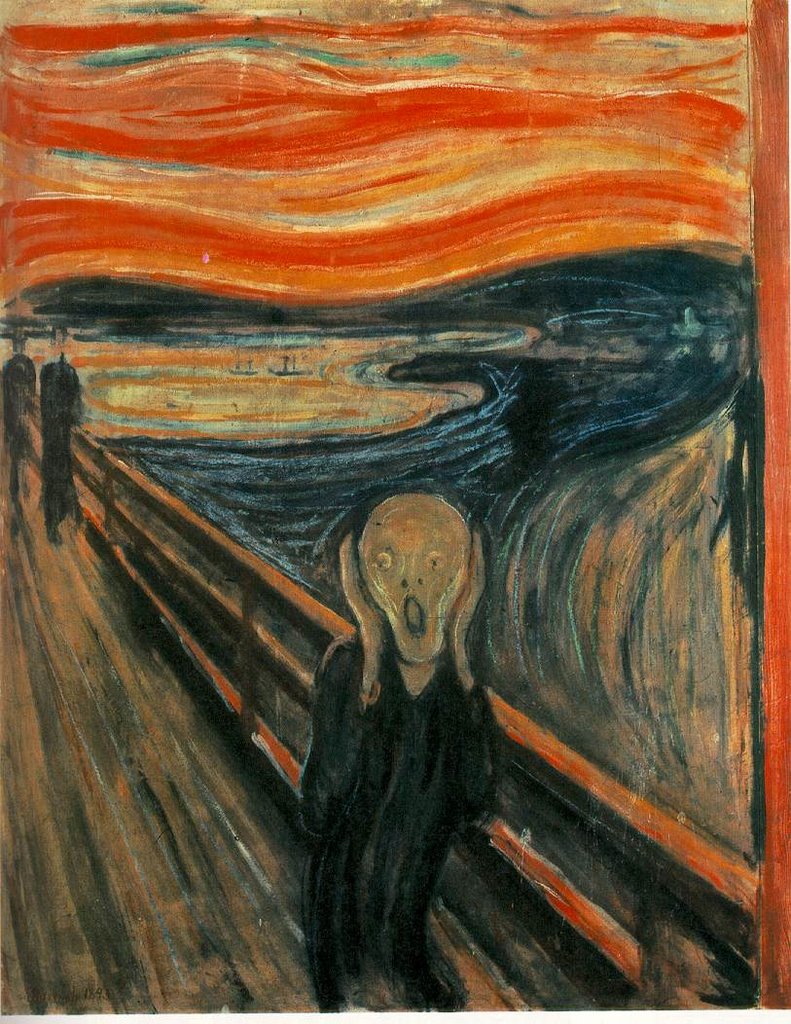
Don's vault - a large steel room, with access through a single door requiring Narang's palm print to deactivate the locks, the vault contains money, diamonds, cocaine, the infamous disc (a red diary in the original) with all those contacts, some ancient Asian sculptures, and - WAIT A MINUTE - is that Edward Munch's "The Scream"? The one that was stolen at gunpoint in August 2004, only to be recovered earlier this year? So we finally know who had it all that time the international hunt for the masterpiece was on...

Bachao - Don mera peechcha kar raha haiSecond thing of note - when Don spots Kamini (Kareena Kapoor) they are both in a nightclub in KL. The scene is incredibly reminiscent of the club scene from Dil Chahta Hai - lots of flashing strobe lights, a dance floor packed with clubbers, alcohol, and pulsating music....hmmm....that beat seems familiar.....hey wait a minute - it sounds like the one from Koi Kahe Kehta Rahe in the club scene in Dil Chahta Hai. Interesting way to build in a signature Mr. Akhtar...
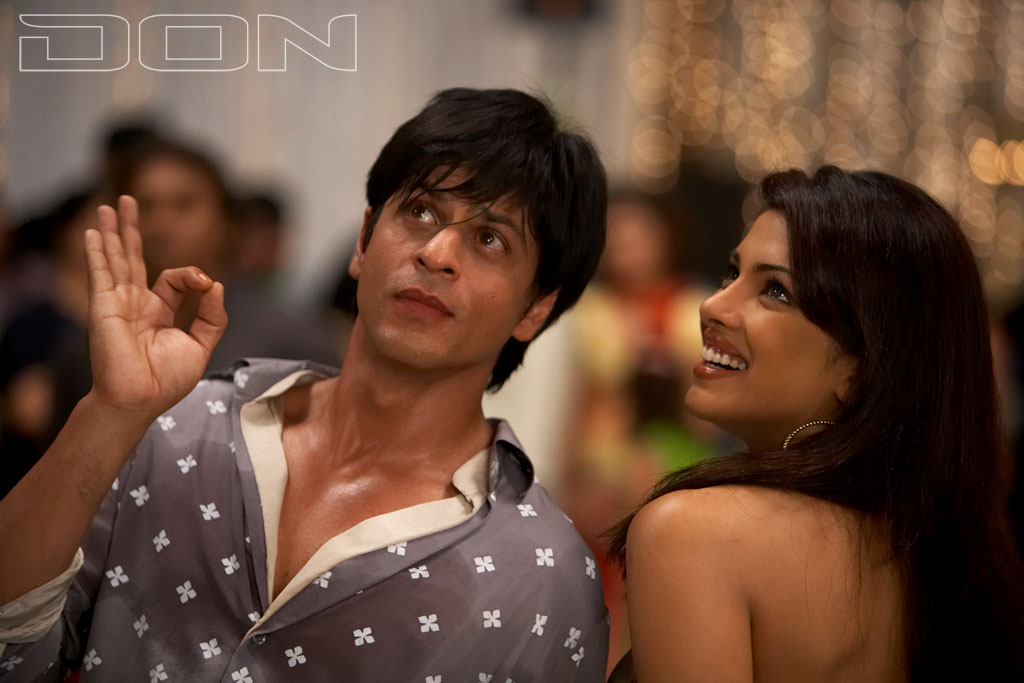
Third thing - Priyanka Chopra. This woman has come a long way, from being a wooden Ms India to a pretty competent screen presence (note the absence of the word actress) Chopra is beautiful, and also very photogenic. She also plays a convincing Roma, out to avenge her brother's death at Don's hands by infiltrating Don's gang. There were several moments when she was on screen that wolf whistles went off all over the cinema (at one point, a particularly distressed man kept wailing, "Sexy" at the screen until he was, I presume, either escorted out or passed out, because the noise died out after some point - I just hope he didn't stop because he had managed to "gratify" himself...)

Laakhon taare aasman mein, ek magar dhoonde na mila...Khaike Paan Banaraswalla - this song made the original movie, and in many ways also cemented Amitabh Bachchan's fan following in his own home state of Uttar Pradesh. Sadly, while King Khan does his best to emulate a paan chewing rustic from the Gangetic plains, high on bhaang and also on the tambaaku in his beeda, this is where you miss the old Bachchan. Khan throws some fairly energetic moves, while Chopra does a good job as well, but you can't help but remember the original. Having said that, I had never thought this particular song would do well as a karaoke number, but at one point, half the audience was going, "Hai, Hai, Haaai" with Don when he sang about ek kanya kuvaanri & ek meethi kataari.
Oh yeah - another good point in the movie is Arjun Rampal. Akhtar coaches out a believable performance from him; there are some creepy moments when he's locked in a coffin, and also when he's hunting down DCP Da Silva. Rampal's also looks convincing in the fight scenes, though his geeky IT consultant image jars just a bit.

Whistle Quotient - highest for Kareena Kapoor for her Yeh Mera Dil number, followed closely by Priyanka Chopra in a bathing suit. Isha Khoppikar didn't get much attention, but seriously, what do you expect when the woman's wearing a maternity frock?!

Isha, girl, you gotta talk to my designer next time...
Disbelief Quotient - pretty low, with the exception of Don flying through mid air like a Patriot missile to zoom in the guy with a parachute. Thankfully, the high wire walk by a lame man with two kids is replaced by a much more believable scene...

Overall Result - go watch it, for some good fun, good thrills and very slick production. Picture mast hai baap...

Images courtesy official movie website

Edward Munch's The Scream courtesy Wikipedia

Saturday, October 14, 2006

Thelma & Louise do Bollywood

Warning: This piece contains plot spoilers

There is a school of thought that believes that the true measure of whether a movie is great cinema or merely passing fare is whether or not there is that one screenshot that captures the ultimate essence of the entire film; one that becomes the leitmotif of the film. Hindi cinema has several such moments - scenes that have become emblematic of the film as a whole, as well as signposts along the filmmaker's career. Scenes such as Waheeda Rehman sleeping on the couch in Chaudhvin Ka Chand, Nargis hunting for food in the mud in Mother India, Manisha Koirala's burqa snagging on a tree and her flinging it aside in Bombay.

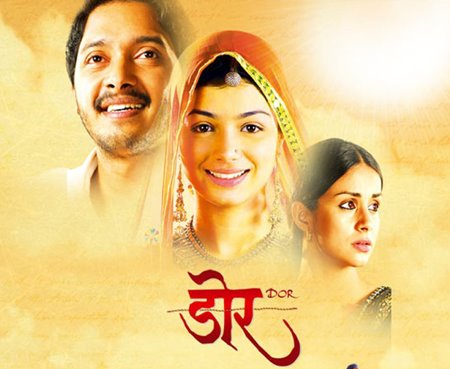
And today, I saw a similar scene - when Mira threw off her odhni in Dor.

One of the smaller, lower budget movies of the year, Dor is the latest offering from Nagesh Kukonoor, Indian cinema's NRI engineer turned India-returned filmmaker. After giving us some seriously low budget films like Hyderabad Blues, Kukunoor's growing stature has given him more funding, while each successive film has shown his maturing into a talented filmmaker.
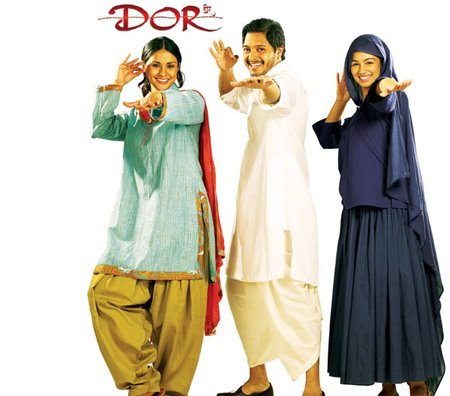
Dor, is his most mature & well crafted movie. Compared to the raw amateurishness and boisterous enthusiasm (coupled with the pretty stilted acting) of his earlier ventures, his latest cinematic venture is a brilliantly executed work in understated, subtle film making. With a low-profile but competent cast, some extremely simple but powerful landscapes, and a very tight script, Kukunoor delivers a film that is worth seeing several times.

The film traces the journey of two women, Zeenat (Gul Panag) from Himachal Pradesh, Mira (Ayesha Tankia) from Rajasthan, on their journeys of separation, loss, friendship & liberation. Both women are married to husbands whom we see leaving for Saudi Arabia at the start of the movie. When it emerges that while in the Gulf, Mira's husband has died, ostensibly at the hands of Zeenat's husband, one woman is widowed while the other is left knowing her spouse is to be executed for murder. Zeenat's only hope is to obtain a pardon from the victim's wife, and for which she undertakes the arduous journey to the desert state to track down Mira and convince her to sign the pardon.

Dor has been labelled a feminist film, in the sense that the narrative is entirely focused on the two women who are central to the plot. From the start through to the end, the male characters in the film serve only to progress the plot, but are also merely incidental to it. Kukunoor almost takes Thelma & Louise and injects into it a distinctive "Indian-ness", in terms of aesthetics, plot as well as character development. Both Zeenat & Mira face very different circumstances, both from their western counterparts as well as from each other, differing in language, religion & perspective, but each is ultimately Indian. Kukunoor fleshes out the disparities between them easily, both through narrative and cinematography - Zeenat & Mira are as different as their respective homelands of verdant Himalayan mountains and the arid Rajasthani desert, but this difference does not detract from their instant recognition of a companion soul in the other.

Kajra re, kajra re, mere kaale kaale naina...Kukunoor also manages to inject his story telling with a healthy dose of cross referencing to mainstream Bollywood, lending a unique intertextuality to Dor. Several references through dialogue, many of them to contemporary films like Munnabhai MBBS & Bunty aur Babli, and the use of Hindi film songs (You are my Soniya, Kajra Re) also help Kukunoor develop aspects to his characters that would have been challenging to flesh out otherwise. You can immediately recognise in Mira every small town girl that learnt the steps to famous songs, to be performed at family festivals in front of cousins and at wedding sangeets, while the Behroopiya's mouthing of filmi dialogues marks him out in five seconds as that small town performer who entertains in villages with his impersonations. Furthermore, this intertextuality is both a testimony to the over-arching influence of popular cinema in the lives of millions, as well as a fitting tribute to Bollywood. Kukunoor has done well in not going down the route of many "auteurs" who look down on their mainstream counterparts; on the contrary, he uses them intelligently to sustain the sparseness of his own narrative.

The film thus etches the characters of Zeenat & Mira as much through dialogue & situation as through visualisation and imagery. If Zeenat's overt fearlessness, but inner hesitation, is most clearly etched out as she stands cornered by two men in a doorway, silently clutching a small stone to defend herself, Mira's tender innocence is seen most clearly as she dances quietly in a dusty alley to You Are My Soniya, dressed only in the dull blue of the widow. Later, her distress at having to take a decision that affects another human's life, when she herself has been denied the freedom to make decisions about her her own life, is beautifully acted out. Kukunoor chooses to utilise all the elements of cinema at his disposal, rather than relying only on verbalising everything that is to be portrayed. Thus, we see Mira's desolation in her clutching a pink shawl retrieved from her deceased husband's belongings, while Zeenat's independence is seen in her striding confidently through mountains on her own, unaccompanied, to go visit her in-laws or work on her house, hammer in hand.

This, then is what good cinema is about. This is what we have expected from our new breed of directors but have not seen much of until now. Kukunoor is to be lauded on reaching a stage of maturity in his film making through a relatively brief filmography. From Hyderabad Blues to Dor, he has crossed a big gap and has given us one of the best movies of the year, if not decade. Dor is a tribute to the strength of the individual will to make its own decisions and bear their consequences; to the power of humanity and to the complexity of human relations. This is a definite 6 out of 5 - go watch it or you'll miss out on some of the best cinema in years. And when its out, go buy the DVD and watch it again.

A final comment on the closing sequence. Kukunoor's intextuality continues, with a tearful departure on a small train station. Zeenat is leaving, and takes with her Mira's pardon. Unlike when Mira's husband was going, this is a solitary departure, alone, without the strictures or support of family ties.

Here, we are treated to a scene of greater pathos - Mira hands the pardon to Zeenat through the grilles of the train window. With that pardon, she hands across not only her forgiveness, but her desire for revenge, and in a sense, her one and only friend. For surely a married Zeenat will leave her to her own private desolation? What we see instead is a desi version of Thelma & Louise, with Zeenat holding out her hand for Mira to catch. But in this case, because this is a Hindi movie which is to have a happy ending, we are not looking at two friends about to drive off a cliff, but at two friends who are looking into the future.

It is virtually impossible to not think of Dilwale Dulhaniya Le Jaayenge, when Simran must beg her father to let her go with Rahul. Unlike Simran, Mira must not beg for freedom from her constraints as personified by anyone; her boundaries are made amply clear to her in her own widow's garb. Seeing in front of her a future, a life and a friendship, Mira chooses to run and board her own life.

And as she does so, she lets her dull blue widow's odhni fly away.

Images courtesy Apun Ka Choice

Thursday, October 12, 2006

Orhan & his Istanbul

The Swedish Academy announced today that it had awarded the 10 million Swedish kroner Nobel Prize for Literature to controversial Turkish author Orhan Pamuk. Of the many writers who were out there and notable contenders for the Nobel, I could not think of a more suitable winner than Pamuk.

The award citation read, "In the quest for the melancholic soul of his native city, (Pamuk) has discovered new symbols for the clash and interlacing of cultures."

Perhaps this, then, is Pamuk's greatest legacy. Born in a staunchly nationalist Turkey, the memories of Ottoman decline fresh in its mind, and the glory of Kemal Ataturk at the forefront of the national consciousness, Pamuk could be the Cassandra of modern Turkey. His has been the voice of prophecies and quiet introspection, and one that has been incredibly divisive internally. His work has attracted much attention, and a great deal of criticism, with some considering Pamuk to represent a vision of Turkey that is palatable to the West, but which it actually is not. His mention of the massacres of Kurds & Armenians has not gone down well in Turkey either. Pamuk has recently been victim of a lawsuit, brought to court by nationalist Turkish lawyers for insulting the Turkish nation state by accepting the genocides. In fact, its probably no coincidence that Pamuk won the prize in the same year that he faced the lawsuit - many Turks would probably also feel that the lawsuit itself might be the only reason for his winning the award at all.

Pamuk has continually chosen to depict the dichotomies of tradition and modernity and their conflicts within Turkish consciousness in most of his work. His work has focused on more easily identifiable themes, such as the syncretism of Istanbul and its transition from a centuries old capital to a simple commercial city in Istanbul or My Name is Red. He has also chosen to delve deeper into the issues of identity formation and constructivist identities that operate at multiple levels in The White Castle, Snow & The Black Book. There is also a recurrent mystic quality to his writings, whether in his descriptions of art as a means to reach God in My Name is Red, or in the power of books to transform lives (The Black Book, The New Life).

But for me, none of this is anything more than an intellectual exercise.For me, as a non - Turk, non - European, perhaps some of the complexities in his writing are inaccesible. I am definitely impartial to most of the controversies surrounding his work. Pamuk became one of my favourite authors, and the reasons for that were simple. He opened my eyes to his beloved city, Istanbul.

A city that has long fascinated me, I was intrigued by a place that is poised between Europe & Asia, historically, geographically, culturally. I wanted to see how Istanbul, for many centuries a great city, has dealt with no longer being the centre of the known world, where different cultures, empires, societies would meet in the original melting pot.

Pamuk helped answer some of those questions for me. Through his writings, I could trace the transition that Istanbul & Turkey have undergone over the past forty years - from a slow decline of Ottoman tradition, to the steady growth of European style secularism, with recent years seeing a resurgence of Islamism. His work helped me discern the fine divisions that existed between different factions within Turkey and their views of how Turkey should be; how it veered towards a modern, outward looking nation that is increasingly global & consciously European in outlook, against the backdrop of a strong Ottoman legacy, a distinctly Asian heritage and a syncretic society that saw many religions and ethnicities coexist within a distinctly Islamic framework.

The first Pamuk novel I read was his classic, My Name is Red. A historic murder mystery, set in medieval Istanbul, it brilliantly etches the strongly divergent views on art & representation between the Islamic & European worlds. At the centre of the narrative is this discord, of how long established traditions are threatened by new trends brought east by Genoese merchants, of how the quest for modernity can be so easily shattered by the tyranny of tradition. My Name is Red sketched for me a view of an Istanbul that was redolent of power and grandeur, but that was laced with a seamy underside of political intrigue & stifling traditional conservatism, as well as a city that was essentially divided between its European & Asian halves, psychologically as well as geographically.

I read My Name is Red & Istanbul before I visited Istanbul. But Pamuk's writing had painted a glorious picture for me, had opened my eyes to the multifarious realities that make up that uber-city, had prepared me for the schizophrenia that was to confront me at every step. I learnt not to blink at the sight of a woman in a full chador, only her eyes visible, walk down Istaklal Caddesi and pass several open air cafes, their tables occupied by several gorgeous young women, blond, in low cut tops, chatting and smoking cigarettes. I learnt to expect Turks to look Caucasian, Arab, Persian. I learnt that the architecture in Istanbul was a glorious cacophony of different styles, the older Ottoman heritage clearly showing its Mongol ascendancy, while more recent constructions spoke of rococo & Baroque influences. I learnt that it was normal for people to live in Asia and work in Europe, and cross that great divide twice a day on their way to work.

Pamuk's writing taught me, before I had even stepped foot in his city, that if you were in Istanbul, your name, too, would soon be Red. And for that alone, I applaud Pamuk on his Nobel prize - rarely has an award been so well deserved.