
And so the day approaches.
Tomorrow, on the 17th of April, 2008, the latest leg of the Torture Relay will take place in New Delhi, capital city of the world's largest democracy.
Tomorrow, on the 17th of April, 2008, over 13,000 security personnel will line the broad expanses of Rajpath down to India Gate, creating a corridor for 70 Indian citizens to carry the torch of shame, each of whom will have hopefully searched their consciences about the moral and ethical implications to have made an informed decision.
Tomorrow, on the 17th of April, 2008, thousands of free Indian citizens and our Tibetan friends will be denied their legal right to protest in the vicinity of the torch, which has now been reduced to nothing more than a crass symbol of authoritarianism and jingoistic nationalism for one of the most tyrannical regimes in today's world.
Tomorrow, on the 17th of April, 2008, thousands will watch across the world as New Delhi delivers, at a governmental level, the greatest slap on the face of democracy and Indian suzerainty, as elite commandos from China's special forces escort the torch on Indian soil.
Tomorrow, on the 17th of April, 2008, the world will watch the Government of the Republic of India, (led by, lets not forget so easily, the only political party in India to have voluntarily suspended the Fundamental Rights of the Indian Citizen through the declaration of an Emergency in 1975) as it genuflects before the Communist Party of China, accompanied in its prostrations by its supporters in the Indian communist parties.
Tomorrow, on the 17th of April, 2008, the world will watch as India turns its back on the greatest opportunity to break out of the shadow of its eastern neighbour and demonstrate to the wider world at large that while the globe can talk of "China & India" in the same breath, the two are fundamentally different countries, cultures and regimes. Tomorrow, the world will watch as the Government of the Republic of India voluntarity subsumes itself to the dictats of Beijing, while absolving itself of any responsibility to uphold freedom of speech, freedom of assembly, freedom of political thought, freedom of peaceful dissent, and most of all, freedom of conscience.
But that is not all. Tomorrow may be a day of despair, but it is also a day of glory.
Tomorrow, on the 17th of April, 2008, the world will watch runners cobbled together by the Indian Olympic Committee, but will remember that four Indian citizens chose not to participate in the Torture Relay. The world will watch and will think of Bhaichung Bhutia, Kiran Bedi, Soha Ali Khan Pataudi and Sachin Tendulkar. Only Bhaichung has cited his support for the Tibetan cause, but the gradual withdrawal of the others is yet another moral victory for those of us who would draw attention to the crass politicking of the Chinese Communist Party in its attempt to turn what could have been a great opportunity for change into a despicable attempt at projecting hegemonic glory while seeking political acceptance from the six continents of the world.
Tomorrow, on the 17th of April, 2008, the world will also watch as (hopefully) thousands of free Indian citizens and our Tibetans friends will congregate separately to lead a freedom rally, away from the main tunnel of shame. Tomorrow, on the 17th of April, 2008, the world will watch as the stands surrounding the tunnel of shame stay nearly empty, with the Government of the State of Delhi announcing today that schoolchildren will not be sent to attend the the Torture Relay. Tomorrow, on the 17th of April, 2008, the world will watch as Delhi and India turns its back on the torch, sending the clear message that even when the Government does not raise its voice in conscientious disagreement, the citizens of India will.
So if you are reading this from India, from Delhi, then go and show your support for the thousands who will follow the torch of freedom, who will stand in solidarity against a mighty military empire with nothing more than the strength of their convictions as their weapons. Go and show the world that India is the world's largest democracy, the only country in the world to have defeated the world's greatest coloniser with the power of the conscience, the land of the Mahatma, of ahimsa, of satyagraha, of the Buddha and Mahavira, of Meera, Ashoka and Parashurama. Go and show the world that even if the rest of the world will capitulate in the face of economic and military power, India will not.
And make sure that tomorrow, on the 17th of April, 2008, your voice is heard.
(The title of this post is taken from vernacular references to the 1847 War of Independence, when sepoys from Meerut headed towards Delhi to crown Bahadur Shah Zafar the Emperor of India. No reference to violent protest is implied, and the author completely disassociates himself from any violent protest - violence is not something that would make The Buddha Smile)
Showing posts with label New India. Show all posts
Showing posts with label New India. Show all posts
Wednesday, April 16, 2008


Sunday, September 30, 2007
A Crumbling Palace of Glass
Things are stirring in Burma.
I've been following news reports of the protest marches that have been ongoing for several days now in Myanmar, as the crowds have gotten bigger and bigger, the protesting voices louder. Myanmar's people are, yet again, raising their voices against the tyranny of a junta that has stayed in power intermittently since 1962. Similar protests have been brutally suppressed, in 1988 & 1996, and pro-democracy activists arrested, beaten, tortured and killed in what has to remain, along with North Korea, one of the most isolated countries in the world.
The world has been watching with worry as the most recent protests have gotten louder. Everyday people expect news of the imminent crackdown, expect to see scenes of violence and brutality unfold through the few camera crews in the country. This week saw first signs of such a crackdown - monasteries raided at night & isolated, monks beaten up and arrested, live rounds fired into crowds attempting to reach Shwedagon Pagoda.
The UN Security Council has already expressed concern. But the organisation remains toothless, because even though the US, UK & EU continue condemning the oppressive Burmese junta, Russia, China & India have developed close economic & defence links with the regime over the years. All three have been attracted by the lure of Myanmar's oil & natural gas deposits, with Indian petroleum minister Murli Deora most recently making a trip to the troubled country earlier this week.
Calls have been increasing for both India & China to respond to the crisis, leveraging their historic & current econoimc & political ties to the country and impose either change or restraint. India, home to many Burmese refugees, is almost expected to take a stance in what is unfolding in its immediate neighbourhood. India, traditionally a supporter of pro-democracy movements around the world, has taken a different stance in its own neighbourhood. It has chosen, instead, to forge military & economic ties with the miltary junta in Myanmar.
India's decision to engage with the junta is predicated on three key factors; and for a change, none of the three factors relate to India's desire to be the moral compass of the world, in which realpolitik was replaced with idealism. The first, and perhaps most directly relevant reason for establishing relations with the junta has to do with insurgencey movements in the Northeast of India. Naga & Mizo rebels have long used the western jungles of Myanmar to regroup and establish logistical centres. Falling outside the area that could be accessible to Indian security forces, the insurgencies have managed to remain active. India's decision to support & engage with the junta has been a direct result of its desire to eliminate these outposts. The strategy, so far, has seemed to work.
The second factor is similarly related to regional stability, but in a more tangential way. With most of the Western world having shunned economic & political ties with Myanmar, the country's greatest supporter has been China, a country with which India itself has a complex relationship. In the dance of the elephant and the dragon, where countries are reduced to areas where the two jockey to extend their spheres of influence, to stand back and let Myanmar get totally overwhelmed by China became a position India could little afford to take. Myanmar has an extended border with India along the Northeast, and securing this border remains, as always a key concern for the Indian security establishment.
And finally, in the most prosaic of terms, India is severely energy deficient.To have massive oil & natural gas reserves in your own neighbourhood, as is the case with both Iran & Myanmar, and not be able to tackle them for reasons of diplomatic morality is a difficult & economically unviable position.
So while understanding why India has chosen to do business with what is quite arguably one of the worst regimes in the world helps contextualise India's current silence on the situation, it does not answer the question of whether or not taking a stand against a brutal and tyrannical regime in its neighbourhood is the appropriate strategy. Because whether we like it or not, India has moved away from its historical blunder of being the world's moral police, adopting the idealistic high ground and wagging a finger at other powers in the world. India has increasingly moved away from this limiting position, towards one where pragmatism has taken root.
The idealist would argue that India should step in, take a stand against the junta, and use its political & economic leverage with the regime to force change, or if not change, at least prevent the sort of bloodshed and brutal suppression that the entire world fears is already underway. I would argue that this is probably incredibly counterproductive; not for Myanmar's people, but for India's longer term ambitions in the country & wider region.
India lives in a pretty bad neighbourhood. With the exception of Bhutan & China, all of our neighbouring states are in the grips of the sort of political turmoil and armed conflict that at worst could flare up into civil war, if they haven't done so already. General (President?) Musharraf is battling to retain control over Pakistan, which is steadily getting out of his hands; Nepal is in the throes of a Maoist uprising, Sri Lanka has yet to resolve the Tamil civil war, Bangladesh looks like a coup is underway, and don't even get me started on Afghanistan. To step into Myanmar, which itself has a long history of ethnic turmoil and political instability, and jeopardise the regime that has allowed India access to valuable energy reserves & cooperation in tackling military training would be pretty self-defeating.
The pro-interventionists argue that if India were to support the move for democracy, it would gain credibility with the local populace, who on forming a democratically elected government would continue to support India the way the junta has done. I'd point out a few facts here first. India has economic clout with Myanmar because it was able to access the market without competing with Western companies. ONGC & CNOCC have access to Myanmar's oil & natural gas reserves because the BP's, Chevron & Texaco's of the world do not. Were Myanmar to gain democracy, the chances of these countries remaining out of the race would decline significantly, taking away the cost advantage that the current arrangement provides.
We also have historical precedents of our intervention not quite going to plan. When India entered Bangladesh in 1971, with the full understanding that it was breaking up Pakistan, its soldiers were greeted with cheers by the local population. Within weeks, those cheers had turned to hostile sloganeering, with India being accused of "separating brother from brother". To expect our grandstanding in Myanmar to be received better in the long term is a delusion we would do well to consider carefully. India has an unusual position in South Asia. It is the largest country, and its sheer size, scale & power act as both an advantage, and an immense disadvantage, in its relations with significantly smaller neighbours, who operate out of a mentality of inferiority and resentment.
Finally, Myanmar is today a stable country (not counting the past few weeks). The price of that stability is the brutal suppression we see in the country today. I do not condone that suppression, and neither do I suggest that it should remain in place. However, for India to act unilaterally against it is not in our best interests. Because let's not forget that political allies are fickle friends in the world, and to expect eternal gratitude or friendship from any country is nothing short of delusional.
So what's the way forward? Whether we like it or not, the UN must remain the key tool of international dispute resolution. Myanmar's regime should go, but it is NOT for India to force it to do so.
The title of this post is inspired by Amitav Ghosh's novel, The Glass Palace, which takes place extensively in colonial Burma, and deals with the historic ties between India & Myanmar. No other direct link is implied.
I've been following news reports of the protest marches that have been ongoing for several days now in Myanmar, as the crowds have gotten bigger and bigger, the protesting voices louder. Myanmar's people are, yet again, raising their voices against the tyranny of a junta that has stayed in power intermittently since 1962. Similar protests have been brutally suppressed, in 1988 & 1996, and pro-democracy activists arrested, beaten, tortured and killed in what has to remain, along with North Korea, one of the most isolated countries in the world.
The world has been watching with worry as the most recent protests have gotten louder. Everyday people expect news of the imminent crackdown, expect to see scenes of violence and brutality unfold through the few camera crews in the country. This week saw first signs of such a crackdown - monasteries raided at night & isolated, monks beaten up and arrested, live rounds fired into crowds attempting to reach Shwedagon Pagoda.
The UN Security Council has already expressed concern. But the organisation remains toothless, because even though the US, UK & EU continue condemning the oppressive Burmese junta, Russia, China & India have developed close economic & defence links with the regime over the years. All three have been attracted by the lure of Myanmar's oil & natural gas deposits, with Indian petroleum minister Murli Deora most recently making a trip to the troubled country earlier this week.
Calls have been increasing for both India & China to respond to the crisis, leveraging their historic & current econoimc & political ties to the country and impose either change or restraint. India, home to many Burmese refugees, is almost expected to take a stance in what is unfolding in its immediate neighbourhood. India, traditionally a supporter of pro-democracy movements around the world, has taken a different stance in its own neighbourhood. It has chosen, instead, to forge military & economic ties with the miltary junta in Myanmar.
India's decision to engage with the junta is predicated on three key factors; and for a change, none of the three factors relate to India's desire to be the moral compass of the world, in which realpolitik was replaced with idealism. The first, and perhaps most directly relevant reason for establishing relations with the junta has to do with insurgencey movements in the Northeast of India. Naga & Mizo rebels have long used the western jungles of Myanmar to regroup and establish logistical centres. Falling outside the area that could be accessible to Indian security forces, the insurgencies have managed to remain active. India's decision to support & engage with the junta has been a direct result of its desire to eliminate these outposts. The strategy, so far, has seemed to work.
The second factor is similarly related to regional stability, but in a more tangential way. With most of the Western world having shunned economic & political ties with Myanmar, the country's greatest supporter has been China, a country with which India itself has a complex relationship. In the dance of the elephant and the dragon, where countries are reduced to areas where the two jockey to extend their spheres of influence, to stand back and let Myanmar get totally overwhelmed by China became a position India could little afford to take. Myanmar has an extended border with India along the Northeast, and securing this border remains, as always a key concern for the Indian security establishment.
And finally, in the most prosaic of terms, India is severely energy deficient.To have massive oil & natural gas reserves in your own neighbourhood, as is the case with both Iran & Myanmar, and not be able to tackle them for reasons of diplomatic morality is a difficult & economically unviable position.
So while understanding why India has chosen to do business with what is quite arguably one of the worst regimes in the world helps contextualise India's current silence on the situation, it does not answer the question of whether or not taking a stand against a brutal and tyrannical regime in its neighbourhood is the appropriate strategy. Because whether we like it or not, India has moved away from its historical blunder of being the world's moral police, adopting the idealistic high ground and wagging a finger at other powers in the world. India has increasingly moved away from this limiting position, towards one where pragmatism has taken root.
The idealist would argue that India should step in, take a stand against the junta, and use its political & economic leverage with the regime to force change, or if not change, at least prevent the sort of bloodshed and brutal suppression that the entire world fears is already underway. I would argue that this is probably incredibly counterproductive; not for Myanmar's people, but for India's longer term ambitions in the country & wider region.
India lives in a pretty bad neighbourhood. With the exception of Bhutan & China, all of our neighbouring states are in the grips of the sort of political turmoil and armed conflict that at worst could flare up into civil war, if they haven't done so already. General (President?) Musharraf is battling to retain control over Pakistan, which is steadily getting out of his hands; Nepal is in the throes of a Maoist uprising, Sri Lanka has yet to resolve the Tamil civil war, Bangladesh looks like a coup is underway, and don't even get me started on Afghanistan. To step into Myanmar, which itself has a long history of ethnic turmoil and political instability, and jeopardise the regime that has allowed India access to valuable energy reserves & cooperation in tackling military training would be pretty self-defeating.
The pro-interventionists argue that if India were to support the move for democracy, it would gain credibility with the local populace, who on forming a democratically elected government would continue to support India the way the junta has done. I'd point out a few facts here first. India has economic clout with Myanmar because it was able to access the market without competing with Western companies. ONGC & CNOCC have access to Myanmar's oil & natural gas reserves because the BP's, Chevron & Texaco's of the world do not. Were Myanmar to gain democracy, the chances of these countries remaining out of the race would decline significantly, taking away the cost advantage that the current arrangement provides.
We also have historical precedents of our intervention not quite going to plan. When India entered Bangladesh in 1971, with the full understanding that it was breaking up Pakistan, its soldiers were greeted with cheers by the local population. Within weeks, those cheers had turned to hostile sloganeering, with India being accused of "separating brother from brother". To expect our grandstanding in Myanmar to be received better in the long term is a delusion we would do well to consider carefully. India has an unusual position in South Asia. It is the largest country, and its sheer size, scale & power act as both an advantage, and an immense disadvantage, in its relations with significantly smaller neighbours, who operate out of a mentality of inferiority and resentment.
Finally, Myanmar is today a stable country (not counting the past few weeks). The price of that stability is the brutal suppression we see in the country today. I do not condone that suppression, and neither do I suggest that it should remain in place. However, for India to act unilaterally against it is not in our best interests. Because let's not forget that political allies are fickle friends in the world, and to expect eternal gratitude or friendship from any country is nothing short of delusional.
So what's the way forward? Whether we like it or not, the UN must remain the key tool of international dispute resolution. Myanmar's regime should go, but it is NOT for India to force it to do so.
The title of this post is inspired by Amitav Ghosh's novel, The Glass Palace, which takes place extensively in colonial Burma, and deals with the historic ties between India & Myanmar. No other direct link is implied.
Sunday, July 08, 2007
We Won! We Won!
The results for the voting for the Seven New Wonders of the world came in yesterday...apparently, the Taj Mahal made it as well! :)
Check out the list of winners here
Check out the list of winners here
Monday, June 25, 2007
Democracy in Action
An earnest request to all readers - you have only 11 more days to vote for the Seven New Wonders of the World. The short list of monuments is over here, so exercise your democratic right and go choose the seven monuments that you think ought to be included.
Just to make a subtle point, my list of seven included the following:

So, as they say in India,
आपसे यह आग्रह है कि आप अपने मत का उचित प्रयोग करें और हमारे चहेते ताज महल को विजयी बनाए!
And as they also say in India,
भोट फ़ॉर ताज!
Thanks goes to fellow Desicritic DesiGirl for jogging my memory and reminding me to vote through her post
Image pinched from Incredible India!
Just to make a subtle point, my list of seven included the following:

So, as they say in India,
आपसे यह आग्रह है कि आप अपने मत का उचित प्रयोग करें और हमारे चहेते ताज महल को विजयी बनाए!
And as they also say in India,
भोट फ़ॉर ताज!
Thanks goes to fellow Desicritic DesiGirl for jogging my memory and reminding me to vote through her post
Image pinched from Incredible India!
Thursday, January 18, 2007
Shilpagate - Celebrity Big Brother's Ugly Underbelly
You can always gauge what’s big news in the
Unfortunately, Channel 4 seems to have decided that it will try to milk the controversy for all its worth, and by trying to adopt an attitude of feeding clippings to the public that will fuel the controversy are trying to milk the situation for all the viewership ratings it can get.
There have been some discussions of whether Shetty needs to be more aggressive in her reactions to statements from the coven. Funnily enough, when I hear that, I remember something that my mother told me when growing up – that by reacting to people in their language, you only reduce yourself to their level, and that does you no favours. Shetty has shown incredible restraint, resilience and much more class than any of her persecutors.
I only wonder how long it’s going to be before things get so ugly that external intervention is required. I am amazed that the producers of the show can sit back and let the behaviour that is rampant in the house continue without doing anything about it. I struggle to think how far this can go – will we need to see Shetty physically attacked by the deranged coven before they intervene? (Though given that she’s a black belt in karate, I wouldn’t mind seeing her kick some chav a**)
To top everything else off, Shetty isn’t even consonant with the only image of a glamorous South Asian woman – Amber (played by Laila Rouass) in Footballers’ Wives; a character that is sexy and incredibly intelligent, but nasty, shrewish, conniving and vicious (“a Bollywood freak show” is one of the terms used to describe Amber’s less than savoury character)
Check out fellow blogger Sunny's comments on Shilpa and the star narrative here
Also check out The Times weblog on Big Brother here - I love India Knight!!
Tuesday, January 02, 2007
Sexing Up the Sati Savitri
So 2007 finally rolled around. So here's wishing all of you a fantastic 2007, and hoping that it brings you all the very best this weird and wonderful world has to offer!
 And while we're on the topic of weird, I found this story on the Wall Street Journal this afternoon while at work. Normally, I'm not one to read Media & Marketing stories, principally because my work interests lie elsewhere - I'd much rather keep up to date with global politics, or try to keep abreast of the latest events in the world of financial services, corporate finance & capital markets. The title, though, ""Holy Heroes of Indian Lore, Batman!" caught my eye for its decided departure from conventional financial journalism headlines.
.jpg) So there you have it, folks - after centuries of hearing Indian mythological stories from our grandmothers, reading about the exploits of legendary heroes in Amar Chitra Kathas, and more recently learning about the Ramayana & Mahabharata from television, we will now see our stories told by Virgin Comics LLC. Add to this is a Nicholas Cage starring movie, titled "The Sadhu". Indian mythology, apparently, has gone global, and the craze for all things Indian seems now to extend to our cultural narratives as well.
So there you have it, folks - after centuries of hearing Indian mythological stories from our grandmothers, reading about the exploits of legendary heroes in Amar Chitra Kathas, and more recently learning about the Ramayana & Mahabharata from television, we will now see our stories told by Virgin Comics LLC. Add to this is a Nicholas Cage starring movie, titled "The Sadhu". Indian mythology, apparently, has gone global, and the craze for all things Indian seems now to extend to our cultural narratives as well.
To be honest, I'm not completely happy with this particular development. I appreciate that Indian mythologies are continuing to reinforce their cultural positioning after centuries of European colonial rule and Occidental imperialsim. More importantly, cultural narratives are only as good as their relevance and involvement in the communities they are a part of, and Indian mythology has a long standing tradition of being shaped, transformed and evolved over the centuries as the stories were transmitted between generations through the oral tradition, before being formally committed to paper. Call me modernist, but this idea of a living story and an evolutionary meta-narrative that can alter and mutate through time adds greater depth and synchronicity with the community it is a part of.
It is an incredibly inclusive concept if you think about it - a mythological legend that is as easily altered and transformed by the narration of a very ordinary person as it is by a powerful intellectual; what it engenders is a fantastic, participatory cultural narrative that can evolve, adjust and ultimately remain relevant for the times it is told in.
 That, unfortunately, is where the good news ends. I am especially troubled by what appears to be a blatant appropriation of an Indian & Hindu cultural narrative by a Western world, to be shaped, altered and transformed by people who will not have the cultural moorings to really grasp the intricacies of the stories, the profound reverence with which they are viewed in India, and the importance of keeping something that is linked to religion from descending into profanity. Linking into this appropriation of a Hindu & Indian narrative is the forced imposition of a clearly non-Indian aesthetic into the animation. The initial imagery that Virgin has released from their comics shows a startling similarity to Japanese anime - the landscapes are dark, menacing and unclear, while the characters seem similarly morphed and completely "un-Indian". The character Tara is not even vaguely Indian looking, while Devi herself seems like a Beverley Hills starlet - a silicone-enhanced white woman, with giant breasts, lacking totally the curved waist, hips & thighs that are normally seen in Asian representations.
 More disturbingly, and especially with reference to the planned Hollywood release, "The Sadhu", the fact that a Caucasian actor, Nicholas Cage, was chosen to play the modern incarnation of a Hindu holy man just seems to go that much further and reinfore the fact that in media that emanates from the West, the good guy is still the white American, even when his superhero status lies in a previous, Asian birth. So while the idea seems good enough, and would have fit ideally into the idea of a self-regenerating and re-inventing cultural narrative, this particular development is nothing more than yet another example of a Western, white international media structure that seeks to identify, but then appropriate and distort, cultural metaphors from around the world, and to fit it into a "white" paradigm.
Where is the Sangh Parivar when you need them?! Oh right - they're building temples to protect us from ourselves...
All images from: Virgin Comics LLC
 And while we're on the topic of weird, I found this story on the Wall Street Journal this afternoon while at work. Normally, I'm not one to read Media & Marketing stories, principally because my work interests lie elsewhere - I'd much rather keep up to date with global politics, or try to keep abreast of the latest events in the world of financial services, corporate finance & capital markets. The title, though, ""Holy Heroes of Indian Lore, Batman!" caught my eye for its decided departure from conventional financial journalism headlines.
.jpg) So there you have it, folks - after centuries of hearing Indian mythological stories from our grandmothers, reading about the exploits of legendary heroes in Amar Chitra Kathas, and more recently learning about the Ramayana & Mahabharata from television, we will now see our stories told by Virgin Comics LLC. Add to this is a Nicholas Cage starring movie, titled "The Sadhu". Indian mythology, apparently, has gone global, and the craze for all things Indian seems now to extend to our cultural narratives as well.
So there you have it, folks - after centuries of hearing Indian mythological stories from our grandmothers, reading about the exploits of legendary heroes in Amar Chitra Kathas, and more recently learning about the Ramayana & Mahabharata from television, we will now see our stories told by Virgin Comics LLC. Add to this is a Nicholas Cage starring movie, titled "The Sadhu". Indian mythology, apparently, has gone global, and the craze for all things Indian seems now to extend to our cultural narratives as well.To be honest, I'm not completely happy with this particular development. I appreciate that Indian mythologies are continuing to reinforce their cultural positioning after centuries of European colonial rule and Occidental imperialsim. More importantly, cultural narratives are only as good as their relevance and involvement in the communities they are a part of, and Indian mythology has a long standing tradition of being shaped, transformed and evolved over the centuries as the stories were transmitted between generations through the oral tradition, before being formally committed to paper. Call me modernist, but this idea of a living story and an evolutionary meta-narrative that can alter and mutate through time adds greater depth and synchronicity with the community it is a part of.
It is an incredibly inclusive concept if you think about it - a mythological legend that is as easily altered and transformed by the narration of a very ordinary person as it is by a powerful intellectual; what it engenders is a fantastic, participatory cultural narrative that can evolve, adjust and ultimately remain relevant for the times it is told in.
 That, unfortunately, is where the good news ends. I am especially troubled by what appears to be a blatant appropriation of an Indian & Hindu cultural narrative by a Western world, to be shaped, altered and transformed by people who will not have the cultural moorings to really grasp the intricacies of the stories, the profound reverence with which they are viewed in India, and the importance of keeping something that is linked to religion from descending into profanity. Linking into this appropriation of a Hindu & Indian narrative is the forced imposition of a clearly non-Indian aesthetic into the animation. The initial imagery that Virgin has released from their comics shows a startling similarity to Japanese anime - the landscapes are dark, menacing and unclear, while the characters seem similarly morphed and completely "un-Indian". The character Tara is not even vaguely Indian looking, while Devi herself seems like a Beverley Hills starlet - a silicone-enhanced white woman, with giant breasts, lacking totally the curved waist, hips & thighs that are normally seen in Asian representations.
 More disturbingly, and especially with reference to the planned Hollywood release, "The Sadhu", the fact that a Caucasian actor, Nicholas Cage, was chosen to play the modern incarnation of a Hindu holy man just seems to go that much further and reinfore the fact that in media that emanates from the West, the good guy is still the white American, even when his superhero status lies in a previous, Asian birth. So while the idea seems good enough, and would have fit ideally into the idea of a self-regenerating and re-inventing cultural narrative, this particular development is nothing more than yet another example of a Western, white international media structure that seeks to identify, but then appropriate and distort, cultural metaphors from around the world, and to fit it into a "white" paradigm.
Where is the Sangh Parivar when you need them?! Oh right - they're building temples to protect us from ourselves...
All images from: Virgin Comics LLC
Saturday, September 09, 2006
Cameron in India - a retrospective
The past week hasn't been a good one for Tony Blair. Even for someone used to getting hauled over the coals on a regular basis, the past week has seen his own loyalists closing ranks with the Brownians (Brown-ites?) and baying for his head - Blair must go, the refrain has been in Labour circles.
Add to this more recent conflagrations in Iraq, strengthening Taliban forces in Afghanistan, George Bush's admission that CIA has been using "secret" prisons in the war on terror, and you have to agree that things haven't been good for Mr Blair.
It's therefore not unusual that most mainstream media commentators in the UK have managed to gloss over a rather interesting event concerning the UK & India - the recent trip made by Conservative leader and Leader of Opposition David Cameron to India over the past week.
Normally, Mr Cameron is not that different from his contemporaries in UK politics (or indeed global politics). He has however, shown slightly quirky behaviour in the recent past, which makes him a little more interesting than the usual ilk of dull as dirty dishwater Charlie Brown-esque characters that make up UK politics. His election to the head of the Tories was accompanied by widespread media speculation around his choice of underwear, which you could argue shouldn't have been of that much importance, though I guess given how critical the issue of "support" is in a democratic setup, this should not be totally unsurprising. I shudder to think of the day when Indian journalists speculate on the choice of our national leader's underwear... it conjures images that just don't need to enter my head! Cameron has also been known to make some rather unexpected remarks - such as how antisocial elements just needed to be loved (leading to the popular "Hug a Hoodie" refrain around England; "hoodies" here referring to the unruly masses that tend to lurk in inner city hell holes wearing sweats with hood pulled up)
Cameron is, despite these incongruencies, a fairly charismatic politician. He almost reminds me of Blair when he was younger, less supercilious and definitely less enamoured of the US and its troubling worldview. Cameron has that eager, fresh-faced "I'm here for the greater good" that most young Oxfam volunteers display while on gap year projects spent helping struggling communities in Africa build solar heaters. He is young, dynamic, educated and also quite erudite. You hear him speak and come away with the niggling feeling that you weren't watching the leader of a national party speak, but rather a sophomoric foppy haired Englishman at St. something College in Oxford/Cambridge participating in some major debating competition. Interestingly, that clipped English accent lends a sense of old world to his general aura.
So from this rather jumbled old-world-new-world melee that is the head of "new" Tory, it was to be expected that a political trip to visit the global hub of IT services would be met with a complimentary blog. For that is indeed what Mr Cameron chose to do - maintain a blog to share his experiences of a foreign land with an electorate back home.
The blog, pointedly titled "David Cameron in India" carried brief passages explaining the purpose behind the blog. Most of the content is in video format, with Google videos covering different facets of the MP's visit to India. These included discussions of a more abstract nature around how factory inaugurations in India tend to be different from those in the UK, random rides in a CNG auto rickshaw (somewhat misleadingly called a "tuk-tuk" on several occasions) through Lutyen's Delhi, and general interactions with local Indian passersby who seemed more bemused than impressed (perhaps they might have thought that he was thinking of marrying into Indian politics as well.) Cameron did goof up when he insisted on referring to Rashtrapati Bhawan as the "Viceroy's Palace" - he could have softened the legacy with an appropriately placed "former", but alas, his foppish Oxbridge debating style didn't allow that. The final post from India covered his visit to the Delhi metro, his discussions with university students on their way to North Campus, and the comforts of air conditioning on an underground (obviously a reference to London's Tube, which has sweltered for three months as temperatures soared above ground)
There are two key points to take away from this event. First, we are seeing a sudden resurgence in general interest in India from the UK. Government & industry are both recognising the need to engage with India more proactively than they have been doing in the past, if they are to be able to capitalise on India's predicted economic growth. For an economy that has plateaued in recent years, the urgency to be able to somehow get a share of India's predicted astronomical growth is critical. Cameron is only being pragmatic when he speaks of building on a past heritage to strengthen current relations. His visit to India, even as only Leader of Opposition, is an important statement of British foreign policy to build on relations with India.
However, what is more interesting, at least for me personally, is how Cameron has chosen to utilise a fairly new medium to spread a political message. By using a blog to communicate with his electorate, Cameron is adding a political seal of approval to a growing international phenomenon. Blogging has in a very short span of time managed to present a significant alternative to millions of readers and internet users out there. It has taken the power of communication, and thereby the power to control what is being communicated, out of the hands of big media conglomerates & publishing houses, and has allowed individuals to seize the narrative. Perhaps I am being too post-modernist, but blogging has allowed the individual to deconstruct the meta-narrative of mainstream media and present an alternative that is comprised of millions of infinitesimal micro-narratives.
So has Cameron managed to alter the way in which politicians will communicate with their electorates? I doubt that - blogging still has a long way to go before it will be able to overtake its mainstream, corporate counterparts. More importantly, blogging is only as good as the penetration of the internet - and internet connectivity remains an issue in many parts of the world (You can take a newspaper onto a plane, but can't log onto a website on most aircraft!) Similarly, in developing countries, internet connectivity remains a challenge.
This is not to say that I think Cameron's gesture to use a blog to speak "directly" to his voters will fall by the wayside, especially in the UK. He has managed to capture a very direct forum of communication, and rival British politicians would be very short sighted to let him, and the Tory's, claim that turf for their own without a challenge. It won't be long before we hear of a Blair blog or a Brown blog (a brog?) a green Blog (a grog?) and a French blog, which could most appropriately be called a frog...
And what of India? I struggle to believe that many Indian politicians would bother with using a blog to communicate with voters - can you imagine La senora choosing to write a blog? (Maybe she'd call it Just Janpath) The only Indian politician I could have imagined setting up a blog would have been Pramod Mahajan, but we all know that he's been a victim of fratricide quite recently. And I doubt the bambino Gandhi would either. However, this is a great opportunity for any political party out there that is looking to work its way into the minds of a younger, educated electorate. Unlike the UK, India's population is incredibly young, and any political establishment that can be seen to embrace new technology would go a long way in shedding the ageing, out of touch image that characterises the political class.
Check out David Cameron's blog here
Add to this more recent conflagrations in Iraq, strengthening Taliban forces in Afghanistan, George Bush's admission that CIA has been using "secret" prisons in the war on terror, and you have to agree that things haven't been good for Mr Blair.
It's therefore not unusual that most mainstream media commentators in the UK have managed to gloss over a rather interesting event concerning the UK & India - the recent trip made by Conservative leader and Leader of Opposition David Cameron to India over the past week.
Normally, Mr Cameron is not that different from his contemporaries in UK politics (or indeed global politics). He has however, shown slightly quirky behaviour in the recent past, which makes him a little more interesting than the usual ilk of dull as dirty dishwater Charlie Brown-esque characters that make up UK politics. His election to the head of the Tories was accompanied by widespread media speculation around his choice of underwear, which you could argue shouldn't have been of that much importance, though I guess given how critical the issue of "support" is in a democratic setup, this should not be totally unsurprising. I shudder to think of the day when Indian journalists speculate on the choice of our national leader's underwear... it conjures images that just don't need to enter my head! Cameron has also been known to make some rather unexpected remarks - such as how antisocial elements just needed to be loved (leading to the popular "Hug a Hoodie" refrain around England; "hoodies" here referring to the unruly masses that tend to lurk in inner city hell holes wearing sweats with hood pulled up)
Cameron is, despite these incongruencies, a fairly charismatic politician. He almost reminds me of Blair when he was younger, less supercilious and definitely less enamoured of the US and its troubling worldview. Cameron has that eager, fresh-faced "I'm here for the greater good" that most young Oxfam volunteers display while on gap year projects spent helping struggling communities in Africa build solar heaters. He is young, dynamic, educated and also quite erudite. You hear him speak and come away with the niggling feeling that you weren't watching the leader of a national party speak, but rather a sophomoric foppy haired Englishman at St. something College in Oxford/Cambridge participating in some major debating competition. Interestingly, that clipped English accent lends a sense of old world to his general aura.
So from this rather jumbled old-world-new-world melee that is the head of "new" Tory, it was to be expected that a political trip to visit the global hub of IT services would be met with a complimentary blog. For that is indeed what Mr Cameron chose to do - maintain a blog to share his experiences of a foreign land with an electorate back home.
The blog, pointedly titled "David Cameron in India" carried brief passages explaining the purpose behind the blog. Most of the content is in video format, with Google videos covering different facets of the MP's visit to India. These included discussions of a more abstract nature around how factory inaugurations in India tend to be different from those in the UK, random rides in a CNG auto rickshaw (somewhat misleadingly called a "tuk-tuk" on several occasions) through Lutyen's Delhi, and general interactions with local Indian passersby who seemed more bemused than impressed (perhaps they might have thought that he was thinking of marrying into Indian politics as well.) Cameron did goof up when he insisted on referring to Rashtrapati Bhawan as the "Viceroy's Palace" - he could have softened the legacy with an appropriately placed "former", but alas, his foppish Oxbridge debating style didn't allow that. The final post from India covered his visit to the Delhi metro, his discussions with university students on their way to North Campus, and the comforts of air conditioning on an underground (obviously a reference to London's Tube, which has sweltered for three months as temperatures soared above ground)
There are two key points to take away from this event. First, we are seeing a sudden resurgence in general interest in India from the UK. Government & industry are both recognising the need to engage with India more proactively than they have been doing in the past, if they are to be able to capitalise on India's predicted economic growth. For an economy that has plateaued in recent years, the urgency to be able to somehow get a share of India's predicted astronomical growth is critical. Cameron is only being pragmatic when he speaks of building on a past heritage to strengthen current relations. His visit to India, even as only Leader of Opposition, is an important statement of British foreign policy to build on relations with India.
However, what is more interesting, at least for me personally, is how Cameron has chosen to utilise a fairly new medium to spread a political message. By using a blog to communicate with his electorate, Cameron is adding a political seal of approval to a growing international phenomenon. Blogging has in a very short span of time managed to present a significant alternative to millions of readers and internet users out there. It has taken the power of communication, and thereby the power to control what is being communicated, out of the hands of big media conglomerates & publishing houses, and has allowed individuals to seize the narrative. Perhaps I am being too post-modernist, but blogging has allowed the individual to deconstruct the meta-narrative of mainstream media and present an alternative that is comprised of millions of infinitesimal micro-narratives.
So has Cameron managed to alter the way in which politicians will communicate with their electorates? I doubt that - blogging still has a long way to go before it will be able to overtake its mainstream, corporate counterparts. More importantly, blogging is only as good as the penetration of the internet - and internet connectivity remains an issue in many parts of the world (You can take a newspaper onto a plane, but can't log onto a website on most aircraft!) Similarly, in developing countries, internet connectivity remains a challenge.
This is not to say that I think Cameron's gesture to use a blog to speak "directly" to his voters will fall by the wayside, especially in the UK. He has managed to capture a very direct forum of communication, and rival British politicians would be very short sighted to let him, and the Tory's, claim that turf for their own without a challenge. It won't be long before we hear of a Blair blog or a Brown blog (a brog?) a green Blog (a grog?) and a French blog, which could most appropriately be called a frog...
And what of India? I struggle to believe that many Indian politicians would bother with using a blog to communicate with voters - can you imagine La senora choosing to write a blog? (Maybe she'd call it Just Janpath) The only Indian politician I could have imagined setting up a blog would have been Pramod Mahajan, but we all know that he's been a victim of fratricide quite recently. And I doubt the bambino Gandhi would either. However, this is a great opportunity for any political party out there that is looking to work its way into the minds of a younger, educated electorate. Unlike the UK, India's population is incredibly young, and any political establishment that can be seen to embrace new technology would go a long way in shedding the ageing, out of touch image that characterises the political class.
Check out David Cameron's blog here
Tuesday, August 22, 2006
Lose a Raj, Gain a Nation
This post might seem to be a full week late, but that is wholly intentional. The week running up to India's Independence Day on the 15th of August has thousands of articles, quotes, photo essays, video clips, news stories, etc, related to Indianness. By choosing to put this post up now, I'm actually trying out the old, "Two birds, one stone" routine. Waiting that full week allows me to beat the hordes of articles out there and actually stand a chance of getting a readership, but it also gave me time to sit back and digest the events of my past week, which ended up being totally India specific.
Let me elaborate on that point a bit. London is no stranger to Indians - you will probably find that Indians make up one of the most significant communities here (we're the majority minority?) both in terms of strength and visibility. Despite that, its quite easy once you're going through the motions of daily life to forget just how visible and significant that community is, until its brought to your notice.
So last week, not inappropriately, ended up being about getting a taste of my Indianness again. It all started out with an impromptu dinner at the Bombay Brasserie, which is probably my favourite Indian restaurant in town - unlike the thousands of (predominantly) Bangladeshi curry houses, the Bombay Brasserie comes closest to replicating the Indian experience for me. The decor, somewhat reminiscent of The Imperial Hotel in New Delhi, doesn't hurt either when I'm nostalgic for life in Delhi. Normally, I don't go to Indian restaurants that frequently, and given the price tags on a meal at the Brasserie, its not quite the sort of place I'd go to regularly, so the impromptu meal was a great, if unexpected treat.
That Friday night meal was followed swiftly by another impromptu expedition out on the Sunday to the London Mela in Gunnersbury. Gunnersbury is a London suburb that has a massive Indian (especially Punjabi) community,, and the annual mela is now a big fixture on most Brit Asian calendars. I found out later that a fellow Bollywood blogger, Maja, was also there but we didn't manage to catch up.
 The Mela itself was great fun - I had gol gappas after a long time, and the chhole bhature, kebab rolls, nariyal pani and pista kulfi were pretty good as well. Like all true melas, there were several tents with musical performances, a lot of rides, and also random shops selling typical mela fair, as well as a (slightly bizarre) open air beauty parlour where if you weren't careful you could catch a glimpse of Mrs. Taneja getting her eyebrows threaded - not a good sight at all!
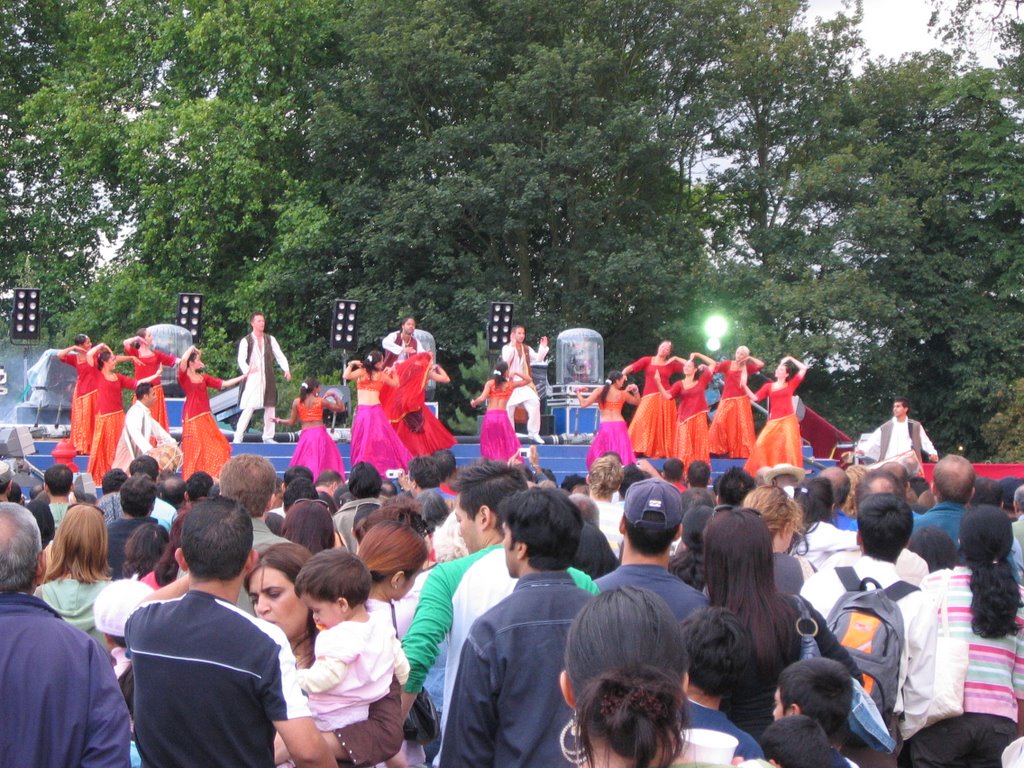
Perhaps the best part of the Mela were the Bollywood dancers - many of whom weren't Indian - and who put together a pretty impressive show, with well choreographed numbers, including Kajra Re & Dhadak Dhadak. Keeping with the Indian tradition, we went to the mela in a group of seven people - only four of our group were Europeans, two of whom barely speak English, and who had never stepped outside Florence, Italy, before that Friday. So for them, the entire experience was a complete culture shock, and the poor kids were really overwhelmed. By the end of the day, though, they seemed to have found their footing, enough for one to ask us how to dance Bhangra!
 Our hectic day at the Mela wasn't over - we then dashed off to go for a marathon emotional rollercoaster by going to see Kabhi Alvida Naa Kehna, only to find the hall packed full of Arab families, all waiting to have their heartstrings tugged viciously at by Mr Johar. I love it whenever I get to see a Bollywood movie in Central London; it's perhaps the best example of the Empire striking back. The international fan following isn't that out of the ordinary anymore either. The Monday edition of the Metro (the free morning newspaper that every London Tube commuter worth his salt will pick up at the station to read on the journey) had a short blurb about how in 2005, British releases in the UK were overtaken by Bollywood releases, while more Bollywood films made it to the UK top ten lists last year than British ones. Watch out Hollywood!
The final major Indian experience of the week was arguably a constructed one, but it was great fun nevertheless. By a strange coincidence of career planning, my two sisters & I have managed to end up living in the same city after a long time - usually we're in different continents. We'd been talking about organising joint drinks with our respective groups of friends, so we finally took the plunge last week and had that party. However, the irony of the situation was too good to let go of - three young, ambitious and reasonably aggressive Indians in London. The party theme was therefore, "Lose a Raj, Gain a Nation". We wanted to be inclusive you see - if you were imperialist, you could come to drink your sorrows away and we would commiserate with you on the loss of the Raj, whereas post - colonialists would be more than welcome to celebrate with us. Oddly enough, turnout being what it was, the three of us were the only Indians in a group of over 35 in a Mexican bar raising toasts to India's Independence in Covent Garden.
For one week in London, that's a lot of different Indian experiences rolled into one. Some very disparate events, very different areas and groups of people, but somehow with a lot of common themes that emerged only when I had a chance to reflect on the broader issue this weekend while lolling on a large white couch with the Financial Times Weekend. (My regular readers will detect a striking commonality to many of my epiphanies - the FT is always lurking near me at the time.)
India is fortunate to have two fantastic cultural ambassadors working for us - our cuisine & our films. My own experience of the world has led me to think that these two have earlier on worked in mutually exclusive geographies. Our cuisine is what got us a foothold in the developed West, while Bollywood has helped us build cultural links with a lot of the developing world. However, over the past decade, our food has started spreading to more countries, while the West has finally realised that they cannot sit back and not take Bollywood into notice. Indian restaurants are now almost necessities in most urban plans in the Western world, while the UK fascination for a good "curry" is legend. Compare this to Bollywood, which has built up a fan following in Latin America, Africa, the Middle East and South East Asia. Between those two, we've got the world covered!
Perhaps more importantly, and this is something I realised from the crowds I saw at the London Mela, is how the attitudes have changed. When many Indians immigrated to the UK, especially after Independence, they came in to fill blue collar roles. They were industrious and prudent, and by sheer effort built productive and economically sound lives (not unlike what the latest wave of Polish migrants is doing in the UK). Unlike the US, which saw highly educated professionals moving to take up roles in medicine, academics, engineering or finance, the UK migrant community has been incredibly segregated, isolationist and also financially weak. Given the time many of them left India, they did not speak from a position of strength.
Compare this mindset with that of the average Indian who travels each year. Many young Indians travelling globally these days do so for work or education. We are hard working - a result of our highly competitive education system. We are fiercely ambitious, often disconcertingly so for others, and are not ashamed of it. More importantly, I think Indians today are much more willing to take a stand for their country, and as our economy grows stronger and we begin to embed the value of merit in our system, this international "cockiness", as someone I know referred to it, will only grow.
Today, to be Indian means something in the world. No longer are we the country where the Beatles came to search for spirituality (though if you were from Liverpool, you'd probably need the time away as well), nor are we the country where thousands of people come to "see the elephants and tigers". Today, when people say India, they say "you guys are bloody good in maths", they'll say, "IT", and if they're French, they usually say "Mittal!"
 There's still a lot that needs to go right, but given our penchant for always talking about the bad stuff that needs fixing, we run the risk of overlooking the great achievements we've made. So let's take that little five minute tea break to celebrate where we've come, look back on the path we've been climbing, and then after the five minutes, look up to the summit where we're heading.
As they're saying in a little Mexican bar in Covent Garden, "Lose a Raj, Gain a Nation!"
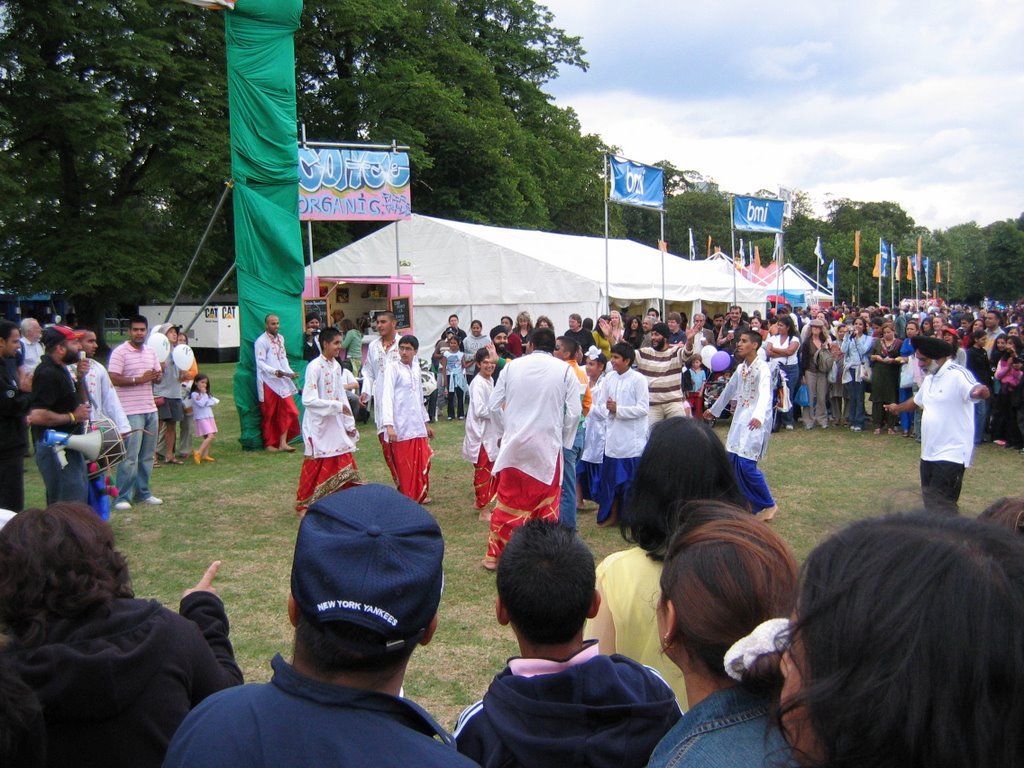
All images are from the London Mela, held on 13th August, 2005)
Let me elaborate on that point a bit. London is no stranger to Indians - you will probably find that Indians make up one of the most significant communities here (we're the majority minority?) both in terms of strength and visibility. Despite that, its quite easy once you're going through the motions of daily life to forget just how visible and significant that community is, until its brought to your notice.
So last week, not inappropriately, ended up being about getting a taste of my Indianness again. It all started out with an impromptu dinner at the Bombay Brasserie, which is probably my favourite Indian restaurant in town - unlike the thousands of (predominantly) Bangladeshi curry houses, the Bombay Brasserie comes closest to replicating the Indian experience for me. The decor, somewhat reminiscent of The Imperial Hotel in New Delhi, doesn't hurt either when I'm nostalgic for life in Delhi. Normally, I don't go to Indian restaurants that frequently, and given the price tags on a meal at the Brasserie, its not quite the sort of place I'd go to regularly, so the impromptu meal was a great, if unexpected treat.
That Friday night meal was followed swiftly by another impromptu expedition out on the Sunday to the London Mela in Gunnersbury. Gunnersbury is a London suburb that has a massive Indian (especially Punjabi) community,, and the annual mela is now a big fixture on most Brit Asian calendars. I found out later that a fellow Bollywood blogger, Maja, was also there but we didn't manage to catch up.
 The Mela itself was great fun - I had gol gappas after a long time, and the chhole bhature, kebab rolls, nariyal pani and pista kulfi were pretty good as well. Like all true melas, there were several tents with musical performances, a lot of rides, and also random shops selling typical mela fair, as well as a (slightly bizarre) open air beauty parlour where if you weren't careful you could catch a glimpse of Mrs. Taneja getting her eyebrows threaded - not a good sight at all!
Perhaps the best part of the Mela were the Bollywood dancers - many of whom weren't Indian - and who put together a pretty impressive show, with well choreographed numbers, including Kajra Re & Dhadak Dhadak. Keeping with the Indian tradition, we went to the mela in a group of seven people - only four of our group were Europeans, two of whom barely speak English, and who had never stepped outside Florence, Italy, before that Friday. So for them, the entire experience was a complete culture shock, and the poor kids were really overwhelmed. By the end of the day, though, they seemed to have found their footing, enough for one to ask us how to dance Bhangra!
 Our hectic day at the Mela wasn't over - we then dashed off to go for a marathon emotional rollercoaster by going to see Kabhi Alvida Naa Kehna, only to find the hall packed full of Arab families, all waiting to have their heartstrings tugged viciously at by Mr Johar. I love it whenever I get to see a Bollywood movie in Central London; it's perhaps the best example of the Empire striking back. The international fan following isn't that out of the ordinary anymore either. The Monday edition of the Metro (the free morning newspaper that every London Tube commuter worth his salt will pick up at the station to read on the journey) had a short blurb about how in 2005, British releases in the UK were overtaken by Bollywood releases, while more Bollywood films made it to the UK top ten lists last year than British ones. Watch out Hollywood!
The final major Indian experience of the week was arguably a constructed one, but it was great fun nevertheless. By a strange coincidence of career planning, my two sisters & I have managed to end up living in the same city after a long time - usually we're in different continents. We'd been talking about organising joint drinks with our respective groups of friends, so we finally took the plunge last week and had that party. However, the irony of the situation was too good to let go of - three young, ambitious and reasonably aggressive Indians in London. The party theme was therefore, "Lose a Raj, Gain a Nation". We wanted to be inclusive you see - if you were imperialist, you could come to drink your sorrows away and we would commiserate with you on the loss of the Raj, whereas post - colonialists would be more than welcome to celebrate with us. Oddly enough, turnout being what it was, the three of us were the only Indians in a group of over 35 in a Mexican bar raising toasts to India's Independence in Covent Garden.
For one week in London, that's a lot of different Indian experiences rolled into one. Some very disparate events, very different areas and groups of people, but somehow with a lot of common themes that emerged only when I had a chance to reflect on the broader issue this weekend while lolling on a large white couch with the Financial Times Weekend. (My regular readers will detect a striking commonality to many of my epiphanies - the FT is always lurking near me at the time.)
India is fortunate to have two fantastic cultural ambassadors working for us - our cuisine & our films. My own experience of the world has led me to think that these two have earlier on worked in mutually exclusive geographies. Our cuisine is what got us a foothold in the developed West, while Bollywood has helped us build cultural links with a lot of the developing world. However, over the past decade, our food has started spreading to more countries, while the West has finally realised that they cannot sit back and not take Bollywood into notice. Indian restaurants are now almost necessities in most urban plans in the Western world, while the UK fascination for a good "curry" is legend. Compare this to Bollywood, which has built up a fan following in Latin America, Africa, the Middle East and South East Asia. Between those two, we've got the world covered!
Perhaps more importantly, and this is something I realised from the crowds I saw at the London Mela, is how the attitudes have changed. When many Indians immigrated to the UK, especially after Independence, they came in to fill blue collar roles. They were industrious and prudent, and by sheer effort built productive and economically sound lives (not unlike what the latest wave of Polish migrants is doing in the UK). Unlike the US, which saw highly educated professionals moving to take up roles in medicine, academics, engineering or finance, the UK migrant community has been incredibly segregated, isolationist and also financially weak. Given the time many of them left India, they did not speak from a position of strength.
Compare this mindset with that of the average Indian who travels each year. Many young Indians travelling globally these days do so for work or education. We are hard working - a result of our highly competitive education system. We are fiercely ambitious, often disconcertingly so for others, and are not ashamed of it. More importantly, I think Indians today are much more willing to take a stand for their country, and as our economy grows stronger and we begin to embed the value of merit in our system, this international "cockiness", as someone I know referred to it, will only grow.
Today, to be Indian means something in the world. No longer are we the country where the Beatles came to search for spirituality (though if you were from Liverpool, you'd probably need the time away as well), nor are we the country where thousands of people come to "see the elephants and tigers". Today, when people say India, they say "you guys are bloody good in maths", they'll say, "IT", and if they're French, they usually say "Mittal!"
 There's still a lot that needs to go right, but given our penchant for always talking about the bad stuff that needs fixing, we run the risk of overlooking the great achievements we've made. So let's take that little five minute tea break to celebrate where we've come, look back on the path we've been climbing, and then after the five minutes, look up to the summit where we're heading.
As they're saying in a little Mexican bar in Covent Garden, "Lose a Raj, Gain a Nation!"
All images are from the London Mela, held on 13th August, 2005)
Saturday, July 29, 2006
I dreamt of Delhi last night
But the Delhi I dreamt of last night wasn’t the Delhi of long, unbelievably hot summers. It wasn’t the Delhi that reels from severe water shortages, where load shedding is a daily occurrence, where the rhythms of your diurnal activity revolves as much around the benediction of Delhi Vidyut Board as it does around your own schedule.
It was also not the Delhi of long, cold winters. I didn’t dream of those long, cold nights, when the roads are empty and your eyesight dimmed by the fog that comes in menacingly before midnight and stays there till late morning, when the cold settles into your bones and makes touching the bathroom tap in the morning a dreaded activity.
I dreamt of my Delhi. It was the Delhi of the lush evenings of late August & September. I dreamt of the Delhi that is found driving down the Mehrauli road, where you can look out at the Qutub Minar, warmly lit in limpid pools of amber lighting, the bright halogens refracted into an abstruse amber puddle against a warm sky by the dust and pollution thrown up by a frantically busy city. I dreamt of the craggy hillsides near Rai Pithora, where the rough red stones turn soft shades of dark brown & slate grey as your car moves past, with the camel thorn trees that in the day time stand testament to the rugged harshness of the climate mutating into dark, black etches against a night sky glowing with promise.
Delhi is the city that I went to university in, and it is the city that was my first real playground as an adult. No matter how many cities I go to, anywhere in the world, Delhi shall always remain the one indelibly etched on my mind. And more than anything else, the Delhi that I loved the most was the Delhi of the dark, when the burning sun had dropped below the horizon, the glowing grey of the evening sky had dimmed to an inky midnight blue, the street lights casting long shadows on roads, where the cool breeze would be countered by the heat that would radiate from the tarmac until the early morning. It is that Delhi that I love, and it is that Delhi that I miss the most.
There are so many memories associated with travelling along those seemingly endless roads at night, under the cover of darkness. There were endless evenings when I would drive through Lutyens Delhi. Usually a necessity of living and moving around in Delhi, driving was sometimes never the means to an end – it would often be an end in itself. There were times when we would be sitting around, bored, tired of the endless hum of air conditioners at a friends place, or the more radical, industrialised noise of air coolers (that magical sound of dripping water, the cold damp of the straw against your fingers as you ran your hands up and down that panel, the rich, wet smell of khas perfume that would be dropped into the water tanker every morning)
And when the boredom got too much, when just chilling was not enough, when TV or Barista or TGIF got too much, we’d go for a drive. Remember that scene in Monsoon Wedding, when Vasundhara Das sneaks out at night to meet her married lover? When asked where she wants to go, she says, "Just drive. I just want to go for a long drive..."
And so would we. We would just want to get out of the house, climb into our cars, and keep driving. Heading out from South Delhi, we’d drive up Shanti Path, the windows of my little Maruti 800 rolled down, music playing softly on the radio.
“You’ve got the music playing, night & day…FM is ready for you….in the morning, or late at night, wow, we’re gonna let the music play…
AIR F.M. Stereo….all the time……..on All India Radio”
Driving up Chanakyapuri, we would turn off towards Teen Murti, drive up South Avenue, until we finally hit the periphery of South Block. From there, it was a quick drive up to Rajpath, and then we’d careen down the long stretch, the proud flanks of Indian government behind us, India Gate looming large in front.
The lawns along Rajpath were always lined with families out for ice cream. There would be couples, trying to get two seconds of privacy under the trees that in the daytime provide shade for thousands. The balloon walas, Kwality Walls ice cream carts, kiosks selling ice cold Coke, Pepsi & Fanta (but nothing to beat the synthetic lemony tang of a chilled Limca on a warm sunny evening). A friend, any friend, sitting in the passenger seat, the cigarette we were sharing moving back and forth. (“Don’t drop any cinders on that dashboard or the seat – my dad’s gonna kill me”)
And then turning off at Shahjahan Road, heading down to Aurangzeb and back to Race Course, before heading back behind Chanakya Cinema to hit the end of Shanti Path and going back down Moti Bagh at the Rail Museum…the road home was equally magical.
Or if we were really bored, we’d head out of Priya and drive past Vasant Kunj, double back towards Andheria Mod and head for Gurgaon down past Qutub, Chhatarpur and Ghitorni. That road was the route to so many farmhouse parties – normal evening chillouts, more hard core scenes and the many, many music concerts that kept us occupied through long, hot summer nights.
But when we were out for a drive, the road to Gurgaon was rarely our destination. Once we went past the Delhi border (“Welcome to Haryana – jahaan doodh dahi ka khaana”) and made it through the sterile high rises of DLF, we’d head past IFFCO crossing and hit the Jaipur highway.
Oh, that great road. Long, endless stretches of highway, the dark looming trucks trundling along. The big Jaipur merchants in their fancy Mercedes and Toyotas would effortlessly cruise past our little rattling student cars – usually beat up old Marutis, or if we were lucky, a Santro or maybe even a Qualis. The wide, dusty Aravalis stretching out ahead and besides you, the ground falling away on either side, petering away into darkness. The air would always be warm – never hot, but this was Haryana, heading into Rajasthan, so there was always a flavour of desert dryness, a grainy, dusty layer on your arm where it rested on the door as you drove through the night.
Music was our constant companion. Nietzsche said that a life without music was senseless. Each of those long journeys, where the destination is meaningless and there is a quiet peace in the journey would have been incomplete without the music we played.
Our tape decks were our lifelines, as was AIR FM. When three new FM stations were launched in Delhi, our lives became fuller, richer – we were given the freedom to change music at the touch of a button without having to change tapes, fumble around the dashboard or in the glove compartment to find the right replacement. Such luxury.
But the music that sustained us, it was some of the best. We had Indian Ocean, Shaan, Strings, Junoon, Euphoria, Creed, Metallica, Tom Petty & the Heartbreakers, John Denver, Farida Khanum, Nusrat Fateh Ali Khaan, Adnaan Sami, A.R. Rehman, Joan Baez, Joni Mitchell, Paul Mc Cartney – there are songs that even now I can play and I can feel the shudder of the steering wheel under my palms, the smell of nicotine and dust in my nose.
I dreamt of Delhi last night. And I hope I dream of it again.
It was also not the Delhi of long, cold winters. I didn’t dream of those long, cold nights, when the roads are empty and your eyesight dimmed by the fog that comes in menacingly before midnight and stays there till late morning, when the cold settles into your bones and makes touching the bathroom tap in the morning a dreaded activity.
I dreamt of my Delhi. It was the Delhi of the lush evenings of late August & September. I dreamt of the Delhi that is found driving down the Mehrauli road, where you can look out at the Qutub Minar, warmly lit in limpid pools of amber lighting, the bright halogens refracted into an abstruse amber puddle against a warm sky by the dust and pollution thrown up by a frantically busy city. I dreamt of the craggy hillsides near Rai Pithora, where the rough red stones turn soft shades of dark brown & slate grey as your car moves past, with the camel thorn trees that in the day time stand testament to the rugged harshness of the climate mutating into dark, black etches against a night sky glowing with promise.
Delhi is the city that I went to university in, and it is the city that was my first real playground as an adult. No matter how many cities I go to, anywhere in the world, Delhi shall always remain the one indelibly etched on my mind. And more than anything else, the Delhi that I loved the most was the Delhi of the dark, when the burning sun had dropped below the horizon, the glowing grey of the evening sky had dimmed to an inky midnight blue, the street lights casting long shadows on roads, where the cool breeze would be countered by the heat that would radiate from the tarmac until the early morning. It is that Delhi that I love, and it is that Delhi that I miss the most.
There are so many memories associated with travelling along those seemingly endless roads at night, under the cover of darkness. There were endless evenings when I would drive through Lutyens Delhi. Usually a necessity of living and moving around in Delhi, driving was sometimes never the means to an end – it would often be an end in itself. There were times when we would be sitting around, bored, tired of the endless hum of air conditioners at a friends place, or the more radical, industrialised noise of air coolers (that magical sound of dripping water, the cold damp of the straw against your fingers as you ran your hands up and down that panel, the rich, wet smell of khas perfume that would be dropped into the water tanker every morning)
And when the boredom got too much, when just chilling was not enough, when TV or Barista or TGIF got too much, we’d go for a drive. Remember that scene in Monsoon Wedding, when Vasundhara Das sneaks out at night to meet her married lover? When asked where she wants to go, she says, "Just drive. I just want to go for a long drive..."
And so would we. We would just want to get out of the house, climb into our cars, and keep driving. Heading out from South Delhi, we’d drive up Shanti Path, the windows of my little Maruti 800 rolled down, music playing softly on the radio.
“You’ve got the music playing, night & day…FM is ready for you….in the morning, or late at night, wow, we’re gonna let the music play…
AIR F.M. Stereo….all the time……..on All India Radio”
Driving up Chanakyapuri, we would turn off towards Teen Murti, drive up South Avenue, until we finally hit the periphery of South Block. From there, it was a quick drive up to Rajpath, and then we’d careen down the long stretch, the proud flanks of Indian government behind us, India Gate looming large in front.
The lawns along Rajpath were always lined with families out for ice cream. There would be couples, trying to get two seconds of privacy under the trees that in the daytime provide shade for thousands. The balloon walas, Kwality Walls ice cream carts, kiosks selling ice cold Coke, Pepsi & Fanta (but nothing to beat the synthetic lemony tang of a chilled Limca on a warm sunny evening). A friend, any friend, sitting in the passenger seat, the cigarette we were sharing moving back and forth. (“Don’t drop any cinders on that dashboard or the seat – my dad’s gonna kill me”)
And then turning off at Shahjahan Road, heading down to Aurangzeb and back to Race Course, before heading back behind Chanakya Cinema to hit the end of Shanti Path and going back down Moti Bagh at the Rail Museum…the road home was equally magical.
Or if we were really bored, we’d head out of Priya and drive past Vasant Kunj, double back towards Andheria Mod and head for Gurgaon down past Qutub, Chhatarpur and Ghitorni. That road was the route to so many farmhouse parties – normal evening chillouts, more hard core scenes and the many, many music concerts that kept us occupied through long, hot summer nights.
But when we were out for a drive, the road to Gurgaon was rarely our destination. Once we went past the Delhi border (“Welcome to Haryana – jahaan doodh dahi ka khaana”) and made it through the sterile high rises of DLF, we’d head past IFFCO crossing and hit the Jaipur highway.
Oh, that great road. Long, endless stretches of highway, the dark looming trucks trundling along. The big Jaipur merchants in their fancy Mercedes and Toyotas would effortlessly cruise past our little rattling student cars – usually beat up old Marutis, or if we were lucky, a Santro or maybe even a Qualis. The wide, dusty Aravalis stretching out ahead and besides you, the ground falling away on either side, petering away into darkness. The air would always be warm – never hot, but this was Haryana, heading into Rajasthan, so there was always a flavour of desert dryness, a grainy, dusty layer on your arm where it rested on the door as you drove through the night.
Music was our constant companion. Nietzsche said that a life without music was senseless. Each of those long journeys, where the destination is meaningless and there is a quiet peace in the journey would have been incomplete without the music we played.
Our tape decks were our lifelines, as was AIR FM. When three new FM stations were launched in Delhi, our lives became fuller, richer – we were given the freedom to change music at the touch of a button without having to change tapes, fumble around the dashboard or in the glove compartment to find the right replacement. Such luxury.
But the music that sustained us, it was some of the best. We had Indian Ocean, Shaan, Strings, Junoon, Euphoria, Creed, Metallica, Tom Petty & the Heartbreakers, John Denver, Farida Khanum, Nusrat Fateh Ali Khaan, Adnaan Sami, A.R. Rehman, Joan Baez, Joni Mitchell, Paul Mc Cartney – there are songs that even now I can play and I can feel the shudder of the steering wheel under my palms, the smell of nicotine and dust in my nose.
I dreamt of Delhi last night. And I hope I dream of it again.
Saturday, July 22, 2006
The Monsoon in India..
Back when I lived in Delhi (i.e. until 2003) I used to write articles for a website based in Austin, Texas. I suddenly remembered one article about the monsoon breaking in India, and have posted that here.
You know, when other night it was raining in Delhi, I couldn't help but sit up and look out of my window at the downpour. There's this mango tree outside that never seems to bear any fruit, but is always filled with blossoms and causes much woe to my allergy. In the winter, it keeps the sun out, and in summer it fills the room with dead leaves during a dust storm. But when it rains, that tree, which I generally curse out throughout the rest of the year, becomes my favorite haunt in the monsoons. My bed, which is just below the window, puts me in range of the leaves. When the raindrops hit the dust-laden branches, the tree emits a heavenly, fruity, dusty and wet scent.
The smell and texture of the rains are my favorite aspects of the monsoons. At two in the morning, when the rains started, I sat up, stuck my head as close to the grille as possible, and felt the sprinkle of water on my face. It has to be one of the most refreshing experiences in the world, and any health spa can go to hell!
The monsoon has to be the most difficult season to write about in the world. And I guess that is why very few writers manage to capture the essence of the country when the first drops hit the parched ground. That sondhi smell, which has no translation into English, has so many connotations and ideas attached that each whiff is laden with the cultural baggage of centuries. The magic of the kajris of Vrindavan, the crazy sound of the raag which is sung in a garden pavilion in the middle of a downpour, or even the frustration of being trapped indoors for a week at a stretch.
What is it about a rushing mass of clouds that can drive an entire civilisation crazy with a weird madness? A season that is so magical that it can be immortalised in the culture of an ancient land? What makes the monsoons so special, so different from any other downpour anywhere else in the world?
I think it has to do with the anticipation. Only a person who has sweated out the unbearable scorching summer months of April, May and June can understand the lure of the dark, water laden blessings. Only a person who has stood under a tree at noon, who has felt the searing hot winds of the desert over the plains, only they can understand the relief the rains bring.
Imagine yourself spending three months in the fiery bowels of hell. Think of the eternal damnation your local priest never fails to remind you of. Think of spending three months where the nights are oppressive and the days are malignant. Think of all the heat you can imagine, and imagine spending your summer in that furnace. No red hydrant baths in suburbia, no kids frolicking in the afternoon. Just an eerie stillness on the roads after eleven o'clock. People hurry indoors, to spend the worst hours in the cool comfort of their homes and offices. Children scurry into dark classrooms to avoid the scorching winds outside. Even the street vendors seek the shade of the local tree.
Think of the painful, dusty Indian summer, the real Indian summer, not the reprieve in the cold Montana autumn. Think of the worst fate you can. Land that is so hot and arid that the soil cracks in deep gashes. The tarmac is so fiery you can feel the boiling heart of the earth through the soles of your feet. Temperatures rise so high that birds fall dead from the aching bright blue sky. Wells dry out, ponds evaporate into nothingness; even the mud turns to fine, dry sand. The world weeps under the relentless summer. Sarat Chandra Chatterjee spoke of the "rainless firmament" in one of his short stories. I use that imagery here. The sky is so blue that your eyes wince at the brightness above. Not a fragment of cloud is there to ease the pain in your soul. The summer in India is terrible.
Then, from somewhere over the azure Indian Ocean, a wind comes. Drawn by the imbalances of pressure, the lifesaver heads towards a burning land. Moisture gathers on its flanks, slowly, slowly. It builds up into giant cotton wool cumulonimbus, large white fluffs of redemption. The Maharashtrians call the first rains of the monsoon the tiger. It roars and howls over the earth, and then, suddenly the painful heat is gone. The aching is replaced by an urgent expectancy. The sky, once so blue, is now covered with grey and slate sheets, which hover ominously over the horizon. The hot winds, which earlier on burned your skin, are now gone. In their place is a heavy oppressiveness, which is worse than all the heat of the summer. That was permanent; this is uncertain. Will that reprieve last?
Rain. The sky bursts into a torrent of water. Raindrops so large that they sting where they hit your skin. The grey and slate is now darker still, and you are trapped in the deluge of relief. The dry, parched earth is now quenched. Its heavy odor rises and fills your nostrils. Relief and the savior unite to give succor to a deprived earth.
And who can forget the supreme pleasure and ecstasy of soaking in the first deluge? An aunt of mine, a very respectable embassy press officer, with a six year old son, makes it a point of running out of where ever she may be and getting drenched to the skin in the first rains of the season. Many times, I join her in her manic, child like rain dance. The thrill of just being out there in the open, with a seemingly never-ending downpour is too rich to describe. Surrounded by the neighborhood children, I am generally mobbed by seven or eight preteens who want to be swung around from my arms.
And then, when my skin is so wet, it wrinkles, when the heavy rain becomes heavier still, when the raindrops cease to please and begin to hurt, and if I'm unlucky, if the hailstorms take over, I come indoors. My mother fusses over my dripping all over the carpet, so I am given a towel at the door itself. After drying up and changing, I head straight towards the bed. There I find a thick sheet and generally burrow deep under the covers, and just look up out of my windows towards the rain. The steel gray is a nice backdrop to my room, and I usually spend the rest of the day with a book and endless cups of piping hot tea.
What makes the monsoons so special?
You know, when other night it was raining in Delhi, I couldn't help but sit up and look out of my window at the downpour. There's this mango tree outside that never seems to bear any fruit, but is always filled with blossoms and causes much woe to my allergy. In the winter, it keeps the sun out, and in summer it fills the room with dead leaves during a dust storm. But when it rains, that tree, which I generally curse out throughout the rest of the year, becomes my favorite haunt in the monsoons. My bed, which is just below the window, puts me in range of the leaves. When the raindrops hit the dust-laden branches, the tree emits a heavenly, fruity, dusty and wet scent.
The smell and texture of the rains are my favorite aspects of the monsoons. At two in the morning, when the rains started, I sat up, stuck my head as close to the grille as possible, and felt the sprinkle of water on my face. It has to be one of the most refreshing experiences in the world, and any health spa can go to hell!
The monsoon has to be the most difficult season to write about in the world. And I guess that is why very few writers manage to capture the essence of the country when the first drops hit the parched ground. That sondhi smell, which has no translation into English, has so many connotations and ideas attached that each whiff is laden with the cultural baggage of centuries. The magic of the kajris of Vrindavan, the crazy sound of the raag which is sung in a garden pavilion in the middle of a downpour, or even the frustration of being trapped indoors for a week at a stretch.
What is it about a rushing mass of clouds that can drive an entire civilisation crazy with a weird madness? A season that is so magical that it can be immortalised in the culture of an ancient land? What makes the monsoons so special, so different from any other downpour anywhere else in the world?
I think it has to do with the anticipation. Only a person who has sweated out the unbearable scorching summer months of April, May and June can understand the lure of the dark, water laden blessings. Only a person who has stood under a tree at noon, who has felt the searing hot winds of the desert over the plains, only they can understand the relief the rains bring.
Imagine yourself spending three months in the fiery bowels of hell. Think of the eternal damnation your local priest never fails to remind you of. Think of spending three months where the nights are oppressive and the days are malignant. Think of all the heat you can imagine, and imagine spending your summer in that furnace. No red hydrant baths in suburbia, no kids frolicking in the afternoon. Just an eerie stillness on the roads after eleven o'clock. People hurry indoors, to spend the worst hours in the cool comfort of their homes and offices. Children scurry into dark classrooms to avoid the scorching winds outside. Even the street vendors seek the shade of the local tree.
Think of the painful, dusty Indian summer, the real Indian summer, not the reprieve in the cold Montana autumn. Think of the worst fate you can. Land that is so hot and arid that the soil cracks in deep gashes. The tarmac is so fiery you can feel the boiling heart of the earth through the soles of your feet. Temperatures rise so high that birds fall dead from the aching bright blue sky. Wells dry out, ponds evaporate into nothingness; even the mud turns to fine, dry sand. The world weeps under the relentless summer. Sarat Chandra Chatterjee spoke of the "rainless firmament" in one of his short stories. I use that imagery here. The sky is so blue that your eyes wince at the brightness above. Not a fragment of cloud is there to ease the pain in your soul. The summer in India is terrible.
Then, from somewhere over the azure Indian Ocean, a wind comes. Drawn by the imbalances of pressure, the lifesaver heads towards a burning land. Moisture gathers on its flanks, slowly, slowly. It builds up into giant cotton wool cumulonimbus, large white fluffs of redemption. The Maharashtrians call the first rains of the monsoon the tiger. It roars and howls over the earth, and then, suddenly the painful heat is gone. The aching is replaced by an urgent expectancy. The sky, once so blue, is now covered with grey and slate sheets, which hover ominously over the horizon. The hot winds, which earlier on burned your skin, are now gone. In their place is a heavy oppressiveness, which is worse than all the heat of the summer. That was permanent; this is uncertain. Will that reprieve last?
Rain. The sky bursts into a torrent of water. Raindrops so large that they sting where they hit your skin. The grey and slate is now darker still, and you are trapped in the deluge of relief. The dry, parched earth is now quenched. Its heavy odor rises and fills your nostrils. Relief and the savior unite to give succor to a deprived earth.
And who can forget the supreme pleasure and ecstasy of soaking in the first deluge? An aunt of mine, a very respectable embassy press officer, with a six year old son, makes it a point of running out of where ever she may be and getting drenched to the skin in the first rains of the season. Many times, I join her in her manic, child like rain dance. The thrill of just being out there in the open, with a seemingly never-ending downpour is too rich to describe. Surrounded by the neighborhood children, I am generally mobbed by seven or eight preteens who want to be swung around from my arms.
And then, when my skin is so wet, it wrinkles, when the heavy rain becomes heavier still, when the raindrops cease to please and begin to hurt, and if I'm unlucky, if the hailstorms take over, I come indoors. My mother fusses over my dripping all over the carpet, so I am given a towel at the door itself. After drying up and changing, I head straight towards the bed. There I find a thick sheet and generally burrow deep under the covers, and just look up out of my windows towards the rain. The steel gray is a nice backdrop to my room, and I usually spend the rest of the day with a book and endless cups of piping hot tea.
What makes the monsoons so special?
Thursday, July 20, 2006
What - we're imitating China now?! - Update
There are several really good resources out there if you're looking to read up more on the discussions in the blogosphere.
The Bloggers Against Censorship group have opened a wiki on this issue.
For a pretty thorough listing of the major debate around the blog ban and the issues surrounding the topic (including a link to my own post titled, "The Blog Ban - Signs of Hope") take a look at DesiPundit
Rediff has said it should be able to provide full access to all blogs within 48 hours - let's see where that stands.
Slowly, slowly...
The Bloggers Against Censorship group have opened a wiki on this issue.
For a pretty thorough listing of the major debate around the blog ban and the issues surrounding the topic (including a link to my own post titled, "The Blog Ban - Signs of Hope") take a look at DesiPundit
Rediff has said it should be able to provide full access to all blogs within 48 hours - let's see where that stands.
Slowly, slowly...


The Blog Ban - Signs of Hope
The Indian government’s decision to block several blogs and websites earlier this week has been met, across cyberspace, with outrage & anger. This is perhaps the latest episode in a chain of events where government action has not been met with indifference, but with a different reaction.
The public reaction to the blog ban is worthy of analysis itself, but for me it is more important to examine it as a continuation of a trend that is increasingly visible in India – the emergence of a younger India that is no longer willing to let the political ruling class escape accountability. I also believe that this development is a good thing for the country as a whole. In many ways, India has been a post-colonial establishment for the past sixty years. We are still a people that is emerging from the shackles of colonialism, and the control of national discourse has not yet fully transferred completely to a post Independence generation that is able to articulate its own wants and desires without having to refer to the trauma of rule by another. This transfer is already underway in the media & in business, which can and have more easily espoused values of free choice and the rule of merit, but it is taking much longer in the arguably most influential sphere - politics. We therefore can view our national discourse as being dichotomous – one half dominated by a young India that has no need to seek validation against an external former authority, and an old India that is unable to operate without utilising the rule of the other as some benchmark, either to emulate or reject.
The latest blog ban and its reaction are therefore both merely manifestations of this contradiction. On one side you have a medium that is primarily used and run by people below the age of 40; people who have seen the last sixteen years of economic liberalisation and have also felt its benefits. The average Indian who uses the internet is young, had some form of tertiary education and is also the product of a free India, with no colonial memory or anguish. Compare this with the people who work in the Department of Telecommunications: bureaucrats usually inured to competitive pressures and the need for efficiency at work, subservient to a political class that is corrupt, ageing and unable to understand that there the India of today is no longer willing to let them escape accountability. For the average government mandarin, banning an internet website (or indeed, thousands of them as has happened with the block on blogspot) is perfectly acceptable, and is a regular tool of colonial (read tyrannical) administration. However, this becomes increasingly unacceptable to a young democracy which values its freedom of speech and is no longer willing to take at face value whatever is doled out to it from the government.
2006 has been the year of a young India rising up and staking its claim in a political discourse. Long accused of indifference and a lack of concern, a young India has stood up to be counted this year. Starting with the vigils at India Gate for Jessica Lall, followed by the agitation against reservations in higher education, and more recently, the AIIMS medical strikes that saw a minister having to back down in the face of public anger – these are all good indicators.
The reservations protests were perhaps the best examples of how a young India, exposed to economic self sufficiency and no longer dependent on a national bureaucracy for a livelihood, and is now used to the benefits of capitalism, chose to take the government on. Unlike the protests of 1990, when a desperate youth took to self immolation, and was still not heeded by the government, this year the protests were not about using self –destructive methods to be heard. This year, young India seized technology. SMS, internet petitions, public marches, street protests, and also hunger strikes (we can’t all forget our roots now, can we?) The government was forced to debate the issue, and even though as yet unsuccessful, the campaigns made the government wake up and take notice of this young country.
The blog banning issue is a continuation of this trend. Using new technology to subvert this ban, and also using legal recourse, the Indian public have shown that they are now no longer willing to let another Satanic Verses episode be repeated. More importantly, the government’s claims that the ban was enforced in the interests of national security have also been met with vociferous protests. This is especially resonant in today’s global geopolitical scenario, when we see “national security” used to justify the worst examples of human rights violations in the USA & Israel.
Where this movement goes from here is hard to say. However, I'm pretty convinced that the trend, by itself, is one of India's greatest strengths, and can help us transition from a post-colonial entity, ruled by Macauley's elite, to a true democracy, where neo-liberal principles of humanism, the rights of all people, freedom of speech and economic freedom can safely coexist.
Welcome to tomorrow!
The public reaction to the blog ban is worthy of analysis itself, but for me it is more important to examine it as a continuation of a trend that is increasingly visible in India – the emergence of a younger India that is no longer willing to let the political ruling class escape accountability. I also believe that this development is a good thing for the country as a whole. In many ways, India has been a post-colonial establishment for the past sixty years. We are still a people that is emerging from the shackles of colonialism, and the control of national discourse has not yet fully transferred completely to a post Independence generation that is able to articulate its own wants and desires without having to refer to the trauma of rule by another. This transfer is already underway in the media & in business, which can and have more easily espoused values of free choice and the rule of merit, but it is taking much longer in the arguably most influential sphere - politics. We therefore can view our national discourse as being dichotomous – one half dominated by a young India that has no need to seek validation against an external former authority, and an old India that is unable to operate without utilising the rule of the other as some benchmark, either to emulate or reject.
The latest blog ban and its reaction are therefore both merely manifestations of this contradiction. On one side you have a medium that is primarily used and run by people below the age of 40; people who have seen the last sixteen years of economic liberalisation and have also felt its benefits. The average Indian who uses the internet is young, had some form of tertiary education and is also the product of a free India, with no colonial memory or anguish. Compare this with the people who work in the Department of Telecommunications: bureaucrats usually inured to competitive pressures and the need for efficiency at work, subservient to a political class that is corrupt, ageing and unable to understand that there the India of today is no longer willing to let them escape accountability. For the average government mandarin, banning an internet website (or indeed, thousands of them as has happened with the block on blogspot) is perfectly acceptable, and is a regular tool of colonial (read tyrannical) administration. However, this becomes increasingly unacceptable to a young democracy which values its freedom of speech and is no longer willing to take at face value whatever is doled out to it from the government.
2006 has been the year of a young India rising up and staking its claim in a political discourse. Long accused of indifference and a lack of concern, a young India has stood up to be counted this year. Starting with the vigils at India Gate for Jessica Lall, followed by the agitation against reservations in higher education, and more recently, the AIIMS medical strikes that saw a minister having to back down in the face of public anger – these are all good indicators.
The reservations protests were perhaps the best examples of how a young India, exposed to economic self sufficiency and no longer dependent on a national bureaucracy for a livelihood, and is now used to the benefits of capitalism, chose to take the government on. Unlike the protests of 1990, when a desperate youth took to self immolation, and was still not heeded by the government, this year the protests were not about using self –destructive methods to be heard. This year, young India seized technology. SMS, internet petitions, public marches, street protests, and also hunger strikes (we can’t all forget our roots now, can we?) The government was forced to debate the issue, and even though as yet unsuccessful, the campaigns made the government wake up and take notice of this young country.
The blog banning issue is a continuation of this trend. Using new technology to subvert this ban, and also using legal recourse, the Indian public have shown that they are now no longer willing to let another Satanic Verses episode be repeated. More importantly, the government’s claims that the ban was enforced in the interests of national security have also been met with vociferous protests. This is especially resonant in today’s global geopolitical scenario, when we see “national security” used to justify the worst examples of human rights violations in the USA & Israel.
Where this movement goes from here is hard to say. However, I'm pretty convinced that the trend, by itself, is one of India's greatest strengths, and can help us transition from a post-colonial entity, ruled by Macauley's elite, to a true democracy, where neo-liberal principles of humanism, the rights of all people, freedom of speech and economic freedom can safely coexist.
Welcome to tomorrow!
What - we're imitating China now?! - Update
Today's International Herald Tribune carried an article on the current blog ban in India. The Indian Consulate General in New York claimed it to be the result of a technological error. Read the full story here
Most sites are still theoretically down, but it looks like the public uproar is beginning to cause discomfort. (Alternatively, the originally hypothesised "operations" against terrorists could be winding down) Hopefully we shall see something more concrete coming out of the government at home.
Most sites are still theoretically down, but it looks like the public uproar is beginning to cause discomfort. (Alternatively, the originally hypothesised "operations" against terrorists could be winding down) Hopefully we shall see something more concrete coming out of the government at home.
Wednesday, July 19, 2006
What - we're imitating China now?!
Talk about random...
What started out as a rumour has proven, unfortunately, to be true. As part of its "operations" against suspects implicated in the Mumbai blasts of last week (colloquially being called 7/11), the Indian government has blocked a list of approximately 150 blogs. These include links to sites like www.hinduunity.org and www.dalitstan.org. The justification for this action is that certain terrorist cells are being suspected of communicating through blogs.
If this was not ironic, it would have been funny. We Indians wear our democracy on our sleeves, and as such it is always great fun to pull out the democracy card to bash people over the head with. We can sit back and laugh at China's juggernautical (is that a real word? If not, it is now) economic progress with a smug, "well, at least WE don't require google to report usage statistics". Similarly, when the infamous Pakistani government blocked the ENTIRE blogspot domain earlier this year, we could gloat, secure in our own independence and access to information. (Not surprisingly, a parallel web infrastructure soon sprang into play, with pkblogs acting as a mirror site for all the sites hosted on blogspot)
I am still able to access most sites, but given that I'm in the UK that's not too unusual (blocking a domain locally would not affect users in other countries. In fact, given the tangled web of access that the Internet actually is, its quite likely that users in some part of India can access the blogs they want to without a problem). If its little consolation, the Government of India confirmed that the block is not all India - it doesn't affect the islands of Andaman & Nicobar, or Lakshwadeep. FINALLY! They make it to national, mainstream discourse!
Hopefully this is a temporary blip while the aforementioned "operation" is underway. Let us see how long it lasts...
Inquilab Zindabad!!
What started out as a rumour has proven, unfortunately, to be true. As part of its "operations" against suspects implicated in the Mumbai blasts of last week (colloquially being called 7/11), the Indian government has blocked a list of approximately 150 blogs. These include links to sites like www.hinduunity.org and www.dalitstan.org. The justification for this action is that certain terrorist cells are being suspected of communicating through blogs.
If this was not ironic, it would have been funny. We Indians wear our democracy on our sleeves, and as such it is always great fun to pull out the democracy card to bash people over the head with. We can sit back and laugh at China's juggernautical (is that a real word? If not, it is now) economic progress with a smug, "well, at least WE don't require google to report usage statistics". Similarly, when the infamous Pakistani government blocked the ENTIRE blogspot domain earlier this year, we could gloat, secure in our own independence and access to information. (Not surprisingly, a parallel web infrastructure soon sprang into play, with pkblogs acting as a mirror site for all the sites hosted on blogspot)
I am still able to access most sites, but given that I'm in the UK that's not too unusual (blocking a domain locally would not affect users in other countries. In fact, given the tangled web of access that the Internet actually is, its quite likely that users in some part of India can access the blogs they want to without a problem). If its little consolation, the Government of India confirmed that the block is not all India - it doesn't affect the islands of Andaman & Nicobar, or Lakshwadeep. FINALLY! They make it to national, mainstream discourse!
Hopefully this is a temporary blip while the aforementioned "operation" is underway. Let us see how long it lasts...
Inquilab Zindabad!!
Subscribe to:
Posts (Atom)


