Showing posts with label Diaspora. Show all posts

Thursday, January 18, 2007

Shilpagate - Celebrity Big Brother's Ugly Underbelly

You can always gauge what’s big news in the UK by the contents of the gamut of free evening papers like “London Lite” or “The London Paper”. On the way back from work today, most of these free publications had enormous taglines about the row on Celebrity Big Brother involving Bollywood star Shilpa Shetty. This morning’s Metro also had a full cover story, with a picture of Shetty in tears after yet another round of brow-beating.

In addition to being raised in the UK House of Commons, noted by UK Chancellor Gordon Brown on a trip to India, and commented on by the Government of India’s Junior Minister for External Affairs Anand Sharma, the issue has raged on the internet and news shows for the past twenty four hours. The key issue in question is whether the abuse and intimidation that Shetty is being subjected to by several UK housemates qualifies as racism, or its apparently less sinister cousin, bullying.

Fellow Desicritic Sakshi feels that the issue is one of bitchiness, not racism. I would however, beg to differ. The issue isn’t just that Shetty is being subjected to intimidation – that much is obvious. The issue at stake here is that for whatever reasons that might have caused the coven that have ganged up against Shilpe to have developed a dislike for her, they are choosing to act on that by picking on things that are blatantly racist. To refuse to identify her by her name, to generalise about Indians as a whole on the basis of their interactions with her, to tell her to “f*****g go back home”, and to “go back to the slums” is nothing if not racist. The motivations behind making those statements may or may not be racist – that is not what I question at this point. However, the manner in which the feelings of the coven are verbalised is definitely racist, and as a consequence totally unacceptable.


Unfortunately, Channel 4 seems to have decided that it will try to milk the controversy for all its worth, and by trying to adopt an attitude of feeding clippings to the public that will fuel the controversy are trying to milk the situation for all the viewership ratings it can get.

There have been some discussions of whether Shetty needs to be more aggressive in her reactions to statements from the coven. Funnily enough, when I hear that, I remember something that my mother told me when growing up – that by reacting to people in their language, you only reduce yourself to their level, and that does you no favours. Shetty has shown incredible restraint, resilience and much more class than any of her persecutors.

I only wonder how long it’s going to be before things get so ugly that external intervention is required. I am amazed that the producers of the show can sit back and let the behaviour that is rampant in the house continue without doing anything about it. I struggle to think how far this can go – will we need to see Shetty physically attacked by the deranged coven before they intervene? (Though given that she’s a black belt in karate, I wouldn’t mind seeing her kick some chav a**)

But what is worth investigating in some detail is what drives this victimisation of Shety. Perhaps not surprisingly, it probably stems from the insecurities that she creates in the coven. But more importantly, those insecurities are driven by the fact that she does not fit the classical stereotype of what South Asian/Indian women are truly like. British media and culture have incredibly static stereotypes of what Asian women are supposed to be like, and very few women have managed to take those stereotypes on. Her jamawar draped figure is in contrast to the standard Goodness Gracious Me or The Kumars & No. 42 imagery of slightly dumpy middle-aged women, who are neither glamorous nor sexy, and therefore non-threatening if you’re an aspiring beauty queen. She is incredibly articulate, but while this is okay if you’re a BBC newsreader or reporter (e.g. Nisha Pillai) it is at complete odds if you’re a UK celebrity – take a look around, and you will struggle to find a single female UK celebrity that is articulate, beautiful & successful. Try adding the adjective, “brown” to that set, and you’ll hit a total blank.

To top everything else off, Shetty isn’t even consonant with the only image of a glamorous South Asian woman – Amber (played by Laila Rouass) in Footballers’ Wives; a character that is sexy and incredibly intelligent, but nasty, shrewish, conniving and vicious (“a Bollywood freak show” is one of the terms used to describe Amber’s less than savoury character)

Unfortunately, Shetty fits none of the stereotypes currently available to the UK masses, and is therefore that much more threatening. To top it all off, her privilege grates a large proportion of the UK’s white working class, which is resentful of the upper class & bourgeoisie anyway – to then have that posh-ness on display from a “brown” woman, someone who is subconsciously thought of as being less than them, is even worse.

So we have four disgusting, ill-mannered (and dare I say it, ill-bred) scumbags ganging up on a woman who is much better educated, more talented and classier than all of them put together, and try to “take her down” a few pegs. Unfortunately, the policy has backfired on them, and the sort of dislike generated in the majority of viewers should hopefully see all of them evicted sooner rather than later.

The only positive in this entire fiasco is that for a change, the blatant racism has not gone unnoticed. India’s growing economic clout has made this incredibly problematic an episode for the UK. The country is desperate to be seen to be multicultural, and currently has its Chancellor and PM-in-waiting Gordon Brown on a trip to promote trade & investment. The furore in the press and the concern expressed by the Indian Government over the appalling treatment of a woman who had gone to be a representative of Bollywood & India to the UK has made what could have been a UK media incident a global diplomatic embarrassment. It remains to be seen if the Government will choose to intervene or not.

Until then, all I can say is if you can vote, please vote to keep Shilpa in the house – after all that she’s been through, she deserves to win!

Check out fellow blogger Sunny's comments on Shilpa and the star narrative here

Also check out The Times weblog on Big Brother here - I love India Knight!!

Tuesday, January 02, 2007

Sexing Up the Sati Savitri

So 2007 finally rolled around. So here's wishing all of you a fantastic 2007, and hoping that it brings you all the very best this weird and wonderful world has to offer!

I could have danced all night...And while we're on the topic of weird, I found this story on the Wall Street Journal this afternoon while at work. Normally, I'm not one to read Media & Marketing stories, principally because my work interests lie elsewhere - I'd much rather keep up to date with global politics, or try to keep abreast of the latest events in the world of financial services, corporate finance & capital markets. The title, though, ""Holy Heroes of Indian Lore, Batman!" caught my eye for its decided departure from conventional financial journalism headlines.

YOU SHALL NOT PASS!So there you have it, folks - after centuries of hearing Indian mythological stories from our grandmothers, reading about the exploits of legendary heroes in Amar Chitra Kathas, and more recently learning about the Ramayana & Mahabharata from television, we will now see our stories told by Virgin Comics LLC. Add to this is a Nicholas Cage starring movie, titled "The Sadhu". Indian mythology, apparently, has gone global, and the craze for all things Indian seems now to extend to our cultural narratives as well.

To be honest, I'm not completely happy with this particular development. I appreciate that Indian mythologies are continuing to reinforce their cultural positioning after centuries of European colonial rule and Occidental imperialsim. More importantly, cultural narratives are only as good as their relevance and involvement in the communities they are a part of, and Indian mythology has a long standing tradition of being shaped, transformed and evolved over the centuries as the stories were transmitted between generations through the oral tradition, before being formally committed to paper. Call me modernist, but this idea of a living story and an evolutionary meta-narrative that can alter and mutate through time adds greater depth and synchronicity with the community it is a part of.

It is an incredibly inclusive concept if you think about it - a mythological legend that is as easily altered and transformed by the narration of a very ordinary person as it is by a powerful intellectual; what it engenders is a fantastic, participatory cultural narrative that can evolve, adjust and ultimately remain relevant for the times it is told in.

Sita was born of the earth - and so is siliconThat, unfortunately, is where the good news ends. I am especially troubled by what appears to be a blatant appropriation of an Indian & Hindu cultural narrative by a Western world, to be shaped, altered and transformed by people who will not have the cultural moorings to really grasp the intricacies of the stories, the profound reverence with which they are viewed in India, and the importance of keeping something that is linked to religion from descending into profanity. Linking into this appropriation of a Hindu & Indian narrative is the forced imposition of a clearly non-Indian aesthetic into the animation. The initial imagery that Virgin has released from their comics shows a startling similarity to Japanese anime - the landscapes are dark, menacing and unclear, while the characters seem similarly morphed and completely "un-Indian". The character Tara is not even vaguely Indian looking, while Devi herself seems like a Beverley Hills starlet - a silicone-enhanced white woman, with giant breasts, lacking totally the curved waist, hips & thighs that are normally seen in Asian representations.

Hello Boys!More disturbingly, and especially with reference to the planned Hollywood release, "The Sadhu", the fact that a Caucasian actor, Nicholas Cage, was chosen to play the modern incarnation of a Hindu holy man just seems to go that much further and reinfore the fact that in media that emanates from the West, the good guy is still the white American, even when his superhero status lies in a previous, Asian birth. So while the idea seems good enough, and would have fit ideally into the idea of a self-regenerating and re-inventing cultural narrative, this particular development is nothing more than yet another example of a Western, white international media structure that seeks to identify, but then appropriate and distort, cultural metaphors from around the world, and to fit it into a "white" paradigm.

Where is the Sangh Parivar when you need them?! Oh right - they're building temples to protect us from ourselves...

All images from: Virgin Comics LLC

Thursday, September 07, 2006

Kahaan Se Aaya, Main Hoon Kaun?!

Almost a century after Max Mueller made Indology fashionable, the Germans have finally woken up from their slumber and looked eastwards again.

You could argue that the brief interlude that led to World War II and a lot of unpleasantness involving Austrian megalomaniacs called Hitler didn't let Germany lose the Indian touch (I mean, that whole swastika thing was hippy before the hippies were even around) but let's not go there. Recent events in India around shisha bars choosing Nazi themed decors has left a bad taste in a lot of mouths (and this without even trying the food there) so we could avoid that completely.

Getting back to the point - this post is all about how a new high gloss magazine has just recently been launched. Called, somewhat uninspiringly, "Indien Magazin", which translates literally into "India Magazine", published in German, it focuses exclusively on India & Bollywood.

The name is their only tragedy, so far as I can see (given that my knowledge of the German language is limited to a rusty one year at school, this is a totally ungrounded opinion, but hey, let's live dangerously) but you can't ignore the fact that at least their hearts are in the right place. The magazine purports to fill an important gap in contemporary German publishing - that for an informative periodical that targets a non-Indian German speaking readership wanting to learn more about India, its culture and its cinema. And as far as choosing a cover photo, you can't go wrong by picking the biggest name in the Indian fillum industry, Shah Rukh "King" Khan himself, in the biggest ever remake of the century, Don.

The magazine's first issue also has some DVD reviews, as well as retro pieces on classic cinema - there's a story about Umrao Jaan, as well as interview with Sanjay Dutt on his new movie (I'm guessing its Lage Raho Munnabhai) There also seems to be an article on the toy trains in Darjeeling (the title is a somewhat amateurish, "Full Steam Ahead into the Clouds", but the images it conjures are whimsical and definitely entertaining)

Fellow Bollywood blogger Michael already has a post on his site on it, but my German is too poor (and Altavista's Babelfish translator too random) to really make it work!

So let's see where "Indien Magazin" heads - so far, its a promising start. I'm going to see if I can figure out where to buy a copy to try to work my way through with a big dictionary and internet access readily available to run a Babelfish translation...

Check out the official magazine website here
Image from Indien Magazine

Tuesday, August 22, 2006

Lose a Raj, Gain a Nation

This post might seem to be a full week late, but that is wholly intentional. The week running up to India's Independence Day on the 15th of August has thousands of articles, quotes, photo essays, video clips, news stories, etc, related to Indianness. By choosing to put this post up now, I'm actually trying out the old, "Two birds, one stone" routine. Waiting that full week allows me to beat the hordes of articles out there and actually stand a chance of getting a readership, but it also gave me time to sit back and digest the events of my past week, which ended up being totally India specific.

Let me elaborate on that point a bit. London is no stranger to Indians - you will probably find that Indians make up one of the most significant communities here (we're the majority minority?) both in terms of strength and visibility. Despite that, its quite easy once you're going through the motions of daily life to forget just how visible and significant that community is, until its brought to your notice.

So last week, not inappropriately, ended up being about getting a taste of my Indianness again. It all started out with an impromptu dinner at the Bombay Brasserie, which is probably my favourite Indian restaurant in town - unlike the thousands of (predominantly) Bangladeshi curry houses, the Bombay Brasserie comes closest to replicating the Indian experience for me. The decor, somewhat reminiscent of The Imperial Hotel in New Delhi, doesn't hurt either when I'm nostalgic for life in Delhi. Normally, I don't go to Indian restaurants that frequently, and given the price tags on a meal at the Brasserie, its not quite the sort of place I'd go to regularly, so the impromptu meal was a great, if unexpected treat.

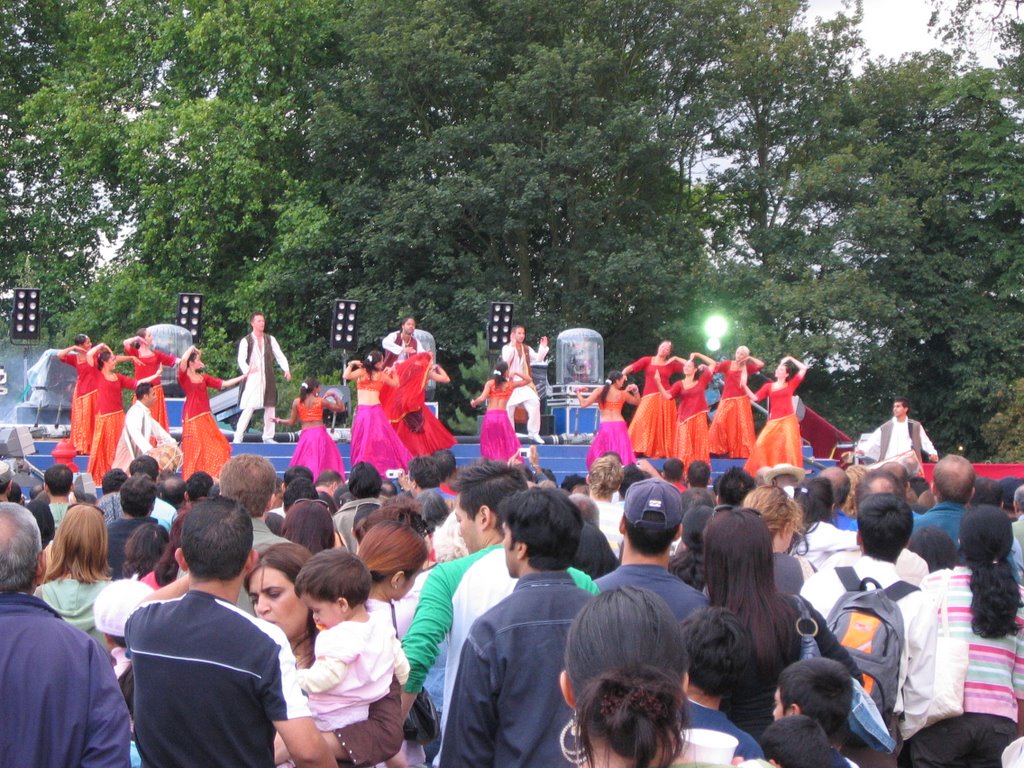
That Friday night meal was followed swiftly by another impromptu expedition out on the Sunday to the London Mela in Gunnersbury. Gunnersbury is a London suburb that has a massive Indian (especially Punjabi) community,, and the annual mela is now a big fixture on most Brit Asian calendars. I found out later that a fellow Bollywood blogger, Maja, was also there but we didn't manage to catch up.

Pav Bhaji rules!The Mela itself was great fun - I had gol gappas after a long time, and the chhole bhature, kebab rolls, nariyal pani and pista kulfi were pretty good as well. Like all true melas, there were several tents with musical performances, a lot of rides, and also random shops selling typical mela fair, as well as a (slightly bizarre) open air beauty parlour where if you weren't careful you could catch a glimpse of Mrs. Taneja getting her eyebrows threaded - not a good sight at all!

Perhaps the best part of the Mela were the Bollywood dancers - many of whom weren't Indian - and who put together a pretty impressive show, with well choreographed numbers, including Kajra Re & Dhadak Dhadak. Keeping with the Indian tradition, we went to the mela in a group of seven people - only four of our group were Europeans, two of whom barely speak English, and who had never stepped outside Florence, Italy, before that Friday. So for them, the entire experience was a complete culture shock, and the poor kids were really overwhelmed. By the end of the day, though, they seemed to have found their footing, enough for one to ask us how to dance Bhangra!

...bada bada koyle se naam falak pe likhna hai...Our hectic day at the Mela wasn't over - we then dashed off to go for a marathon emotional rollercoaster by going to see Kabhi Alvida Naa Kehna, only to find the hall packed full of Arab families, all waiting to have their heartstrings tugged viciously at by Mr Johar. I love it whenever I get to see a Bollywood movie in Central London; it's perhaps the best example of the Empire striking back. The international fan following isn't that out of the ordinary anymore either. The Monday edition of the Metro (the free morning newspaper that every London Tube commuter worth his salt will pick up at the station to read on the journey) had a short blurb about how in 2005, British releases in the UK were overtaken by Bollywood releases, while more Bollywood films made it to the UK top ten lists last year than British ones. Watch out Hollywood!

The final major Indian experience of the week was arguably a constructed one, but it was great fun nevertheless. By a strange coincidence of career planning, my two sisters & I have managed to end up living in the same city after a long time - usually we're in different continents. We'd been talking about organising joint drinks with our respective groups of friends, so we finally took the plunge last week and had that party. However, the irony of the situation was too good to let go of - three young, ambitious and reasonably aggressive Indians in London. The party theme was therefore, "Lose a Raj, Gain a Nation". We wanted to be inclusive you see - if you were imperialist, you could come to drink your sorrows away and we would commiserate with you on the loss of the Raj, whereas post - colonialists would be more than welcome to celebrate with us. Oddly enough, turnout being what it was, the three of us were the only Indians in a group of over 35 in a Mexican bar raising toasts to India's Independence in Covent Garden.

For one week in London, that's a lot of different Indian experiences rolled into one. Some very disparate events, very different areas and groups of people, but somehow with a lot of common themes that emerged only when I had a chance to reflect on the broader issue this weekend while lolling on a large white couch with the Financial Times Weekend. (My regular readers will detect a striking commonality to many of my epiphanies - the FT is always lurking near me at the time.)

India is fortunate to have two fantastic cultural ambassadors working for us - our cuisine & our films. My own experience of the world has led me to think that these two have earlier on worked in mutually exclusive geographies. Our cuisine is what got us a foothold in the developed West, while Bollywood has helped us build cultural links with a lot of the developing world. However, over the past decade, our food has started spreading to more countries, while the West has finally realised that they cannot sit back and not take Bollywood into notice. Indian restaurants are now almost necessities in most urban plans in the Western world, while the UK fascination for a good "curry" is legend. Compare this to Bollywood, which has built up a fan following in Latin America, Africa, the Middle East and South East Asia. Between those two, we've got the world covered!

Perhaps more importantly, and this is something I realised from the crowds I saw at the London Mela, is how the attitudes have changed. When many Indians immigrated to the UK, especially after Independence, they came in to fill blue collar roles. They were industrious and prudent, and by sheer effort built productive and economically sound lives (not unlike what the latest wave of Polish migrants is doing in the UK). Unlike the US, which saw highly educated professionals moving to take up roles in medicine, academics, engineering or finance, the UK migrant community has been incredibly segregated, isolationist and also financially weak. Given the time many of them left India, they did not speak from a position of strength.

Compare this mindset with that of the average Indian who travels each year. Many young Indians travelling globally these days do so for work or education. We are hard working - a result of our highly competitive education system. We are fiercely ambitious, often disconcertingly so for others, and are not ashamed of it. More importantly, I think Indians today are much more willing to take a stand for their country, and as our economy grows stronger and we begin to embed the value of merit in our system, this international "cockiness", as someone I know referred to it, will only grow.

Today, to be Indian means something in the world. No longer are we the country where the Beatles came to search for spirituality (though if you were from Liverpool, you'd probably need the time away as well), nor are we the country where thousands of people come to "see the elephants and tigers". Today, when people say India, they say "you guys are bloody good in maths", they'll say, "IT", and if they're French, they usually say "Mittal!"

...dheemi aanch pe tu, zara ishq chadhaa..There's still a lot that needs to go right, but given our penchant for always talking about the bad stuff that needs fixing, we run the risk of overlooking the great achievements we've made. So let's take that little five minute tea break to celebrate where we've come, look back on the path we've been climbing, and then after the five minutes, look up to the summit where we're heading.

As they're saying in a little Mexican bar in Covent Garden, "Lose a Raj, Gain a Nation!"

All images are from the London Mela, held on 13th August, 2005)

Saturday, July 29, 2006

I dreamt of Delhi last night

But the Delhi I dreamt of last night wasn’t the Delhi of long, unbelievably hot summers. It wasn’t the Delhi that reels from severe water shortages, where load shedding is a daily occurrence, where the rhythms of your diurnal activity revolves as much around the benediction of Delhi Vidyut Board as it does around your own schedule.

It was also not the Delhi of long, cold winters. I didn’t dream of those long, cold nights, when the roads are empty and your eyesight dimmed by the fog that comes in menacingly before midnight and stays there till late morning, when the cold settles into your bones and makes touching the bathroom tap in the morning a dreaded activity.

I dreamt of my Delhi. It was the Delhi of the lush evenings of late August & September. I dreamt of the Delhi that is found driving down the Mehrauli road, where you can look out at the Qutub Minar, warmly lit in limpid pools of amber lighting, the bright halogens refracted into an abstruse amber puddle against a warm sky by the dust and pollution thrown up by a frantically busy city. I dreamt of the craggy hillsides near Rai Pithora, where the rough red stones turn soft shades of dark brown & slate grey as your car moves past, with the camel thorn trees that in the day time stand testament to the rugged harshness of the climate mutating into dark, black etches against a night sky glowing with promise.

Delhi is the city that I went to university in, and it is the city that was my first real playground as an adult. No matter how many cities I go to, anywhere in the world, Delhi shall always remain the one indelibly etched on my mind. And more than anything else, the Delhi that I loved the most was the Delhi of the dark, when the burning sun had dropped below the horizon, the glowing grey of the evening sky had dimmed to an inky midnight blue, the street lights casting long shadows on roads, where the cool breeze would be countered by the heat that would radiate from the tarmac until the early morning. It is that Delhi that I love, and it is that Delhi that I miss the most.

There are so many memories associated with travelling along those seemingly endless roads at night, under the cover of darkness. There were endless evenings when I would drive through Lutyens Delhi. Usually a necessity of living and moving around in Delhi, driving was sometimes never the means to an end – it would often be an end in itself. There were times when we would be sitting around, bored, tired of the endless hum of air conditioners at a friends place, or the more radical, industrialised noise of air coolers (that magical sound of dripping water, the cold damp of the straw against your fingers as you ran your hands up and down that panel, the rich, wet smell of khas perfume that would be dropped into the water tanker every morning)

And when the boredom got too much, when just chilling was not enough, when TV or Barista or TGIF got too much, we’d go for a drive. Remember that scene in Monsoon Wedding, when Vasundhara Das sneaks out at night to meet her married lover? When asked where she wants to go, she says, "Just drive. I just want to go for a long drive..."

And so would we. We would just want to get out of the house, climb into our cars, and keep driving. Heading out from South Delhi, we’d drive up Shanti Path, the windows of my little Maruti 800 rolled down, music playing softly on the radio.

“You’ve got the music playing, night & day…FM is ready for you….in the morning, or late at night, wow, we’re gonna let the music play…

AIR F.M. Stereo….all the time……..on All India Radio”

Driving up Chanakyapuri, we would turn off towards Teen Murti, drive up South Avenue, until we finally hit the periphery of South Block. From there, it was a quick drive up to Rajpath, and then we’d careen down the long stretch, the proud flanks of Indian government behind us, India Gate looming large in front.

The lawns along Rajpath were always lined with families out for ice cream. There would be couples, trying to get two seconds of privacy under the trees that in the daytime provide shade for thousands. The balloon walas, Kwality Walls ice cream carts, kiosks selling ice cold Coke, Pepsi & Fanta (but nothing to beat the synthetic lemony tang of a chilled Limca on a warm sunny evening). A friend, any friend, sitting in the passenger seat, the cigarette we were sharing moving back and forth. (“Don’t drop any cinders on that dashboard or the seat – my dad’s gonna kill me”)

And then turning off at Shahjahan Road, heading down to Aurangzeb and back to Race Course, before heading back behind Chanakya Cinema to hit the end of Shanti Path and going back down Moti Bagh at the Rail Museum…the road home was equally magical.

Or if we were really bored, we’d head out of Priya and drive past Vasant Kunj, double back towards Andheria Mod and head for Gurgaon down past Qutub, Chhatarpur and Ghitorni. That road was the route to so many farmhouse parties – normal evening chillouts, more hard core scenes and the many, many music concerts that kept us occupied through long, hot summer nights.

But when we were out for a drive, the road to Gurgaon was rarely our destination. Once we went past the Delhi border (“Welcome to Haryana – jahaan doodh dahi ka khaana”) and made it through the sterile high rises of DLF, we’d head past IFFCO crossing and hit the Jaipur highway.

Oh, that great road. Long, endless stretches of highway, the dark looming trucks trundling along. The big Jaipur merchants in their fancy Mercedes and Toyotas would effortlessly cruise past our little rattling student cars – usually beat up old Marutis, or if we were lucky, a Santro or maybe even a Qualis. The wide, dusty Aravalis stretching out ahead and besides you, the ground falling away on either side, petering away into darkness. The air would always be warm – never hot, but this was Haryana, heading into Rajasthan, so there was always a flavour of desert dryness, a grainy, dusty layer on your arm where it rested on the door as you drove through the night.

Music was our constant companion. Nietzsche said that a life without music was senseless. Each of those long journeys, where the destination is meaningless and there is a quiet peace in the journey would have been incomplete without the music we played.

Our tape decks were our lifelines, as was AIR FM. When three new FM stations were launched in Delhi, our lives became fuller, richer – we were given the freedom to change music at the touch of a button without having to change tapes, fumble around the dashboard or in the glove compartment to find the right replacement. Such luxury.

But the music that sustained us, it was some of the best. We had Indian Ocean, Shaan, Strings, Junoon, Euphoria, Creed, Metallica, Tom Petty & the Heartbreakers, John Denver, Farida Khanum, Nusrat Fateh Ali Khaan, Adnaan Sami, A.R. Rehman, Joan Baez, Joni Mitchell, Paul Mc Cartney – there are songs that even now I can play and I can feel the shudder of the steering wheel under my palms, the smell of nicotine and dust in my nose.

I dreamt of Delhi last night. And I hope I dream of it again.

Thursday, June 22, 2006

Lotus FM & the Spirit of Dissent

Dissent is possibly one of the most ubiquitous human qualities. There are always some people, in any society, in any part of the world, who don't accept the status quo, who can't bear to stand what they see in front of them, who are not happy with the people in power. They are rebels, rebellious, with or often without a cause.

Of the many people who had causes to be rebellious about for a very long time were the non-white communities in South Africa. The sizeable Indian community was also discriminated against by the establishment, though some would argue not as much as the black community. But the experience of immigration is never easy, especially in a time when your origins, your source was what marked you out as different and to be discriminated against. (You could argue that this aspect of immigration has not vanished, it has merely morphed into something more insidious in almost every country with a sizeable immigrant community.)

Anyway - we digress. I was talking to a friend one evening, a month ago, sitting in a steakhouse in Pretoria. It felt odd - this was a restaurant in the erstwhile white heart of a city that was the very nucleus of the apartheid state. And here were two brown people talking about dissent and resistance in this neighbourhood. If I was a sentimentalist, I would insist that it would have made a beautiful closing scene in a happy Alan Paton movie. My friend, a staunch South African and equally staunch lover of all things Indian, including Bollywood, was telling me about Lotus FM, the local music station that played Indian music 24x7.

Apparently, during the fifties, a nostalgic Indian community would tune into All India Radio, on their small (or as the case was, very large transistor based) shortwave radios. They would listen to the latest Bollywood movie songs, the news, cultural programmes, and when Nehru willed that AIR would be educational & cultured, only classical music programmes. It was, for many of them, the only link to a homeland that had been lost a generation or so before. With no ideas of where families came from, where villages lay, or in many cases as well, what castes, names, identities were real, what were imagined. The girmitiya experience was never an easy one.

However, any link to a newly democratic, and increasingly intransigent, India was becoming difficult for the South African apartheid authorities. Things came to a head when Vijayalakshmi Pandit decided to raise the issue of segregational politics in the UN, and the world actually began to take note of the rather inconvenient circumstances in South Africa.

Hence, the decision to ban AIR. Jam the radiowaves, the racists decreed. And so it was done. AIR was no longer accessible from within South Africa, not even the homelands. A distraught Indian community didn't at first know where to turn - and then they turned to Radio Ceylon. By now, Nehru's edict about the low cultural value of Bollywood had been issued, and Radio Ceylon capitalised on AIR's inability to broadcast Hindi songs by playing them over & over again. Binaca Geet Mala, with Ameen Sayani was already on air, and a community greedy for music in South Africa tuned in.

But this too was not to last. As soon as the communities found a source of music, the apartheid powers would block them. So Radio Ceylon was jammed, as was Radio Tanzania in turn. Finally, a determined drive in Durban collected thousands of LP records from every house, loaded them into a small bakkie (for the non initiated, that's South African for four by four) and drove, I'd like to imagine under the cover of darkness, into one of the erstwhile homelands. (Swaziland, I think). Once there, somewhat removed from the racists, people established a small ham radio station, and called it, somewhat fittingly, Lotus FM.

This station proved more difficult to ban, and finally the authorities agreed to allow a few hours of "Indian" programming on South African national radio. A few hours became a few more, extended to a day, and finally a separate radio station was established, by the government, playing Indian music, and targeted at the Indian community specifically.

Today, Lotus FM is still around, and I will admit my car radio is always preset to it when I'm driving around Johannesburg! Tune in sometime - they also stream online! If nothing else, that is my little tribute to all the people who suffered, of all races, in South Africa. And they also play really good dance music that I can blast in my little car...

Sunday, May 28, 2006

Bollywood in London...

Every so often (i.e. when I'm keen to watch a Hindi movie on the big screen) or when there's a big new Bollywood production out (usually this translates into the latest SRK superhit, or the new Yash Raj annual glossy staple) I will head out to one of the many cinemas in London that show Hindi movies.

Usually, the bulk of these tend to be in the suburbs, where there is a sizeable Indian/Pakistani/Bangladeshi/Sri Lankan community (somewhat generically referred to as "South Asian" or more specifically, "Brit-Asian". Interestingly, people refer to French immigrants in the US as French, Germans as Germans, Belgians as Belgians, etc, without actually calling them "Western Europeans", though the term "Eastern European" is heard more and more frequently in the press & public discourse...interesting....)

Anyway, we digress...so as I was saying, usually the Hindi films will play in the suburbs, (many, like Himalaya Palace Cinema, only show Hindi movies) but ever so often, a Bollywood movie will be picked up by one of the big chains - usually the biggest hit of the year. If its a Shah Rukh movie, it WILL be picked up (that man has a fan following all over the world); the big Yash Raj ones usually get distributed as well.

As a result, I managed to catch Mangal Pandey, The Rising (or whatever that movie was called) last summer. (In a strange incidence of poetic justice, I also saw that film in the erstwhile heartland of the East India Company, the Isle of Dogs.) And today, I saw Fanaa in the London Trocadero, just off Piccadilly Circus.

This might not necessarily seem to be a big deal, but actually it is. For the bulk of my childhood, when we were growing up outside India, most people either never watched Bollywood (or if they did, never admitted to it) or openly derided them as fantastical, song & dance tripe. This wasn't just restricted to some snotty critics at the latest Trendy-with-a-capital-T New York magazine, but also a lot of the Indians we met overseas - kids of immigrants, diplomats, etc. Watching Bollywood movies if you weren't in India wasn't cool, and it wasn't something you ever admitted to. (Though given that Mithun Chakraborty was the biggest thing in Bollywood in the 1980s, this may not be completely out of place...)

But it was something that was never in debate in India - everyone saw Hindi movies, everyone knew how to play Antakshari, everyone knew every major Kishore Kumar song. This wasn't something you made an effort to keep up with; it was a fact of life.

However, that was in India. When you were outside India, and perhaps not in South Asia, Bollywood was very deliberately off the radar. The only ones who really watched Bollywood movies were the immigrants who were nostalgic for home - and they never admitted to doing it. If they were found out, it was blamed on blatantly uncool parents. Nobody else really did, did they? They all watched Hollywood!

But it wasn't just that these Indian movies weren't in English - the subtitles could easily rectify that. It was that, unlike the cooperative French, Iranian, Turkish, Korean, whatever, film industries, Indian films just didn't "fit" the mold of what good cinema was. We insisted on making really long movies, which were melodramatic, packed full of formulaic emotional plots, usually pilfered stories from big Hollywood blockbusters, and to top it all off, had to throw in at least 5 songs into each film, for which the leads would suddenly be transported into a glamorous foreign locale (usually, but not always, Switzerland). I mean, they were just SO weird! And we weren't even apologetic about it! We insisted, despite all the friendly advice from the West, to continue making the movies we made, without rhyme or reason!

And then, somewhere, somehow, things began to change. In the late 90s, suddenly, the world started to take notice. Obviously, these were still terribly kitschy movies, lacking in plotlines, darling, and absolutely totally lacking class, but I mean, they still sell! And given that the Indian economy had started attracting some attention, people were keen to see what exactly was happening.

This was the same time that the Swiss, in many ways the most pragmatic and sensible of all Europeans, realised the economic value of Indian film crews shooting in their country. They realised quickly that the biggest hindrance to the smooth flow of industry professions was the visa, and introduced the Unit Visa, allowing entire film crews to travel without difficulty on single documents. This was soon followed by renaming a modest peak in the Swiss Alps Mount India...in honour of the many Sunny Deol song sequences shot around its base!

And suddenly, many more countries began to sit up and take notice. And as Indian cinema became more technically advanced, finding new & exciting locations across the world for the latest glossy song sequence was an essential part of the script. And suddenly, if Switzerland was for the slightly unimaginative Salman Khan starrer, we had Urmila Matondkar in Namibia, Kajol & Shah Rukh in Egypt, Madhuri Dixit in Patagonia, and not to forget, Hrithik Roshan in the British Museum, which was a bit of a coup since it was the first film sequence shot inside the museum. Most recently, the Irish government has actively started wooing Indian filmmakers to its shores.

But was it all the money talking? Was that all that made people realise what Bollywood was all about? There was an obvious financial aspect to the whole attention seeking (the former NDA government also declared Bollywood a formal industry, which thus opened up the business to legal commercial funding, and also streamlined insurance policies, etc) But surely there was something else to this?

I think people have finally realised, and accepted, that Bollywood is a bigger global phenomenon than we might think. More people across the world have seen a Bollywood movie than a Hollywood one. I have heard stories from people from Russia, mainland China, Tanzania, Venezuela & Morocco about how they grew up watching Amitabh Bachchan & (unfortunately!) Mithun Chakraborty. I heard from a Chinese colleague how a movie about a dog that avenges its master's untimely death was her father's favourite, while someone in South Africa told me about the survivor of the Rwandan massacres was less interested in narrating his experiences to the Indian origin human rights lawyer as he was in taking a peek at the CD case for the latest Shah Rukh film. There have been Greek university friends who have watched Kal Ho Na Ho and started sniffling half way through the movie, while other friends have bawled their eyes out in Asoka. My former flatmate, a classic English bloke, insisted on calling his former girlfriend, now happily married to someone else, to tell her he wished her health & happiness, again after watching Kal Ho Na Ho. Kabhi Khushi Kabhi Gham has many stories attached, from the German who insisted on subjecting her rather surprised parents to the unedited DVD over an Easter holiday, while the gruff Afrikaner blasted its songs from his laptop for three days non stop and also made up with his estranged father (I mean, it IS all about loving your parents, isn't it?)

So what is it that makes Bollywood so popular? I don't know, and perhaps we shall never really know. Someone infinitely more intelligent shall no doubt some day start researching this phenomenon in more detail. But what I do know is that I can now walk through London, taking the tube to work, and see posters of Fanaa right next to those of X-Men 3 in the London tube. And that is already enough to celebrate. If I was in a movie, we'd be dancing down that platform right now....