
But the Delhi I dreamt of last night wasn’t the Delhi of long, unbelievably hot summers. It wasn’t the Delhi that reels from severe water shortages, where load shedding is a daily occurrence, where the rhythms of your diurnal activity revolves as much around the benediction of Delhi Vidyut Board as it does around your own schedule.
It was also not the Delhi of long, cold winters. I didn’t dream of those long, cold nights, when the roads are empty and your eyesight dimmed by the fog that comes in menacingly before midnight and stays there till late morning, when the cold settles into your bones and makes touching the bathroom tap in the morning a dreaded activity.
I dreamt of my Delhi. It was the Delhi of the lush evenings of late August & September. I dreamt of the Delhi that is found driving down the Mehrauli road, where you can look out at the Qutub Minar, warmly lit in limpid pools of amber lighting, the bright halogens refracted into an abstruse amber puddle against a warm sky by the dust and pollution thrown up by a frantically busy city. I dreamt of the craggy hillsides near Rai Pithora, where the rough red stones turn soft shades of dark brown & slate grey as your car moves past, with the camel thorn trees that in the day time stand testament to the rugged harshness of the climate mutating into dark, black etches against a night sky glowing with promise.
Delhi is the city that I went to university in, and it is the city that was my first real playground as an adult. No matter how many cities I go to, anywhere in the world, Delhi shall always remain the one indelibly etched on my mind. And more than anything else, the Delhi that I loved the most was the Delhi of the dark, when the burning sun had dropped below the horizon, the glowing grey of the evening sky had dimmed to an inky midnight blue, the street lights casting long shadows on roads, where the cool breeze would be countered by the heat that would radiate from the tarmac until the early morning. It is that Delhi that I love, and it is that Delhi that I miss the most.
There are so many memories associated with travelling along those seemingly endless roads at night, under the cover of darkness. There were endless evenings when I would drive through Lutyens Delhi. Usually a necessity of living and moving around in Delhi, driving was sometimes never the means to an end – it would often be an end in itself. There were times when we would be sitting around, bored, tired of the endless hum of air conditioners at a friends place, or the more radical, industrialised noise of air coolers (that magical sound of dripping water, the cold damp of the straw against your fingers as you ran your hands up and down that panel, the rich, wet smell of khas perfume that would be dropped into the water tanker every morning)
And when the boredom got too much, when just chilling was not enough, when TV or Barista or TGIF got too much, we’d go for a drive. Remember that scene in Monsoon Wedding, when Vasundhara Das sneaks out at night to meet her married lover? When asked where she wants to go, she says, "Just drive. I just want to go for a long drive..."
And so would we. We would just want to get out of the house, climb into our cars, and keep driving. Heading out from South Delhi, we’d drive up Shanti Path, the windows of my little Maruti 800 rolled down, music playing softly on the radio.
“You’ve got the music playing, night & day…FM is ready for you….in the morning, or late at night, wow, we’re gonna let the music play…
AIR F.M. Stereo….all the time……..on All India Radio”
Driving up Chanakyapuri, we would turn off towards Teen Murti, drive up South Avenue, until we finally hit the periphery of South Block. From there, it was a quick drive up to Rajpath, and then we’d careen down the long stretch, the proud flanks of Indian government behind us, India Gate looming large in front.
The lawns along Rajpath were always lined with families out for ice cream. There would be couples, trying to get two seconds of privacy under the trees that in the daytime provide shade for thousands. The balloon walas, Kwality Walls ice cream carts, kiosks selling ice cold Coke, Pepsi & Fanta (but nothing to beat the synthetic lemony tang of a chilled Limca on a warm sunny evening). A friend, any friend, sitting in the passenger seat, the cigarette we were sharing moving back and forth. (“Don’t drop any cinders on that dashboard or the seat – my dad’s gonna kill me”)
And then turning off at Shahjahan Road, heading down to Aurangzeb and back to Race Course, before heading back behind Chanakya Cinema to hit the end of Shanti Path and going back down Moti Bagh at the Rail Museum…the road home was equally magical.
Or if we were really bored, we’d head out of Priya and drive past Vasant Kunj, double back towards Andheria Mod and head for Gurgaon down past Qutub, Chhatarpur and Ghitorni. That road was the route to so many farmhouse parties – normal evening chillouts, more hard core scenes and the many, many music concerts that kept us occupied through long, hot summer nights.
But when we were out for a drive, the road to Gurgaon was rarely our destination. Once we went past the Delhi border (“Welcome to Haryana – jahaan doodh dahi ka khaana”) and made it through the sterile high rises of DLF, we’d head past IFFCO crossing and hit the Jaipur highway.
Oh, that great road. Long, endless stretches of highway, the dark looming trucks trundling along. The big Jaipur merchants in their fancy Mercedes and Toyotas would effortlessly cruise past our little rattling student cars – usually beat up old Marutis, or if we were lucky, a Santro or maybe even a Qualis. The wide, dusty Aravalis stretching out ahead and besides you, the ground falling away on either side, petering away into darkness. The air would always be warm – never hot, but this was Haryana, heading into Rajasthan, so there was always a flavour of desert dryness, a grainy, dusty layer on your arm where it rested on the door as you drove through the night.
Music was our constant companion. Nietzsche said that a life without music was senseless. Each of those long journeys, where the destination is meaningless and there is a quiet peace in the journey would have been incomplete without the music we played.
Our tape decks were our lifelines, as was AIR FM. When three new FM stations were launched in Delhi, our lives became fuller, richer – we were given the freedom to change music at the touch of a button without having to change tapes, fumble around the dashboard or in the glove compartment to find the right replacement. Such luxury.
But the music that sustained us, it was some of the best. We had Indian Ocean, Shaan, Strings, Junoon, Euphoria, Creed, Metallica, Tom Petty & the Heartbreakers, John Denver, Farida Khanum, Nusrat Fateh Ali Khaan, Adnaan Sami, A.R. Rehman, Joan Baez, Joni Mitchell, Paul Mc Cartney – there are songs that even now I can play and I can feel the shudder of the steering wheel under my palms, the smell of nicotine and dust in my nose.
I dreamt of Delhi last night. And I hope I dream of it again.
Saturday, July 29, 2006


Ik Omkara
Maybe I should say a little prayer to get to that movie...
Today was supposed to be the opening day for Omkara in London. I was all prepared. Before going to work, I checked the local online film listings. Like Fanaa, the only cinema in Central London screening this movie is the Cineworld on Shaftesbury Avenue, just off Piccadilly Circus, in the heart of London's theatre district.
So this morning, trying to be all shaana, I tried to log into the Cineworld website to book my tickets online, thereby preempting the queues and being guaranteed of a seat. SMSs were sent to friends, plans confirmed, but the online booking process kept throwing up technical errors.
Never mind, thought I confidently to myself - we'll get there about an hour before hand, pick some tickets up and then while away the hour left catching up with friends over a drink in a local bar.
SMSs were sent again, bars and venues to meet up were confirmed, and I left from work in the evening, looking forward to an evening of classy Bollywood fare.
But (and this is where the prayers will come in very handy) this was not to be. Our team huddle had its rendez-vous at the agreed point. We went in strength towards the cinema, walked up the escalators, and approached the ticket counter, only to see the shutters down, with a rather sorry looking notice tacked in front.
"We are sorry to advise customers that we are currently experiencing a power failure. We hope to resume services shortly, but can only apologise for the inconvenience caused. For further details, please contact a member of staff."
My first day, third show viewing of Omkara has been nipped successfully in the bud by that most Hindi heartland of infrastructural crises - the bijli gul or powercut. (Load shedding, I believe we used to call it!) And unfortunately, while the incredibly helpful member(s) of staff were redirecting distraught customers to alternative venues, they were the only people screening Omkara in Central London, so we'll just have to wait until their hall's power supply is back. We were told it should be up and running by tomorrow evening, but they wouldn't sell us tickets since the show wasn't guaranteed to run. I'm just dreading the thought that there will be a screening tomorrow, but tickets won't be available. So I'm praying...
This is all part of our London summer this year. This morning's papers had headlines screaming about the four hour power cut yesterday afternoon that affected the whole of London's shopping, party & media heartland - the (in)famous West End. Shops had to shut down, demand for back up generators shot through the roof, temperatures and tempers crossed the red line. And while I was gloating yesterday, secure in my Canary Wharf air conditioned finance bubble, today I'm the one suffering.
So we shall try again tomorrow - hopefully the Cineworld should be up and running, and I shall get a chance to see Omkara without an issue. But nothing is certain until it is certain, so don't hold your breath for the review!
Until then, here's a trailor to of the movie to whet your appetite...
Today was supposed to be the opening day for Omkara in London. I was all prepared. Before going to work, I checked the local online film listings. Like Fanaa, the only cinema in Central London screening this movie is the Cineworld on Shaftesbury Avenue, just off Piccadilly Circus, in the heart of London's theatre district.
So this morning, trying to be all shaana, I tried to log into the Cineworld website to book my tickets online, thereby preempting the queues and being guaranteed of a seat. SMSs were sent to friends, plans confirmed, but the online booking process kept throwing up technical errors.
Never mind, thought I confidently to myself - we'll get there about an hour before hand, pick some tickets up and then while away the hour left catching up with friends over a drink in a local bar.
SMSs were sent again, bars and venues to meet up were confirmed, and I left from work in the evening, looking forward to an evening of classy Bollywood fare.
But (and this is where the prayers will come in very handy) this was not to be. Our team huddle had its rendez-vous at the agreed point. We went in strength towards the cinema, walked up the escalators, and approached the ticket counter, only to see the shutters down, with a rather sorry looking notice tacked in front.
"We are sorry to advise customers that we are currently experiencing a power failure. We hope to resume services shortly, but can only apologise for the inconvenience caused. For further details, please contact a member of staff."
My first day, third show viewing of Omkara has been nipped successfully in the bud by that most Hindi heartland of infrastructural crises - the bijli gul or powercut. (Load shedding, I believe we used to call it!) And unfortunately, while the incredibly helpful member(s) of staff were redirecting distraught customers to alternative venues, they were the only people screening Omkara in Central London, so we'll just have to wait until their hall's power supply is back. We were told it should be up and running by tomorrow evening, but they wouldn't sell us tickets since the show wasn't guaranteed to run. I'm just dreading the thought that there will be a screening tomorrow, but tickets won't be available. So I'm praying...
This is all part of our London summer this year. This morning's papers had headlines screaming about the four hour power cut yesterday afternoon that affected the whole of London's shopping, party & media heartland - the (in)famous West End. Shops had to shut down, demand for back up generators shot through the roof, temperatures and tempers crossed the red line. And while I was gloating yesterday, secure in my Canary Wharf air conditioned finance bubble, today I'm the one suffering.
So we shall try again tomorrow - hopefully the Cineworld should be up and running, and I shall get a chance to see Omkara without an issue. But nothing is certain until it is certain, so don't hold your breath for the review!
Until then, here's a trailor to of the movie to whet your appetite...
Monday, July 24, 2006
The strange shores of Ismail Kadare's destiny
The title of this post is taken from a wall in the old British jail in Istanbul. The words are part of a scribble that was etched onto the plaster by an erstwhile prisoner in the cell. The full quote is
“A terrific wind has caught the ship of my destiny & brought it to this strange shore..."
Located near the Galata tower, the jail has seen much change over the past 100 years, and was once a school, a shop, a warehouse and a factory. Today, it houses the offices of the heritage architects who have restored the building. The architects also run a traditional restaurant here, and have furnished the restaurant to resemble what houses in Istanbul looked like back in the 1890s.
 Anyway. I guess this post started with a quote from Istanbul because I wanted to have something about the Ottoman empire, since its about Ismail Kadare, an Albanian writer. I just finished reading Kadare's seminal work, Palace of Dreams. Lauded by many as his most damning indictment of the tyranny of oppressive governments, the book is set within the Tabir Sarrail, (or Palace of Dreams), a governmental ministry tasked with analysing, collating and interpreting all the dreams ever dreamed in the Ottoman empire.
(Click here for book details. SPOILER WARNING - Plot details follow)
First published in 1981 in Albania, The Palace of Dreams was immediately banned for its purported criticism of a government that was so totalitarian that it did not spare the population's subconscious from scrutiny. The protagonist, Mark-Alem, hailing from a politically powerful noble family, joins the Palace as a new recruit, and through the course of the story rises meteorically through the ranks. His progression is less driven by natural ability - it is rather through the patronage of his powerful uncle, the Vizier. Mark-Alem's own political ascension is countered by his family's sudden decline into political disfavour, and the novel ends with a sense of everything being a zero-sum game.
Critics have called The Palace of Dreams Kadare's most powerful critique of intellectual and political dictatorship. Pointing to how its ban and Kadare's subsequent fall from political grace eventually led to his seeking political asylum in France seven years later, many believe that Kadare's place in Albanian history as the voice of intellectual freedom is guaranteed.
I find this claim troubling, essentially driven by Kadare's own legacy in Albanian communism. He was a senior member of Enver Hoxha's political establishment, and used his own literary skills for an oppressive regime by acting as its PR writer. Later, he was appointed deputy in Albania's parliament - an institution that merely served as rubber stamp to Hoxha's policies.
The Palace of Dreams echoes this political privilege. Mark-Alem is never far from political patronage and the influence of his maternal uncles and his family legacy. His family's political conflicts with the Ottoman Sultans have adverse consequences for them, but it does not prevent them from producing several high ranking Viziers for the same dispensation, closely mimicking Kadare's own complex relationship with the Hoxha regime.
Kadare has come out on record to state that given the political climate within Albania at the time, the only space for dissidence was through literature like The Palace of Dreams. Again, this claim does not ring as true as it might, given that Kadare is also the author of works like The Great Winter, which many read as a tribute to Hoxha and his legacy.
The politics of a particular novel are always suspect, depending on which side of the political spectrum you view any single written work from. However, Kadare has built a strong reputation worldwide as an Albanian writer of significance. You can't question his literary worth - the quality of translation is probably more suited to another post, but considering the abundance of Albanian translators, this is probably excusable. I find it difficult to digest when we try to edify Kadare as the ultimate political dissident in Europe, especially when we compare him to writers like Milan Kundera & Boris Pasternak.
“A terrific wind has caught the ship of my destiny & brought it to this strange shore..."
Located near the Galata tower, the jail has seen much change over the past 100 years, and was once a school, a shop, a warehouse and a factory. Today, it houses the offices of the heritage architects who have restored the building. The architects also run a traditional restaurant here, and have furnished the restaurant to resemble what houses in Istanbul looked like back in the 1890s.
 Anyway. I guess this post started with a quote from Istanbul because I wanted to have something about the Ottoman empire, since its about Ismail Kadare, an Albanian writer. I just finished reading Kadare's seminal work, Palace of Dreams. Lauded by many as his most damning indictment of the tyranny of oppressive governments, the book is set within the Tabir Sarrail, (or Palace of Dreams), a governmental ministry tasked with analysing, collating and interpreting all the dreams ever dreamed in the Ottoman empire.
(Click here for book details. SPOILER WARNING - Plot details follow)
First published in 1981 in Albania, The Palace of Dreams was immediately banned for its purported criticism of a government that was so totalitarian that it did not spare the population's subconscious from scrutiny. The protagonist, Mark-Alem, hailing from a politically powerful noble family, joins the Palace as a new recruit, and through the course of the story rises meteorically through the ranks. His progression is less driven by natural ability - it is rather through the patronage of his powerful uncle, the Vizier. Mark-Alem's own political ascension is countered by his family's sudden decline into political disfavour, and the novel ends with a sense of everything being a zero-sum game.
Critics have called The Palace of Dreams Kadare's most powerful critique of intellectual and political dictatorship. Pointing to how its ban and Kadare's subsequent fall from political grace eventually led to his seeking political asylum in France seven years later, many believe that Kadare's place in Albanian history as the voice of intellectual freedom is guaranteed.
I find this claim troubling, essentially driven by Kadare's own legacy in Albanian communism. He was a senior member of Enver Hoxha's political establishment, and used his own literary skills for an oppressive regime by acting as its PR writer. Later, he was appointed deputy in Albania's parliament - an institution that merely served as rubber stamp to Hoxha's policies.
The Palace of Dreams echoes this political privilege. Mark-Alem is never far from political patronage and the influence of his maternal uncles and his family legacy. His family's political conflicts with the Ottoman Sultans have adverse consequences for them, but it does not prevent them from producing several high ranking Viziers for the same dispensation, closely mimicking Kadare's own complex relationship with the Hoxha regime.
Kadare has come out on record to state that given the political climate within Albania at the time, the only space for dissidence was through literature like The Palace of Dreams. Again, this claim does not ring as true as it might, given that Kadare is also the author of works like The Great Winter, which many read as a tribute to Hoxha and his legacy.
The politics of a particular novel are always suspect, depending on which side of the political spectrum you view any single written work from. However, Kadare has built a strong reputation worldwide as an Albanian writer of significance. You can't question his literary worth - the quality of translation is probably more suited to another post, but considering the abundance of Albanian translators, this is probably excusable. I find it difficult to digest when we try to edify Kadare as the ultimate political dissident in Europe, especially when we compare him to writers like Milan Kundera & Boris Pasternak.
What I'm listening to...
Normally I'm not a big listener of French music - other than Edith Piaf & Cheb Mami, there aren't too many singers I tend to like. Khaled, of course, is high on my list of singers. I still remember the first time I heard Didi. We were in Africa, and the song had just topped the UK top ten and was being played by South African cable TV. I was in awe of a man who could come up with such a cool beat.
Anyway, this song is another Khaled classic. There's an English version that was sung by Outlandish, but actually I like the French original better since its got less of an R&B feel...
Aicha
Comme si je n'existais pas
Elle est passee a cote de moi
Sans un regard, Reine de Sabbat
J'ai dit, Aicha, prends, tout est pour toi
Voici, les perles, les bijoux
Aussi, l'or autour de ton cou
Les fruits, bien murs au gout de miel
Ma vie, Aicha si tu m'aimes
J'irai a ton souffle nous mene
Dans les pays d'ivoire et d'ebene
J'effacerai tes larmes, tes peines
Rien n'est trop beau pour une si belle
Aicha, Aicha, ecoute-moi
Aicha, Aicha, t'en vas pas
Aicha, Aicha, regarde-moi
Aicha, Aicha, reponds-moi
Je dirai les mots des poemes
Je jouerai les musiques du ciel
Je prendrai les rayons du soleil
Pour eclairer tes yeux de reine
Aicha, Aicha, ecoute-moi
Aicha, Aicha, t'en vas pas
Aicha, Aicha, regarde-moi
Aicha, Aicha, reponds-moi
Elle a dit, garde tes tresors
Moi, je vaux mieux que tout ca
Des barreaux forts, des barreaux meme en or
Je veux les memes droits que toi
Et du respect pour chaque jour
Moi je ne veux que de l'amour
Nbrik Aicha ou nmout allik [Je te veux Aicha et je meurs pour toi]
'Hhadi kisat hayaty oua habbi [Ceci est l'histoire de ma vie et de mon amour]
Inti omri oua inti hayati [Tu es ma respiration et ma vie]
Tmanit niich maake ghir inti [J'ai envie de vivre avec toi et rien qu'avec toi]
(Lyrics by Khaled)
Anyway, this song is another Khaled classic. There's an English version that was sung by Outlandish, but actually I like the French original better since its got less of an R&B feel...
Aicha
Comme si je n'existais pas
Elle est passee a cote de moi
Sans un regard, Reine de Sabbat
J'ai dit, Aicha, prends, tout est pour toi
Voici, les perles, les bijoux
Aussi, l'or autour de ton cou
Les fruits, bien murs au gout de miel
Ma vie, Aicha si tu m'aimes
J'irai a ton souffle nous mene
Dans les pays d'ivoire et d'ebene
J'effacerai tes larmes, tes peines
Rien n'est trop beau pour une si belle
Aicha, Aicha, ecoute-moi
Aicha, Aicha, t'en vas pas
Aicha, Aicha, regarde-moi
Aicha, Aicha, reponds-moi
Je dirai les mots des poemes
Je jouerai les musiques du ciel
Je prendrai les rayons du soleil
Pour eclairer tes yeux de reine
Aicha, Aicha, ecoute-moi
Aicha, Aicha, t'en vas pas
Aicha, Aicha, regarde-moi
Aicha, Aicha, reponds-moi
Elle a dit, garde tes tresors
Moi, je vaux mieux que tout ca
Des barreaux forts, des barreaux meme en or
Je veux les memes droits que toi
Et du respect pour chaque jour
Moi je ne veux que de l'amour
Nbrik Aicha ou nmout allik [Je te veux Aicha et je meurs pour toi]
'Hhadi kisat hayaty oua habbi [Ceci est l'histoire de ma vie et de mon amour]
Inti omri oua inti hayati [Tu es ma respiration et ma vie]
Tmanit niich maake ghir inti [J'ai envie de vivre avec toi et rien qu'avec toi]
(Lyrics by Khaled)
Saturday, July 22, 2006
The Monsoon in India..
Back when I lived in Delhi (i.e. until 2003) I used to write articles for a website based in Austin, Texas. I suddenly remembered one article about the monsoon breaking in India, and have posted that here.
You know, when other night it was raining in Delhi, I couldn't help but sit up and look out of my window at the downpour. There's this mango tree outside that never seems to bear any fruit, but is always filled with blossoms and causes much woe to my allergy. In the winter, it keeps the sun out, and in summer it fills the room with dead leaves during a dust storm. But when it rains, that tree, which I generally curse out throughout the rest of the year, becomes my favorite haunt in the monsoons. My bed, which is just below the window, puts me in range of the leaves. When the raindrops hit the dust-laden branches, the tree emits a heavenly, fruity, dusty and wet scent.
The smell and texture of the rains are my favorite aspects of the monsoons. At two in the morning, when the rains started, I sat up, stuck my head as close to the grille as possible, and felt the sprinkle of water on my face. It has to be one of the most refreshing experiences in the world, and any health spa can go to hell!
The monsoon has to be the most difficult season to write about in the world. And I guess that is why very few writers manage to capture the essence of the country when the first drops hit the parched ground. That sondhi smell, which has no translation into English, has so many connotations and ideas attached that each whiff is laden with the cultural baggage of centuries. The magic of the kajris of Vrindavan, the crazy sound of the raag which is sung in a garden pavilion in the middle of a downpour, or even the frustration of being trapped indoors for a week at a stretch.
What is it about a rushing mass of clouds that can drive an entire civilisation crazy with a weird madness? A season that is so magical that it can be immortalised in the culture of an ancient land? What makes the monsoons so special, so different from any other downpour anywhere else in the world?
I think it has to do with the anticipation. Only a person who has sweated out the unbearable scorching summer months of April, May and June can understand the lure of the dark, water laden blessings. Only a person who has stood under a tree at noon, who has felt the searing hot winds of the desert over the plains, only they can understand the relief the rains bring.
Imagine yourself spending three months in the fiery bowels of hell. Think of the eternal damnation your local priest never fails to remind you of. Think of spending three months where the nights are oppressive and the days are malignant. Think of all the heat you can imagine, and imagine spending your summer in that furnace. No red hydrant baths in suburbia, no kids frolicking in the afternoon. Just an eerie stillness on the roads after eleven o'clock. People hurry indoors, to spend the worst hours in the cool comfort of their homes and offices. Children scurry into dark classrooms to avoid the scorching winds outside. Even the street vendors seek the shade of the local tree.
Think of the painful, dusty Indian summer, the real Indian summer, not the reprieve in the cold Montana autumn. Think of the worst fate you can. Land that is so hot and arid that the soil cracks in deep gashes. The tarmac is so fiery you can feel the boiling heart of the earth through the soles of your feet. Temperatures rise so high that birds fall dead from the aching bright blue sky. Wells dry out, ponds evaporate into nothingness; even the mud turns to fine, dry sand. The world weeps under the relentless summer. Sarat Chandra Chatterjee spoke of the "rainless firmament" in one of his short stories. I use that imagery here. The sky is so blue that your eyes wince at the brightness above. Not a fragment of cloud is there to ease the pain in your soul. The summer in India is terrible.
Then, from somewhere over the azure Indian Ocean, a wind comes. Drawn by the imbalances of pressure, the lifesaver heads towards a burning land. Moisture gathers on its flanks, slowly, slowly. It builds up into giant cotton wool cumulonimbus, large white fluffs of redemption. The Maharashtrians call the first rains of the monsoon the tiger. It roars and howls over the earth, and then, suddenly the painful heat is gone. The aching is replaced by an urgent expectancy. The sky, once so blue, is now covered with grey and slate sheets, which hover ominously over the horizon. The hot winds, which earlier on burned your skin, are now gone. In their place is a heavy oppressiveness, which is worse than all the heat of the summer. That was permanent; this is uncertain. Will that reprieve last?
Rain. The sky bursts into a torrent of water. Raindrops so large that they sting where they hit your skin. The grey and slate is now darker still, and you are trapped in the deluge of relief. The dry, parched earth is now quenched. Its heavy odor rises and fills your nostrils. Relief and the savior unite to give succor to a deprived earth.
And who can forget the supreme pleasure and ecstasy of soaking in the first deluge? An aunt of mine, a very respectable embassy press officer, with a six year old son, makes it a point of running out of where ever she may be and getting drenched to the skin in the first rains of the season. Many times, I join her in her manic, child like rain dance. The thrill of just being out there in the open, with a seemingly never-ending downpour is too rich to describe. Surrounded by the neighborhood children, I am generally mobbed by seven or eight preteens who want to be swung around from my arms.
And then, when my skin is so wet, it wrinkles, when the heavy rain becomes heavier still, when the raindrops cease to please and begin to hurt, and if I'm unlucky, if the hailstorms take over, I come indoors. My mother fusses over my dripping all over the carpet, so I am given a towel at the door itself. After drying up and changing, I head straight towards the bed. There I find a thick sheet and generally burrow deep under the covers, and just look up out of my windows towards the rain. The steel gray is a nice backdrop to my room, and I usually spend the rest of the day with a book and endless cups of piping hot tea.
What makes the monsoons so special?
You know, when other night it was raining in Delhi, I couldn't help but sit up and look out of my window at the downpour. There's this mango tree outside that never seems to bear any fruit, but is always filled with blossoms and causes much woe to my allergy. In the winter, it keeps the sun out, and in summer it fills the room with dead leaves during a dust storm. But when it rains, that tree, which I generally curse out throughout the rest of the year, becomes my favorite haunt in the monsoons. My bed, which is just below the window, puts me in range of the leaves. When the raindrops hit the dust-laden branches, the tree emits a heavenly, fruity, dusty and wet scent.
The smell and texture of the rains are my favorite aspects of the monsoons. At two in the morning, when the rains started, I sat up, stuck my head as close to the grille as possible, and felt the sprinkle of water on my face. It has to be one of the most refreshing experiences in the world, and any health spa can go to hell!
The monsoon has to be the most difficult season to write about in the world. And I guess that is why very few writers manage to capture the essence of the country when the first drops hit the parched ground. That sondhi smell, which has no translation into English, has so many connotations and ideas attached that each whiff is laden with the cultural baggage of centuries. The magic of the kajris of Vrindavan, the crazy sound of the raag which is sung in a garden pavilion in the middle of a downpour, or even the frustration of being trapped indoors for a week at a stretch.
What is it about a rushing mass of clouds that can drive an entire civilisation crazy with a weird madness? A season that is so magical that it can be immortalised in the culture of an ancient land? What makes the monsoons so special, so different from any other downpour anywhere else in the world?
I think it has to do with the anticipation. Only a person who has sweated out the unbearable scorching summer months of April, May and June can understand the lure of the dark, water laden blessings. Only a person who has stood under a tree at noon, who has felt the searing hot winds of the desert over the plains, only they can understand the relief the rains bring.
Imagine yourself spending three months in the fiery bowels of hell. Think of the eternal damnation your local priest never fails to remind you of. Think of spending three months where the nights are oppressive and the days are malignant. Think of all the heat you can imagine, and imagine spending your summer in that furnace. No red hydrant baths in suburbia, no kids frolicking in the afternoon. Just an eerie stillness on the roads after eleven o'clock. People hurry indoors, to spend the worst hours in the cool comfort of their homes and offices. Children scurry into dark classrooms to avoid the scorching winds outside. Even the street vendors seek the shade of the local tree.
Think of the painful, dusty Indian summer, the real Indian summer, not the reprieve in the cold Montana autumn. Think of the worst fate you can. Land that is so hot and arid that the soil cracks in deep gashes. The tarmac is so fiery you can feel the boiling heart of the earth through the soles of your feet. Temperatures rise so high that birds fall dead from the aching bright blue sky. Wells dry out, ponds evaporate into nothingness; even the mud turns to fine, dry sand. The world weeps under the relentless summer. Sarat Chandra Chatterjee spoke of the "rainless firmament" in one of his short stories. I use that imagery here. The sky is so blue that your eyes wince at the brightness above. Not a fragment of cloud is there to ease the pain in your soul. The summer in India is terrible.
Then, from somewhere over the azure Indian Ocean, a wind comes. Drawn by the imbalances of pressure, the lifesaver heads towards a burning land. Moisture gathers on its flanks, slowly, slowly. It builds up into giant cotton wool cumulonimbus, large white fluffs of redemption. The Maharashtrians call the first rains of the monsoon the tiger. It roars and howls over the earth, and then, suddenly the painful heat is gone. The aching is replaced by an urgent expectancy. The sky, once so blue, is now covered with grey and slate sheets, which hover ominously over the horizon. The hot winds, which earlier on burned your skin, are now gone. In their place is a heavy oppressiveness, which is worse than all the heat of the summer. That was permanent; this is uncertain. Will that reprieve last?
Rain. The sky bursts into a torrent of water. Raindrops so large that they sting where they hit your skin. The grey and slate is now darker still, and you are trapped in the deluge of relief. The dry, parched earth is now quenched. Its heavy odor rises and fills your nostrils. Relief and the savior unite to give succor to a deprived earth.
And who can forget the supreme pleasure and ecstasy of soaking in the first deluge? An aunt of mine, a very respectable embassy press officer, with a six year old son, makes it a point of running out of where ever she may be and getting drenched to the skin in the first rains of the season. Many times, I join her in her manic, child like rain dance. The thrill of just being out there in the open, with a seemingly never-ending downpour is too rich to describe. Surrounded by the neighborhood children, I am generally mobbed by seven or eight preteens who want to be swung around from my arms.
And then, when my skin is so wet, it wrinkles, when the heavy rain becomes heavier still, when the raindrops cease to please and begin to hurt, and if I'm unlucky, if the hailstorms take over, I come indoors. My mother fusses over my dripping all over the carpet, so I am given a towel at the door itself. After drying up and changing, I head straight towards the bed. There I find a thick sheet and generally burrow deep under the covers, and just look up out of my windows towards the rain. The steel gray is a nice backdrop to my room, and I usually spend the rest of the day with a book and endless cups of piping hot tea.
What makes the monsoons so special?
Friday, July 21, 2006
Paint It Yellow...
I have a lot to say about this movie. You shouldn't be surprised at that - I've had the chance to see it not just the one time, but thrice since March, and have been chewing it through and through...

All images from the official movie website
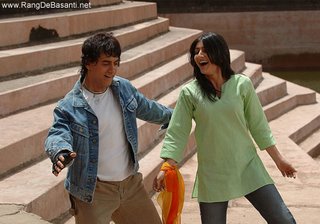
Oh - in case you're wondering why the post has this weird title, Rang De Basanti was shown at last week's "BAFTA Goes Bollywood" event in London, and the movie title was translated into "Paint It Yellow", which is a reasonable translation, but you of course lose so much nuance... what was it that Bill Murray said about things being lost in translation?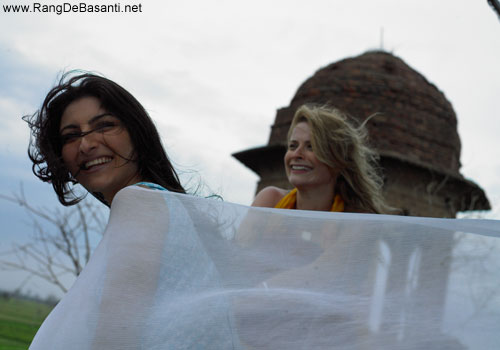
The first time I saw this movie was in March, in a cinema in Dehra Dun. I had gone back to visit my parents, who are living the retired life in that lovely little town, and my parents could not stop talking about this movie and how wonderful it was. My mother kept telling me that when she'd seen it the first time it had reminded her of me when I was in university. In hind sight, all I could think was, OH MY GOD! Did she think I was either (1) that indifferent, (2) that much of a loafer, or (3) that much of a potential political assassin?
However, seeing that movie in a cinema filled with local loony Doonies (a term coined by local resident & columnist David Keeling - read his columns about Doon on a Sunday at the Asian Age) the scene that collectively traumatised us all was when Waheeda Rehman goes to answer the door after her son has been cremated, and is greeted by two Indian Air Force servicemen, there to deliver her son's effects.
The power in this scene is especially resonant in a town like Dehra Dun. Virtually every family there has someone serving in the Indian armed forces, and that scene drew a collective gasp; it was the visualisation of the worst nightmare that everyone with someone in the armed forces harbours. My own mother was near tears in that scene. She told me later about how when my father was off at war in 1971 she had dreaded seeing a military jeep or truck turn into our street. And in 1999, we saw so many trucks coming in with the remains of young men & old from our neighbourhood - men who had died in the Kargil war.
Keep watching for more posts about this great movie...and if you hated it, please tell me why...
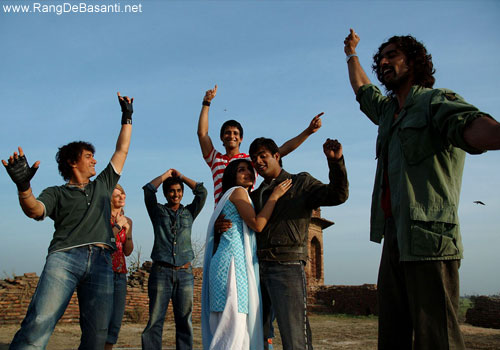
All images from the official movie website
What I'm listening to...
I found my old CD of Leonard Cohen songs. This is after I heard the song Hallelujah in a movie recently - it was a different cover from Cohen, but it brought my old CD to mind. If I don't listen to him, I can forget what a great songwriter that man is.
Anyway, here are the lyrics to another favorite. There are a whole pile of urban legends around this song - some say the singer he talks about is Janis Joplin.
Chelsea Hotel #2
I remember you well in the Chelsea Hotel,
you were talking so brave and so sweet,
giving me head on the unmade bed,
while the limousines wait in the street.
Those were the reasons and that was New York,
we were running for the money and the flesh.
And that was called love for the workers in song
probably still is for those of them left.
Ah but you got away, didn't you babe,
you just turned your back on the crowd,
you got away, I never once heard you say,
I need you, I don't need you,
I need you, I don't need you
and all of that jiving around.
I remember you well in the Chelsea Hotel
you were famous, your heart was a legend.
You told me again you preferred handsome men
but for me you would make an exception.
And clenching your fist for the ones like us
who are oppressed by the figures of beauty,
you fixed yourself, you said,
"Well never mind, we are ugly but we have the music."
And then you got away, didn't you babe
you just turned your back on the crowd,
you got away, I never once heard you say,
I need you, I don't need you,
I need you, I don't need you
and all of that jiving around.
I don't mean to suggest that I loved you the best,
I can't keep track of each fallen robin.
I remember you well in the Chelsea Hotel,
that's all, I don't even think of you that often.
(Lyrics by Leonard Cohen)
Anyway, here are the lyrics to another favorite. There are a whole pile of urban legends around this song - some say the singer he talks about is Janis Joplin.
Chelsea Hotel #2
I remember you well in the Chelsea Hotel,
you were talking so brave and so sweet,
giving me head on the unmade bed,
while the limousines wait in the street.
Those were the reasons and that was New York,
we were running for the money and the flesh.
And that was called love for the workers in song
probably still is for those of them left.
Ah but you got away, didn't you babe,
you just turned your back on the crowd,
you got away, I never once heard you say,
I need you, I don't need you,
I need you, I don't need you
and all of that jiving around.
I remember you well in the Chelsea Hotel
you were famous, your heart was a legend.
You told me again you preferred handsome men
but for me you would make an exception.
And clenching your fist for the ones like us
who are oppressed by the figures of beauty,
you fixed yourself, you said,
"Well never mind, we are ugly but we have the music."
And then you got away, didn't you babe
you just turned your back on the crowd,
you got away, I never once heard you say,
I need you, I don't need you,
I need you, I don't need you
and all of that jiving around.
I don't mean to suggest that I loved you the best,
I can't keep track of each fallen robin.
I remember you well in the Chelsea Hotel,
that's all, I don't even think of you that often.
(Lyrics by Leonard Cohen)
Thursday, July 20, 2006
What - we're imitating China now?! - Update
There are several really good resources out there if you're looking to read up more on the discussions in the blogosphere.
The Bloggers Against Censorship group have opened a wiki on this issue.
For a pretty thorough listing of the major debate around the blog ban and the issues surrounding the topic (including a link to my own post titled, "The Blog Ban - Signs of Hope") take a look at DesiPundit
Rediff has said it should be able to provide full access to all blogs within 48 hours - let's see where that stands.
Slowly, slowly...
The Bloggers Against Censorship group have opened a wiki on this issue.
For a pretty thorough listing of the major debate around the blog ban and the issues surrounding the topic (including a link to my own post titled, "The Blog Ban - Signs of Hope") take a look at DesiPundit
Rediff has said it should be able to provide full access to all blogs within 48 hours - let's see where that stands.
Slowly, slowly...


The Blog Ban - Signs of Hope
The Indian government’s decision to block several blogs and websites earlier this week has been met, across cyberspace, with outrage & anger. This is perhaps the latest episode in a chain of events where government action has not been met with indifference, but with a different reaction.
The public reaction to the blog ban is worthy of analysis itself, but for me it is more important to examine it as a continuation of a trend that is increasingly visible in India – the emergence of a younger India that is no longer willing to let the political ruling class escape accountability. I also believe that this development is a good thing for the country as a whole. In many ways, India has been a post-colonial establishment for the past sixty years. We are still a people that is emerging from the shackles of colonialism, and the control of national discourse has not yet fully transferred completely to a post Independence generation that is able to articulate its own wants and desires without having to refer to the trauma of rule by another. This transfer is already underway in the media & in business, which can and have more easily espoused values of free choice and the rule of merit, but it is taking much longer in the arguably most influential sphere - politics. We therefore can view our national discourse as being dichotomous – one half dominated by a young India that has no need to seek validation against an external former authority, and an old India that is unable to operate without utilising the rule of the other as some benchmark, either to emulate or reject.
The latest blog ban and its reaction are therefore both merely manifestations of this contradiction. On one side you have a medium that is primarily used and run by people below the age of 40; people who have seen the last sixteen years of economic liberalisation and have also felt its benefits. The average Indian who uses the internet is young, had some form of tertiary education and is also the product of a free India, with no colonial memory or anguish. Compare this with the people who work in the Department of Telecommunications: bureaucrats usually inured to competitive pressures and the need for efficiency at work, subservient to a political class that is corrupt, ageing and unable to understand that there the India of today is no longer willing to let them escape accountability. For the average government mandarin, banning an internet website (or indeed, thousands of them as has happened with the block on blogspot) is perfectly acceptable, and is a regular tool of colonial (read tyrannical) administration. However, this becomes increasingly unacceptable to a young democracy which values its freedom of speech and is no longer willing to take at face value whatever is doled out to it from the government.
2006 has been the year of a young India rising up and staking its claim in a political discourse. Long accused of indifference and a lack of concern, a young India has stood up to be counted this year. Starting with the vigils at India Gate for Jessica Lall, followed by the agitation against reservations in higher education, and more recently, the AIIMS medical strikes that saw a minister having to back down in the face of public anger – these are all good indicators.
The reservations protests were perhaps the best examples of how a young India, exposed to economic self sufficiency and no longer dependent on a national bureaucracy for a livelihood, and is now used to the benefits of capitalism, chose to take the government on. Unlike the protests of 1990, when a desperate youth took to self immolation, and was still not heeded by the government, this year the protests were not about using self –destructive methods to be heard. This year, young India seized technology. SMS, internet petitions, public marches, street protests, and also hunger strikes (we can’t all forget our roots now, can we?) The government was forced to debate the issue, and even though as yet unsuccessful, the campaigns made the government wake up and take notice of this young country.
The blog banning issue is a continuation of this trend. Using new technology to subvert this ban, and also using legal recourse, the Indian public have shown that they are now no longer willing to let another Satanic Verses episode be repeated. More importantly, the government’s claims that the ban was enforced in the interests of national security have also been met with vociferous protests. This is especially resonant in today’s global geopolitical scenario, when we see “national security” used to justify the worst examples of human rights violations in the USA & Israel.
Where this movement goes from here is hard to say. However, I'm pretty convinced that the trend, by itself, is one of India's greatest strengths, and can help us transition from a post-colonial entity, ruled by Macauley's elite, to a true democracy, where neo-liberal principles of humanism, the rights of all people, freedom of speech and economic freedom can safely coexist.
Welcome to tomorrow!
The public reaction to the blog ban is worthy of analysis itself, but for me it is more important to examine it as a continuation of a trend that is increasingly visible in India – the emergence of a younger India that is no longer willing to let the political ruling class escape accountability. I also believe that this development is a good thing for the country as a whole. In many ways, India has been a post-colonial establishment for the past sixty years. We are still a people that is emerging from the shackles of colonialism, and the control of national discourse has not yet fully transferred completely to a post Independence generation that is able to articulate its own wants and desires without having to refer to the trauma of rule by another. This transfer is already underway in the media & in business, which can and have more easily espoused values of free choice and the rule of merit, but it is taking much longer in the arguably most influential sphere - politics. We therefore can view our national discourse as being dichotomous – one half dominated by a young India that has no need to seek validation against an external former authority, and an old India that is unable to operate without utilising the rule of the other as some benchmark, either to emulate or reject.
The latest blog ban and its reaction are therefore both merely manifestations of this contradiction. On one side you have a medium that is primarily used and run by people below the age of 40; people who have seen the last sixteen years of economic liberalisation and have also felt its benefits. The average Indian who uses the internet is young, had some form of tertiary education and is also the product of a free India, with no colonial memory or anguish. Compare this with the people who work in the Department of Telecommunications: bureaucrats usually inured to competitive pressures and the need for efficiency at work, subservient to a political class that is corrupt, ageing and unable to understand that there the India of today is no longer willing to let them escape accountability. For the average government mandarin, banning an internet website (or indeed, thousands of them as has happened with the block on blogspot) is perfectly acceptable, and is a regular tool of colonial (read tyrannical) administration. However, this becomes increasingly unacceptable to a young democracy which values its freedom of speech and is no longer willing to take at face value whatever is doled out to it from the government.
2006 has been the year of a young India rising up and staking its claim in a political discourse. Long accused of indifference and a lack of concern, a young India has stood up to be counted this year. Starting with the vigils at India Gate for Jessica Lall, followed by the agitation against reservations in higher education, and more recently, the AIIMS medical strikes that saw a minister having to back down in the face of public anger – these are all good indicators.
The reservations protests were perhaps the best examples of how a young India, exposed to economic self sufficiency and no longer dependent on a national bureaucracy for a livelihood, and is now used to the benefits of capitalism, chose to take the government on. Unlike the protests of 1990, when a desperate youth took to self immolation, and was still not heeded by the government, this year the protests were not about using self –destructive methods to be heard. This year, young India seized technology. SMS, internet petitions, public marches, street protests, and also hunger strikes (we can’t all forget our roots now, can we?) The government was forced to debate the issue, and even though as yet unsuccessful, the campaigns made the government wake up and take notice of this young country.
The blog banning issue is a continuation of this trend. Using new technology to subvert this ban, and also using legal recourse, the Indian public have shown that they are now no longer willing to let another Satanic Verses episode be repeated. More importantly, the government’s claims that the ban was enforced in the interests of national security have also been met with vociferous protests. This is especially resonant in today’s global geopolitical scenario, when we see “national security” used to justify the worst examples of human rights violations in the USA & Israel.
Where this movement goes from here is hard to say. However, I'm pretty convinced that the trend, by itself, is one of India's greatest strengths, and can help us transition from a post-colonial entity, ruled by Macauley's elite, to a true democracy, where neo-liberal principles of humanism, the rights of all people, freedom of speech and economic freedom can safely coexist.
Welcome to tomorrow!
What - we're imitating China now?! - Update
Today's International Herald Tribune carried an article on the current blog ban in India. The Indian Consulate General in New York claimed it to be the result of a technological error. Read the full story here
Most sites are still theoretically down, but it looks like the public uproar is beginning to cause discomfort. (Alternatively, the originally hypothesised "operations" against terrorists could be winding down) Hopefully we shall see something more concrete coming out of the government at home.
Most sites are still theoretically down, but it looks like the public uproar is beginning to cause discomfort. (Alternatively, the originally hypothesised "operations" against terrorists could be winding down) Hopefully we shall see something more concrete coming out of the government at home.
Wednesday, July 19, 2006
Day Two of the Siege - Life in Beirut
This is an email that was sent by a Lebanese woman to her friends, and has been forwarded on through the internet to reach my inbox. Read it carefully - and just think that this was written only on the second day of the bombings. And remember - the writer may not even be there anymore - just another example of "collateral damage".
"Dear All,
I am writing now from a cafe, in West Beirut's Hamra district. It is filled with people who are trying to escape the pull of 24 hour news reporting. Like me. The electricity has been cut off for a while now, and the city has been surviving on generators. The old system that was so familiar at the time of the war, where generators were allowed a lull to rest is back. The cafe is dark, hot and humid. Espresso machines and blenders are silenced. Conversations, rumors, frustrations waft through the room.
I am better off here than at home, following the news, live, on the spot documentation of our plight in sound bites.The sound of Israeli warplanes overwhelms the air on occasion. They drop leaflets to conduct a "psychological" war. Yesterday, their sensitivity training urged them to advise inhabitants of the southern suburbs to flee because the night promised to be "hot". Today, the leaflets warn that they plan to bomb all other bridges and tunnels in Beirut. People are flocking to supermarkets to stock up on food.This morning, I wrote in my emails to people inquiring about my well-being that I was safe, and that the targets seem to be strictly Hezbollah sites and their constituencies, now, I regret typing that. They will escalate. Until a few hours ago, they had only bombed the runways of the airport, as if to "limit" the damage. A few hours ago, four shells were dropped on the buildings of our brand new shining airport.
The night was harrowing. The southern suburbs and the airport were bombed, from air and sea. The apartment where I am living has a magnificient view of the bay of Beirut. I could see the Israeli warships firing at their leisure. It is astounding how comfortable they are in our skies, in our waters, they just travel around, and deliver their violence and congratulate themselves.
The cute French-speaking and English-speaking bourgeoisie has fled to the Christian mountains. A long-standing conviction that the Israelis will not target Lebanon's Christian "populated" mountains. Maybe this time they will be proven wrong? The Gulfies, Saudis, Kuwaities and other expatriates have all fled out of the country, in Pullman buses via Damascus, before the road was bombed. They were supposed to be the economic lifeblood of this country. The contrast in their sense of panic as opposed to the defiance of the inhabitants of the southern suburbs was almost comical. This time, however, I have to admit, I am tired of defying whatever for whatever cause. There is no cause really. There are only sinister post-Kissingerian type negotiations. I can almost hear his hateful voice rationalizing laconically as he does the destruction of a country, the deaths of families, people with dreams and ambitions for the Israelis to win something more, always more.
Although I am unable to see it, I am told left, right and center that there is a rhyme and reason, grand design, and strategy. The short-term military strategy seems to be to cripple transport and communications. And power stations. The southern region has now been reconfigured into small enclaves that cannot communicate between one another. Most have enough fuel, food and supplies to last them until tomorrow, but after that the isolation of each enclave will lead to tragedy. Mayors and governors have been screaming for help on the TV.
This is all bringing back echoes of 1982, the Israeli siege of Beirut. My living nightmare, well one of my living nightmares. It was summer then as well. The Israeli army marched through the south and besieged Beirut. For 3 months, the US administration kept dispatching urges for the Israeli military to act with restraint. And the Israelis assured them they were acting appropriately. We had the PLO command in West Beirut then. I felt safe with the handsome fighters. How I miss them. Between Hezbollah and the Lebanese army I don't feel safe. We are exposed, defenseless, pathetic. And I am older, more aware of danger. I am 37 years old and actually scared. The sound of the warplanes scares me. I am not defiant, there is no more fight left in me. And there is no solidarity, no real cause.
I am furthermore pissed off because no one knows how hard the postwar reconstruction was to all of us. Hariri did not make miracles. People work hard and sacrifice a lot and things get done. No one knows except us how expensive, how arduous that reconstruction was. Every single bridge and tunnel and highway, the runways of that airport, all of these things were built from our sweat and brow, at 3 times the real cost of their construction because every member of government, because every character in the ruling Syrian junta, because the big players in the Hariri administration and beyond, were all thieves. We accepted the thievery and banditry just to get things done and get it over with. Everyone one of us had two jobs (I am not referring to the ruling elite, obviously), paid backbreaking taxes and wages to feed the "social covenant". We faught and faught that neoliberal onslaught, the arrogance of economic consultants and the greed of creditors just to have a nice country that functioned at a minimum, where things got done, that stood on its feet, more or less. A thirving Arab civil society. Public schools were sacrificed for roads to service neglected rural areas and a couple Syrian officers to get richer, and we accepted, that road was desperately needed, and there was the "precarious national consensus" to protect. Social safety nets were given up, healthcare for all, unions were broken and coopted, public spaces taken over, and we bowed our heads and agreed.
Palestinian refugees were pushed deeper and deeper into forgetting, hidden from sight and consciousness, "for the preservation of their identity" we were told, and we accepted. In exchange we had a secular country where the Hezbollah and the Lebanese Forces could co-exist and fight their fights in parliament not with bullets. We bit hard on our tongues and stiffened our upper lip, we protested and were defeated, we took the streets, defied army-imposed curfews, time after time, to protect that modicum of civil rights, that modicum of a semblance of democracy, and it takes one air raid for all our sacrifices and tolls to be blown to smithereens. It's not about the airport, it's what we built during that postwar.
As per the usual of Lebanon, it's not only about Lebanon, the country has paradigmatically been the terrain for regional conflicts to lash out violently. Off course speculations abound. There is rhetoric, and a lot of it, but there are also Theories.
1) Theory Number One.
This is about Syria, Hamas and Hezbollah negotiating an upper hand in the negotiations with Israel. Hezbollah have indicated from the moment they captured the Israeli soldiers that they were willing to negotiate in conjunction with Hamas for the release of all Arab prisoners in Israeli jails. Iran is merely providing a back support for Syria + Hamas.
2) Theory Number Two.
This is not about solidarity with Gaza or strengthening the hand of the Palestinians in negotiating the release of the prisoners in Israeli jails. This is about Iran's nuclear bomb and negotiations with the Europeans/US. The Iranian negotiator left Brussels after the end of negotiations and instead of returning to Tehran, he landed in Damascus. Two days later, Hezbollah kidnapped the Israeli soldiers. The G8 Meeting is on Saturday, Iran is supposed to have some sort of an answer for the G8 by then. In the meantime, they are showing to the world that they have a wide sphere of control in the region: Afghanistan, Iraq and Lebanon. In Lebanon they pose a real threat to Israel. The "new" longer-reaching missiles that Hezbollah fired on Haifa are the message. The kings of Jordan and Saudi Arabia issued statements holding Hezbollah solely responsible for bringing on this escalation, and that is understood as a message to Iran. Iran on the other hand promised to pay for the reconstruction of destroyed homes and infrastructures in the south. And threatened Israel with "hell" if they hit Syria.
3) Theory Number Three.
This is about Lebanon, Hezbollah and 1559 (the UN resolution demanding the disarmement of Hezbollah and deployment of the Lebanese army in the southern territory). It stipulates that this is no more than a secret conspiracy between Syria, Iran and the US to close the Hezbollah file for good, and resolve the pending Lebanese crisis since the assassination of Hariri. Evidence for this conspiracy is Israel leaving Syria so far unharmed. Holders of this theory claim that Israel will deliver a harsh blow to Hezbollah and cripple the Lebanese economy to the brink of creating an internal political crisis. The resolution would then result in Hezbollah giving up arms, and a buffer zone between Israel and Lebanon under the control of the Lebanese army in Lebanon and the Israeli army in the north of Galilee. More evidence for this Theory are the Saudi Arabia and Jordan statements condemning Hezbollah and holding them responsible for all the horrors inflicted on the Lebanese people.
There are more theories... There is also the Israeli government reaching an impasse and feeling a little wossied out by Hezbollah and Hamas, and the Israeli military taking the upper hand with Olmert. The land of conspiracies... Fun? I can't make heads or tails. But I am tired of spending days and nights waiting not to die from a shell, on target or astray. Watching poor people bludgeoned, homeless and preparing to mourn.
I am so weary... "
"Dear All,
I am writing now from a cafe, in West Beirut's Hamra district. It is filled with people who are trying to escape the pull of 24 hour news reporting. Like me. The electricity has been cut off for a while now, and the city has been surviving on generators. The old system that was so familiar at the time of the war, where generators were allowed a lull to rest is back. The cafe is dark, hot and humid. Espresso machines and blenders are silenced. Conversations, rumors, frustrations waft through the room.
I am better off here than at home, following the news, live, on the spot documentation of our plight in sound bites.The sound of Israeli warplanes overwhelms the air on occasion. They drop leaflets to conduct a "psychological" war. Yesterday, their sensitivity training urged them to advise inhabitants of the southern suburbs to flee because the night promised to be "hot". Today, the leaflets warn that they plan to bomb all other bridges and tunnels in Beirut. People are flocking to supermarkets to stock up on food.This morning, I wrote in my emails to people inquiring about my well-being that I was safe, and that the targets seem to be strictly Hezbollah sites and their constituencies, now, I regret typing that. They will escalate. Until a few hours ago, they had only bombed the runways of the airport, as if to "limit" the damage. A few hours ago, four shells were dropped on the buildings of our brand new shining airport.
The night was harrowing. The southern suburbs and the airport were bombed, from air and sea. The apartment where I am living has a magnificient view of the bay of Beirut. I could see the Israeli warships firing at their leisure. It is astounding how comfortable they are in our skies, in our waters, they just travel around, and deliver their violence and congratulate themselves.
The cute French-speaking and English-speaking bourgeoisie has fled to the Christian mountains. A long-standing conviction that the Israelis will not target Lebanon's Christian "populated" mountains. Maybe this time they will be proven wrong? The Gulfies, Saudis, Kuwaities and other expatriates have all fled out of the country, in Pullman buses via Damascus, before the road was bombed. They were supposed to be the economic lifeblood of this country. The contrast in their sense of panic as opposed to the defiance of the inhabitants of the southern suburbs was almost comical. This time, however, I have to admit, I am tired of defying whatever for whatever cause. There is no cause really. There are only sinister post-Kissingerian type negotiations. I can almost hear his hateful voice rationalizing laconically as he does the destruction of a country, the deaths of families, people with dreams and ambitions for the Israelis to win something more, always more.
Although I am unable to see it, I am told left, right and center that there is a rhyme and reason, grand design, and strategy. The short-term military strategy seems to be to cripple transport and communications. And power stations. The southern region has now been reconfigured into small enclaves that cannot communicate between one another. Most have enough fuel, food and supplies to last them until tomorrow, but after that the isolation of each enclave will lead to tragedy. Mayors and governors have been screaming for help on the TV.
This is all bringing back echoes of 1982, the Israeli siege of Beirut. My living nightmare, well one of my living nightmares. It was summer then as well. The Israeli army marched through the south and besieged Beirut. For 3 months, the US administration kept dispatching urges for the Israeli military to act with restraint. And the Israelis assured them they were acting appropriately. We had the PLO command in West Beirut then. I felt safe with the handsome fighters. How I miss them. Between Hezbollah and the Lebanese army I don't feel safe. We are exposed, defenseless, pathetic. And I am older, more aware of danger. I am 37 years old and actually scared. The sound of the warplanes scares me. I am not defiant, there is no more fight left in me. And there is no solidarity, no real cause.
I am furthermore pissed off because no one knows how hard the postwar reconstruction was to all of us. Hariri did not make miracles. People work hard and sacrifice a lot and things get done. No one knows except us how expensive, how arduous that reconstruction was. Every single bridge and tunnel and highway, the runways of that airport, all of these things were built from our sweat and brow, at 3 times the real cost of their construction because every member of government, because every character in the ruling Syrian junta, because the big players in the Hariri administration and beyond, were all thieves. We accepted the thievery and banditry just to get things done and get it over with. Everyone one of us had two jobs (I am not referring to the ruling elite, obviously), paid backbreaking taxes and wages to feed the "social covenant". We faught and faught that neoliberal onslaught, the arrogance of economic consultants and the greed of creditors just to have a nice country that functioned at a minimum, where things got done, that stood on its feet, more or less. A thirving Arab civil society. Public schools were sacrificed for roads to service neglected rural areas and a couple Syrian officers to get richer, and we accepted, that road was desperately needed, and there was the "precarious national consensus" to protect. Social safety nets were given up, healthcare for all, unions were broken and coopted, public spaces taken over, and we bowed our heads and agreed.
Palestinian refugees were pushed deeper and deeper into forgetting, hidden from sight and consciousness, "for the preservation of their identity" we were told, and we accepted. In exchange we had a secular country where the Hezbollah and the Lebanese Forces could co-exist and fight their fights in parliament not with bullets. We bit hard on our tongues and stiffened our upper lip, we protested and were defeated, we took the streets, defied army-imposed curfews, time after time, to protect that modicum of civil rights, that modicum of a semblance of democracy, and it takes one air raid for all our sacrifices and tolls to be blown to smithereens. It's not about the airport, it's what we built during that postwar.
As per the usual of Lebanon, it's not only about Lebanon, the country has paradigmatically been the terrain for regional conflicts to lash out violently. Off course speculations abound. There is rhetoric, and a lot of it, but there are also Theories.
1) Theory Number One.
This is about Syria, Hamas and Hezbollah negotiating an upper hand in the negotiations with Israel. Hezbollah have indicated from the moment they captured the Israeli soldiers that they were willing to negotiate in conjunction with Hamas for the release of all Arab prisoners in Israeli jails. Iran is merely providing a back support for Syria + Hamas.
2) Theory Number Two.
This is not about solidarity with Gaza or strengthening the hand of the Palestinians in negotiating the release of the prisoners in Israeli jails. This is about Iran's nuclear bomb and negotiations with the Europeans/US. The Iranian negotiator left Brussels after the end of negotiations and instead of returning to Tehran, he landed in Damascus. Two days later, Hezbollah kidnapped the Israeli soldiers. The G8 Meeting is on Saturday, Iran is supposed to have some sort of an answer for the G8 by then. In the meantime, they are showing to the world that they have a wide sphere of control in the region: Afghanistan, Iraq and Lebanon. In Lebanon they pose a real threat to Israel. The "new" longer-reaching missiles that Hezbollah fired on Haifa are the message. The kings of Jordan and Saudi Arabia issued statements holding Hezbollah solely responsible for bringing on this escalation, and that is understood as a message to Iran. Iran on the other hand promised to pay for the reconstruction of destroyed homes and infrastructures in the south. And threatened Israel with "hell" if they hit Syria.
3) Theory Number Three.
This is about Lebanon, Hezbollah and 1559 (the UN resolution demanding the disarmement of Hezbollah and deployment of the Lebanese army in the southern territory). It stipulates that this is no more than a secret conspiracy between Syria, Iran and the US to close the Hezbollah file for good, and resolve the pending Lebanese crisis since the assassination of Hariri. Evidence for this conspiracy is Israel leaving Syria so far unharmed. Holders of this theory claim that Israel will deliver a harsh blow to Hezbollah and cripple the Lebanese economy to the brink of creating an internal political crisis. The resolution would then result in Hezbollah giving up arms, and a buffer zone between Israel and Lebanon under the control of the Lebanese army in Lebanon and the Israeli army in the north of Galilee. More evidence for this Theory are the Saudi Arabia and Jordan statements condemning Hezbollah and holding them responsible for all the horrors inflicted on the Lebanese people.
There are more theories... There is also the Israeli government reaching an impasse and feeling a little wossied out by Hezbollah and Hamas, and the Israeli military taking the upper hand with Olmert. The land of conspiracies... Fun? I can't make heads or tails. But I am tired of spending days and nights waiting not to die from a shell, on target or astray. Watching poor people bludgeoned, homeless and preparing to mourn.
I am so weary... "
The Greatest Head Butt of All...
When Zidane took out Materazzi in the final of the FIFA World Cup a few weeks back, it took us all totally by surprise. Zidane is not known for being rowdy; normally very reserved and dignified, Zizou is however known for having a nasty temper that obviously can flare up out of control.
I totally sympathise with Zidane - as someone with a temper, I can recognise how it can go totally out of control. And when you get ma - behen cuss words into the equation, then of course the poor man would react.
Funniest reaction to the story to date: Der Spiegel carried a story on what Materazzi could have possibly said to rile Zizou up so badly. Using expert commentary from lip readers, one of the potential suspects was that Mr Zidane's Algerian origin mother was referred to as a "dirty terrorist whore". Der Spiegel also interviewed said mother, who claimed that she was proud of her son's actions, because he was only defending his family's honour. She did however go on to claim that if what the Italian player had said was true, then she wanted "his balls on a platter"...
Read the story here
And just in case you're getting bored, you can always go play the Zidane Head Butt Game here
I totally sympathise with Zidane - as someone with a temper, I can recognise how it can go totally out of control. And when you get ma - behen cuss words into the equation, then of course the poor man would react.
Funniest reaction to the story to date: Der Spiegel carried a story on what Materazzi could have possibly said to rile Zizou up so badly. Using expert commentary from lip readers, one of the potential suspects was that Mr Zidane's Algerian origin mother was referred to as a "dirty terrorist whore". Der Spiegel also interviewed said mother, who claimed that she was proud of her son's actions, because he was only defending his family's honour. She did however go on to claim that if what the Italian player had said was true, then she wanted "his balls on a platter"...
Read the story here
And just in case you're getting bored, you can always go play the Zidane Head Butt Game here
What - we're imitating China now?!
Talk about random...
What started out as a rumour has proven, unfortunately, to be true. As part of its "operations" against suspects implicated in the Mumbai blasts of last week (colloquially being called 7/11), the Indian government has blocked a list of approximately 150 blogs. These include links to sites like www.hinduunity.org and www.dalitstan.org. The justification for this action is that certain terrorist cells are being suspected of communicating through blogs.
If this was not ironic, it would have been funny. We Indians wear our democracy on our sleeves, and as such it is always great fun to pull out the democracy card to bash people over the head with. We can sit back and laugh at China's juggernautical (is that a real word? If not, it is now) economic progress with a smug, "well, at least WE don't require google to report usage statistics". Similarly, when the infamous Pakistani government blocked the ENTIRE blogspot domain earlier this year, we could gloat, secure in our own independence and access to information. (Not surprisingly, a parallel web infrastructure soon sprang into play, with pkblogs acting as a mirror site for all the sites hosted on blogspot)
I am still able to access most sites, but given that I'm in the UK that's not too unusual (blocking a domain locally would not affect users in other countries. In fact, given the tangled web of access that the Internet actually is, its quite likely that users in some part of India can access the blogs they want to without a problem). If its little consolation, the Government of India confirmed that the block is not all India - it doesn't affect the islands of Andaman & Nicobar, or Lakshwadeep. FINALLY! They make it to national, mainstream discourse!
Hopefully this is a temporary blip while the aforementioned "operation" is underway. Let us see how long it lasts...
Inquilab Zindabad!!
What started out as a rumour has proven, unfortunately, to be true. As part of its "operations" against suspects implicated in the Mumbai blasts of last week (colloquially being called 7/11), the Indian government has blocked a list of approximately 150 blogs. These include links to sites like www.hinduunity.org and www.dalitstan.org. The justification for this action is that certain terrorist cells are being suspected of communicating through blogs.
If this was not ironic, it would have been funny. We Indians wear our democracy on our sleeves, and as such it is always great fun to pull out the democracy card to bash people over the head with. We can sit back and laugh at China's juggernautical (is that a real word? If not, it is now) economic progress with a smug, "well, at least WE don't require google to report usage statistics". Similarly, when the infamous Pakistani government blocked the ENTIRE blogspot domain earlier this year, we could gloat, secure in our own independence and access to information. (Not surprisingly, a parallel web infrastructure soon sprang into play, with pkblogs acting as a mirror site for all the sites hosted on blogspot)
I am still able to access most sites, but given that I'm in the UK that's not too unusual (blocking a domain locally would not affect users in other countries. In fact, given the tangled web of access that the Internet actually is, its quite likely that users in some part of India can access the blogs they want to without a problem). If its little consolation, the Government of India confirmed that the block is not all India - it doesn't affect the islands of Andaman & Nicobar, or Lakshwadeep. FINALLY! They make it to national, mainstream discourse!
Hopefully this is a temporary blip while the aforementioned "operation" is underway. Let us see how long it lasts...
Inquilab Zindabad!!
Monday, July 17, 2006
Late Night London
So it was a late-ish Sunday evening.
We had just finished watching a Hindi movie, and as usually happens at eleven p.m. on Sunday in London, we got the craving for a nice latte and custard cakes. There's only one cafe that I know of in London that is (1) open that late on a Sunday (or any day) and (2) has latte and custard cakes.
Some pictures taken during a warm summer stroll through central London.... do you know where we are?


We had just finished watching a Hindi movie, and as usually happens at eleven p.m. on Sunday in London, we got the craving for a nice latte and custard cakes. There's only one cafe that I know of in London that is (1) open that late on a Sunday (or any day) and (2) has latte and custard cakes.
Some pictures taken during a warm summer stroll through central London.... do you know where we are?



Sunday, July 16, 2006
The Dervishes of Rumi
Some of you will have no doubt heard my endless chatter about a trip I made last year to Istanbul. A fascinating city, with a brilliant historical feel to it, and also some amazing sightseeing.
One of the attractions of Istanbul are the Sufi dervishes from the Mevlevihane. The disciples of Rumi are a special part of Istanbul's traditions and culture. Despite being banned by Ataturk, the practice of whirling remained, surviving underground, until it was legalised again some decades later.
Today, whirling dervishes are more of a tourist attraction, with two shows a week - a Sunday show at the original monastery, and a Tuesday show at the Sirkeci railway station (the terminus for the famous Orient Express from Paris)
This video is from the weekday performance at Sirkeci.
One of the attractions of Istanbul are the Sufi dervishes from the Mevlevihane. The disciples of Rumi are a special part of Istanbul's traditions and culture. Despite being banned by Ataturk, the practice of whirling remained, surviving underground, until it was legalised again some decades later.
Today, whirling dervishes are more of a tourist attraction, with two shows a week - a Sunday show at the original monastery, and a Tuesday show at the Sirkeci railway station (the terminus for the famous Orient Express from Paris)
This video is from the weekday performance at Sirkeci.
Friday, July 14, 2006
What a horrible week
This has just been a terrible week in the world.
First, the Mumbai train blasts on Tuesday. Seven blasts in the main commuter trains in the financial capital of India. More than 200 hundred people dead - and that too in such a horrible, gruesome way. The bombs exploded during the peak of rush hour, at a time they could cause maximum damage.
And then, since Wednesday, Israel's offensive against Lebanon. After the Hezbollah captured two Israeli soldiers on the border, Israel has upped the ante and has been attacking Beirut, holding nothing back. This is in addition to the heavy attacks that it is also carrying out on Gaza City.
Two totally unconnected disasters in different parts of the world. The only commonality is that, as always, it is not the ones in power who actually must face the consequences of their decisions. Innocent civilians are the ones who actually must see their loved ones killed, their houses destroyed, their lives completely shattered. I can't even begin to imagine what it must mean to have your home bombed from the sky. What must it feel like to keep wondering whether you will live another five minutes, what sort of impotent rage will course through your bones as you watch the airplane that totally destroyed your life fly away? What do you do when a loved one, someone who had never ventured off the beaten path - living a safe life, a simple life - goes to work in the morning and never comes home?
I don't know. And I pray that I never do learn, because it must be unbearable anguish. What possibly frightens me the most is the idea that your life is no longer in your control - that your decisions, choices, lifestyle, ability to live even - is decided by the actions of another. And not someone else whom you know and have an influence over, but by someone who is a complete alien to your existence, a stranger to whom your life has no consequence. What must it feel like to feel as if whatever control you have over your life is taken away, that you no longer seem to matter? What does it feel like to no longer exist?
I don't know. What I do know is that I am more concerned by the loudest voices I hear coming out of the region. In India, thankfully, the voices speak of unity, of strength, of brotherhood, of not bowing before terror. In the Middle East, the rhetoric escalates as quickly as the firing.
I don't know who is right and who is wrong. What I do know is this - whoever wins at the end of this conflict - whatever "winning" might mean - that victory will be as tainted and cursed as the worst defeat. Victory in such a meaningless war, one that is fought without honour and code, is meaningless.
There are times this world seems committed to destroying itself as soon as possible.
First, the Mumbai train blasts on Tuesday. Seven blasts in the main commuter trains in the financial capital of India. More than 200 hundred people dead - and that too in such a horrible, gruesome way. The bombs exploded during the peak of rush hour, at a time they could cause maximum damage.
And then, since Wednesday, Israel's offensive against Lebanon. After the Hezbollah captured two Israeli soldiers on the border, Israel has upped the ante and has been attacking Beirut, holding nothing back. This is in addition to the heavy attacks that it is also carrying out on Gaza City.
Two totally unconnected disasters in different parts of the world. The only commonality is that, as always, it is not the ones in power who actually must face the consequences of their decisions. Innocent civilians are the ones who actually must see their loved ones killed, their houses destroyed, their lives completely shattered. I can't even begin to imagine what it must mean to have your home bombed from the sky. What must it feel like to keep wondering whether you will live another five minutes, what sort of impotent rage will course through your bones as you watch the airplane that totally destroyed your life fly away? What do you do when a loved one, someone who had never ventured off the beaten path - living a safe life, a simple life - goes to work in the morning and never comes home?
I don't know. And I pray that I never do learn, because it must be unbearable anguish. What possibly frightens me the most is the idea that your life is no longer in your control - that your decisions, choices, lifestyle, ability to live even - is decided by the actions of another. And not someone else whom you know and have an influence over, but by someone who is a complete alien to your existence, a stranger to whom your life has no consequence. What must it feel like to feel as if whatever control you have over your life is taken away, that you no longer seem to matter? What does it feel like to no longer exist?
I don't know. What I do know is that I am more concerned by the loudest voices I hear coming out of the region. In India, thankfully, the voices speak of unity, of strength, of brotherhood, of not bowing before terror. In the Middle East, the rhetoric escalates as quickly as the firing.
I don't know who is right and who is wrong. What I do know is this - whoever wins at the end of this conflict - whatever "winning" might mean - that victory will be as tainted and cursed as the worst defeat. Victory in such a meaningless war, one that is fought without honour and code, is meaningless.
There are times this world seems committed to destroying itself as soon as possible.
Tuesday, July 11, 2006

Gluttony..
Every so often, I will put myself on what can only be described as an "author-glut" diet. This is of questionable health value - I'd probably have to admit its actually injurious to health. However, it provides great mental & intellectual satisfaction. Howeve, pursue at your own risk. I claim no responsibility or liability for you following this regime.
Essentially the "author-glut" diet requires you to get your hands onto as many books by the same author as you can. You then have to spend every waking minute that you're not legally required to spend at work reading these books. If you choose to be a weakling and find someone who only ever wrote the one novel, you're a disgrace to the people who read this blog and should never come back. Try to find someone who's written at least seven or eight big books - Turgenev is a good one, or even Tolstoy.
To be perfectly honest, Russian realist literature does get me down, so my more memorable diets have included Ondaatje, Pamuk, Atwood, Soueif & Kadare. My most recent glut was supposed to be Murakami, but things didnt' quite end up going according to plan.
You see, I've read almost every book that Haruki Murakami has ever written and has been translated into Japanese. The one that I hadn't read was his older collection of short stories, The Elephant Vanishes. Given that I'd started my Murakami life with Norwegian Wood, moving on swiftly to Sputnik Sweetheart and The Wind Up Bird Chronicle, I thought that a good Murakami glut would take me around 3 weeks of intense reading - on the tube, in the bathroom, before (or on many nights, instead of) sleeping. But I decided to start with The Elephant Vanishes, so that if I found it unsatisfying, at least I could prioritise the remaining reading list so that I ended up with the best one (or just my favourite).
However, in true Murakami style, The Elephant Vanishes proved the wrong book to start with. Simply because there are so many glimpses of his future work that you sort of lose all interest in reading those works again. For example, there is a short story in The Elephant Vanishes that is, basically, an abridged version of the start of The Wind Up Bird Chronicle. And there's another story about a man whose sister is marrying a boring person called ... (wait for it)... Noboru Watanabe! (If you don't get the significance of this name, then why are you even bothering to read what I'm writing about Murakami? It's like trying to figure out what Fanon is all about without knowing about French colonisation of Africa).
So surprised was I at this turn of events that I had to cancel the Murakami glut even before I was through one single book. Now this is a serious occurrence - I have never given up on a glut diet before, and to quit when so early in the race is quite distressing.
I was out of sorts for a while - for those of you who don't know me, I tend to be competitive to an extreme. As such, by quitting so early, I had failed to match my earlier performances, which is never good for someone so competitive! However, some analysis of what the Murakami incident revealed helped me recover from some of the distress.
The basic reason behind an author glut is to try to digest as much of a single author's work in as short a time span as possible. This is possibly the only way (in my own head) of absorbing the "true" voice of the writer, by stripping away all of the flourishes in the writing that is placed there, either by the author or in some cases through dexterous editors. You'll notice that I am very interested in the idea of a unique "voice". This is something that I believe is inherent in every person - it is perhaps a more structuralist viewpoint, but I think that each of us develops a voice that is constrained by and also engendered by the circumstances of our lives. This experiential voice is itself a heterogeneous construct, built up from our social, political & economic realities. However, what I'm interested in when I begin an author glut is to isolate the true "voice" that is within a writer, and that is possibly not apparent from reading one book, or indeed many books, but at leisure.
The key word here is leisure. If we allow ourselves too much time when reading a book, i.e. when you read it because you want to read a book, we end up contaminating our perception of the author's voice with our own constructs, preconceptions and realities. For example, if you read Eco's Foucault's Pendulum at leisure (and this is a book that you can either read in a single sitting or over two months with a hefty encyclopaedia) you can spend time thinking about the student protest described by Casaubon. You can reflect on what the student protest is really about. Depending on your reality, you can be led to think about why students tend to veer towards leftist ideologies when young, only to become devout conservatives when they age a bit and are sucked into the capitalist structures that fund our existences. This might lead you to thik about the student protests you participated in as a college student ("VC ki tanashaahi nahin chalegi!" or possibly, "Hey Hey LBJ...") and then you might think about that cute girl with the banner whom you so desperately wanted to talk to, and were just about to before the water cannons came around and you lost sight of her while running for cover from the stinging water jets. (What is it about water cannons ANYWAY!?)
So the end result is that you started reading up about Casaubon's chance encounter with Belbo at the student march, and by the time you've gone back you've potentially subconsciously inferred that Eco himself might have seen a pretty girl while marching through the streets of Milan in the 60s. Hence you've contaminated his voice, without doing so consciously. I mean, hey - its human, and we all do that.
Perhaps what I'm trying to achieve when I enter into an author glut is too complicated. It might be so much easier to study the author's life and figure out what this "real" voice is from there. Hey, why not just ASK the writer straight?
But you see, that's the point. I'm NOT interested in the writer as a human being. It may sound really harsh, but the only reason I care that there are writers on this world isn't because I know them - I don't know them any better than I know a strange starving child in Somalia, or an oil rig worker in Venezuela (or that idiot who has my dream job in M&A). The only relationship I want to have with a writer is that of a reader and a book. I don't essentially care if James Joyce suffered from Parkinson's or if Charlotte Bronte died from tuberculosis. I'm really only interested in what Ullysses is like, or if Jane Eyre was written truly as Charlotte Bronte meant it to be.
Perhaps its opinionated to assume this, but I think that an author glut helps me get to the core of a book. It's the random sampling theory (or more spefically, the Weak Law of Large Numbers) applied to literature. When you read enough of a single author's canon, you are able to start tending towards a central voice that exists in all works produced by that writer. The speed of reading, while adding a definite edge to the exercise, also helps to avoid contaminating that voice with our own perceptions.
Okay - enough about this.....I need to go back to Murakami! :)
Essentially the "author-glut" diet requires you to get your hands onto as many books by the same author as you can. You then have to spend every waking minute that you're not legally required to spend at work reading these books. If you choose to be a weakling and find someone who only ever wrote the one novel, you're a disgrace to the people who read this blog and should never come back. Try to find someone who's written at least seven or eight big books - Turgenev is a good one, or even Tolstoy.
To be perfectly honest, Russian realist literature does get me down, so my more memorable diets have included Ondaatje, Pamuk, Atwood, Soueif & Kadare. My most recent glut was supposed to be Murakami, but things didnt' quite end up going according to plan.
You see, I've read almost every book that Haruki Murakami has ever written and has been translated into Japanese. The one that I hadn't read was his older collection of short stories, The Elephant Vanishes. Given that I'd started my Murakami life with Norwegian Wood, moving on swiftly to Sputnik Sweetheart and The Wind Up Bird Chronicle, I thought that a good Murakami glut would take me around 3 weeks of intense reading - on the tube, in the bathroom, before (or on many nights, instead of) sleeping. But I decided to start with The Elephant Vanishes, so that if I found it unsatisfying, at least I could prioritise the remaining reading list so that I ended up with the best one (or just my favourite).
However, in true Murakami style, The Elephant Vanishes proved the wrong book to start with. Simply because there are so many glimpses of his future work that you sort of lose all interest in reading those works again. For example, there is a short story in The Elephant Vanishes that is, basically, an abridged version of the start of The Wind Up Bird Chronicle. And there's another story about a man whose sister is marrying a boring person called ... (wait for it)... Noboru Watanabe! (If you don't get the significance of this name, then why are you even bothering to read what I'm writing about Murakami? It's like trying to figure out what Fanon is all about without knowing about French colonisation of Africa).
So surprised was I at this turn of events that I had to cancel the Murakami glut even before I was through one single book. Now this is a serious occurrence - I have never given up on a glut diet before, and to quit when so early in the race is quite distressing.
I was out of sorts for a while - for those of you who don't know me, I tend to be competitive to an extreme. As such, by quitting so early, I had failed to match my earlier performances, which is never good for someone so competitive! However, some analysis of what the Murakami incident revealed helped me recover from some of the distress.
The basic reason behind an author glut is to try to digest as much of a single author's work in as short a time span as possible. This is possibly the only way (in my own head) of absorbing the "true" voice of the writer, by stripping away all of the flourishes in the writing that is placed there, either by the author or in some cases through dexterous editors. You'll notice that I am very interested in the idea of a unique "voice". This is something that I believe is inherent in every person - it is perhaps a more structuralist viewpoint, but I think that each of us develops a voice that is constrained by and also engendered by the circumstances of our lives. This experiential voice is itself a heterogeneous construct, built up from our social, political & economic realities. However, what I'm interested in when I begin an author glut is to isolate the true "voice" that is within a writer, and that is possibly not apparent from reading one book, or indeed many books, but at leisure.
The key word here is leisure. If we allow ourselves too much time when reading a book, i.e. when you read it because you want to read a book, we end up contaminating our perception of the author's voice with our own constructs, preconceptions and realities. For example, if you read Eco's Foucault's Pendulum at leisure (and this is a book that you can either read in a single sitting or over two months with a hefty encyclopaedia) you can spend time thinking about the student protest described by Casaubon. You can reflect on what the student protest is really about. Depending on your reality, you can be led to think about why students tend to veer towards leftist ideologies when young, only to become devout conservatives when they age a bit and are sucked into the capitalist structures that fund our existences. This might lead you to thik about the student protests you participated in as a college student ("VC ki tanashaahi nahin chalegi!" or possibly, "Hey Hey LBJ...") and then you might think about that cute girl with the banner whom you so desperately wanted to talk to, and were just about to before the water cannons came around and you lost sight of her while running for cover from the stinging water jets. (What is it about water cannons ANYWAY!?)
So the end result is that you started reading up about Casaubon's chance encounter with Belbo at the student march, and by the time you've gone back you've potentially subconsciously inferred that Eco himself might have seen a pretty girl while marching through the streets of Milan in the 60s. Hence you've contaminated his voice, without doing so consciously. I mean, hey - its human, and we all do that.
Perhaps what I'm trying to achieve when I enter into an author glut is too complicated. It might be so much easier to study the author's life and figure out what this "real" voice is from there. Hey, why not just ASK the writer straight?
But you see, that's the point. I'm NOT interested in the writer as a human being. It may sound really harsh, but the only reason I care that there are writers on this world isn't because I know them - I don't know them any better than I know a strange starving child in Somalia, or an oil rig worker in Venezuela (or that idiot who has my dream job in M&A). The only relationship I want to have with a writer is that of a reader and a book. I don't essentially care if James Joyce suffered from Parkinson's or if Charlotte Bronte died from tuberculosis. I'm really only interested in what Ullysses is like, or if Jane Eyre was written truly as Charlotte Bronte meant it to be.
Perhaps its opinionated to assume this, but I think that an author glut helps me get to the core of a book. It's the random sampling theory (or more spefically, the Weak Law of Large Numbers) applied to literature. When you read enough of a single author's canon, you are able to start tending towards a central voice that exists in all works produced by that writer. The speed of reading, while adding a definite edge to the exercise, also helps to avoid contaminating that voice with our own perceptions.
Okay - enough about this.....I need to go back to Murakami! :)
Friday, June 30, 2006
A new sickness....
I've had a couple of weeks off work - time taken to avoid doing my usual transcontinental power vacations (my friends tell me that I always come back from holidays in need of a holiday to recover from them). In so many ways, London is a great city to live in, but I always forget when I'm in the middle of my usual routine of work, party, commute, travel how much there is to see and do in this fantastic city.
So these two weeks off have been great. I've had a chance to kick back and just relax, not doing anything too stressful aside from reading books and watching movies. And while I've always loved watching movies, over the past few months I've managed to perfect it to a total sickness - my new addiction.
I think I always loved watching movies. It doesn't matter how good or how bad, how mainstream or how arthouse auteur - English, Hindi, Turkish, Persian, French, Korean, Chinese, Australian, Peruvian, Canadian, Norwegian, German, Bulgarian, Belgian, Mongolian, Pakistani, Sri Lankan, South African - there are enough cinema genres, and movies, in the world to keep me entertained. And the only problem is that you don't have enough time in each day to watch as many movies as you'd like.
I realised that my current obsession with films, long standing though it may be, had reached serious levels when my local film rental store manager was telling me that I probably kept him in business. He said it jokingly, but I then looked down at my hands - within 24 hours, I had seen four movies, which I was in the process of returning, and was issuing four more. The specific movies themselves aren't of consequence - it was all about the experience of watching movies, rather than the individual movies themselves. For me personally, it didn't matter what the movie was about - it was the experience of sitting down and watching it that counted. I also realised that part of my sickness was watching movies at the cost of sleep - something that I picked up in university when a late night of work would culminate in the "movie of the day", something to help me unwind and put me to sleep. However, when deadlines would become pressured, the movie of the day would not be sacrificed. It would be my sleep that would be cut back. So the addiction started small, growing slowly, inevitably, till it came to full strength during this time off.
So the aim for the next week is to wean myself away from the movies - something that will be difficult, as it is for all addicts, but probably worth doing if I am to keep my sanity and ability to turn my neck....
So these two weeks off have been great. I've had a chance to kick back and just relax, not doing anything too stressful aside from reading books and watching movies. And while I've always loved watching movies, over the past few months I've managed to perfect it to a total sickness - my new addiction.
I think I always loved watching movies. It doesn't matter how good or how bad, how mainstream or how arthouse auteur - English, Hindi, Turkish, Persian, French, Korean, Chinese, Australian, Peruvian, Canadian, Norwegian, German, Bulgarian, Belgian, Mongolian, Pakistani, Sri Lankan, South African - there are enough cinema genres, and movies, in the world to keep me entertained. And the only problem is that you don't have enough time in each day to watch as many movies as you'd like.
I realised that my current obsession with films, long standing though it may be, had reached serious levels when my local film rental store manager was telling me that I probably kept him in business. He said it jokingly, but I then looked down at my hands - within 24 hours, I had seen four movies, which I was in the process of returning, and was issuing four more. The specific movies themselves aren't of consequence - it was all about the experience of watching movies, rather than the individual movies themselves. For me personally, it didn't matter what the movie was about - it was the experience of sitting down and watching it that counted. I also realised that part of my sickness was watching movies at the cost of sleep - something that I picked up in university when a late night of work would culminate in the "movie of the day", something to help me unwind and put me to sleep. However, when deadlines would become pressured, the movie of the day would not be sacrificed. It would be my sleep that would be cut back. So the addiction started small, growing slowly, inevitably, till it came to full strength during this time off.
So the aim for the next week is to wean myself away from the movies - something that will be difficult, as it is for all addicts, but probably worth doing if I am to keep my sanity and ability to turn my neck....
Thursday, June 22, 2006
Lotus FM & the Spirit of Dissent
Dissent is possibly one of the most ubiquitous human qualities. There are always some people, in any society, in any part of the world, who don't accept the status quo, who can't bear to stand what they see in front of them, who are not happy with the people in power. They are rebels, rebellious, with or often without a cause.
Of the many people who had causes to be rebellious about for a very long time were the non-white communities in South Africa. The sizeable Indian community was also discriminated against by the establishment, though some would argue not as much as the black community. But the experience of immigration is never easy, especially in a time when your origins, your source was what marked you out as different and to be discriminated against. (You could argue that this aspect of immigration has not vanished, it has merely morphed into something more insidious in almost every country with a sizeable immigrant community.)
Anyway - we digress. I was talking to a friend one evening, a month ago, sitting in a steakhouse in Pretoria. It felt odd - this was a restaurant in the erstwhile white heart of a city that was the very nucleus of the apartheid state. And here were two brown people talking about dissent and resistance in this neighbourhood. If I was a sentimentalist, I would insist that it would have made a beautiful closing scene in a happy Alan Paton movie. My friend, a staunch South African and equally staunch lover of all things Indian, including Bollywood, was telling me about Lotus FM, the local music station that played Indian music 24x7.
Apparently, during the fifties, a nostalgic Indian community would tune into All India Radio, on their small (or as the case was, very large transistor based) shortwave radios. They would listen to the latest Bollywood movie songs, the news, cultural programmes, and when Nehru willed that AIR would be educational & cultured, only classical music programmes. It was, for many of them, the only link to a homeland that had been lost a generation or so before. With no ideas of where families came from, where villages lay, or in many cases as well, what castes, names, identities were real, what were imagined. The girmitiya experience was never an easy one.
However, any link to a newly democratic, and increasingly intransigent, India was becoming difficult for the South African apartheid authorities. Things came to a head when Vijayalakshmi Pandit decided to raise the issue of segregational politics in the UN, and the world actually began to take note of the rather inconvenient circumstances in South Africa.
Hence, the decision to ban AIR. Jam the radiowaves, the racists decreed. And so it was done. AIR was no longer accessible from within South Africa, not even the homelands. A distraught Indian community didn't at first know where to turn - and then they turned to Radio Ceylon. By now, Nehru's edict about the low cultural value of Bollywood had been issued, and Radio Ceylon capitalised on AIR's inability to broadcast Hindi songs by playing them over & over again. Binaca Geet Mala, with Ameen Sayani was already on air, and a community greedy for music in South Africa tuned in.
But this too was not to last. As soon as the communities found a source of music, the apartheid powers would block them. So Radio Ceylon was jammed, as was Radio Tanzania in turn. Finally, a determined drive in Durban collected thousands of LP records from every house, loaded them into a small bakkie (for the non initiated, that's South African for four by four) and drove, I'd like to imagine under the cover of darkness, into one of the erstwhile homelands. (Swaziland, I think). Once there, somewhat removed from the racists, people established a small ham radio station, and called it, somewhat fittingly, Lotus FM.
This station proved more difficult to ban, and finally the authorities agreed to allow a few hours of "Indian" programming on South African national radio. A few hours became a few more, extended to a day, and finally a separate radio station was established, by the government, playing Indian music, and targeted at the Indian community specifically.
Today, Lotus FM is still around, and I will admit my car radio is always preset to it when I'm driving around Johannesburg! Tune in sometime - they also stream online! If nothing else, that is my little tribute to all the people who suffered, of all races, in South Africa. And they also play really good dance music that I can blast in my little car...
Of the many people who had causes to be rebellious about for a very long time were the non-white communities in South Africa. The sizeable Indian community was also discriminated against by the establishment, though some would argue not as much as the black community. But the experience of immigration is never easy, especially in a time when your origins, your source was what marked you out as different and to be discriminated against. (You could argue that this aspect of immigration has not vanished, it has merely morphed into something more insidious in almost every country with a sizeable immigrant community.)
Anyway - we digress. I was talking to a friend one evening, a month ago, sitting in a steakhouse in Pretoria. It felt odd - this was a restaurant in the erstwhile white heart of a city that was the very nucleus of the apartheid state. And here were two brown people talking about dissent and resistance in this neighbourhood. If I was a sentimentalist, I would insist that it would have made a beautiful closing scene in a happy Alan Paton movie. My friend, a staunch South African and equally staunch lover of all things Indian, including Bollywood, was telling me about Lotus FM, the local music station that played Indian music 24x7.
Apparently, during the fifties, a nostalgic Indian community would tune into All India Radio, on their small (or as the case was, very large transistor based) shortwave radios. They would listen to the latest Bollywood movie songs, the news, cultural programmes, and when Nehru willed that AIR would be educational & cultured, only classical music programmes. It was, for many of them, the only link to a homeland that had been lost a generation or so before. With no ideas of where families came from, where villages lay, or in many cases as well, what castes, names, identities were real, what were imagined. The girmitiya experience was never an easy one.
However, any link to a newly democratic, and increasingly intransigent, India was becoming difficult for the South African apartheid authorities. Things came to a head when Vijayalakshmi Pandit decided to raise the issue of segregational politics in the UN, and the world actually began to take note of the rather inconvenient circumstances in South Africa.
Hence, the decision to ban AIR. Jam the radiowaves, the racists decreed. And so it was done. AIR was no longer accessible from within South Africa, not even the homelands. A distraught Indian community didn't at first know where to turn - and then they turned to Radio Ceylon. By now, Nehru's edict about the low cultural value of Bollywood had been issued, and Radio Ceylon capitalised on AIR's inability to broadcast Hindi songs by playing them over & over again. Binaca Geet Mala, with Ameen Sayani was already on air, and a community greedy for music in South Africa tuned in.
But this too was not to last. As soon as the communities found a source of music, the apartheid powers would block them. So Radio Ceylon was jammed, as was Radio Tanzania in turn. Finally, a determined drive in Durban collected thousands of LP records from every house, loaded them into a small bakkie (for the non initiated, that's South African for four by four) and drove, I'd like to imagine under the cover of darkness, into one of the erstwhile homelands. (Swaziland, I think). Once there, somewhat removed from the racists, people established a small ham radio station, and called it, somewhat fittingly, Lotus FM.
This station proved more difficult to ban, and finally the authorities agreed to allow a few hours of "Indian" programming on South African national radio. A few hours became a few more, extended to a day, and finally a separate radio station was established, by the government, playing Indian music, and targeted at the Indian community specifically.
Today, Lotus FM is still around, and I will admit my car radio is always preset to it when I'm driving around Johannesburg! Tune in sometime - they also stream online! If nothing else, that is my little tribute to all the people who suffered, of all races, in South Africa. And they also play really good dance music that I can blast in my little car...
Tuesday, June 20, 2006
Wings...
At night we crossed the border
following a Black robe
to the edge of the reservation
to Cataldo Mission
where the saints and all the martyrs look down on dying converts
what makes the water holy she says is that that it’s the closest thing to rain
I stole a mule from Anthony
I helped Anne up upon it
and we rode to Coeur d’Alene
through Harrison and Wallace
they were blasting out the tunnels
making way for the light of learning
when Jesus comes a’calling she said he’s coming round the mountain on a train
It’s my home—last night I dreamt that I grew wings
I found a place where they could hear me when I sing
We floated on to Hanford
on a lumber boat up river
past the fisheries and the milltowns like a stretch of future graveyards
she was driven to distraction
said I wonder what will happen
when they find out they’re mistaken
the land is too changed to ever change
We waded through the marketplace
someone’s ship had come in
there was silver and begonias
dynamite and cattle
there were hearts as big as apples and apples in the shape of Mary’s heart
I said inside this gilded cage a songbird always looks so plain
It’s my home—last night I dreamt that I grew wings
I found a place where they could hear me when I sing.
And so they came with cameras
breaking through the morning mist
press and businessmen—tycoons—Episcopal philanthropists
lost in their appraisal of the body of a woman
but all we saw were lowlands
clouds clung to mountains without strings
and at last we saw some people...
and at last we saw some people...
and at last we saw some people
huddled up against the rain that was descending
like railroad spikes and hammers
they were headed for the border
walking and then running
and then they were gone into the fog but Anne said underneath their jackets she saw wings
Lyrics by Josh Ritter
Friday, June 16, 2006
Warm sunny days
June is always a good month to be in London. Summer usually has decided to make an appearance, and there is (hopefully!) not too much rain around. The sky tends to remain blue, temperatures hover around the 25 degree mark, and people walk around, determined to be happy in the few short days of summer that a life in London affords you.
This June has been no different. Last weekend was the warmest, with temperatures soaring (well, not quite) to 32 degrees. The houses, built for cold and damp winters, with double glazing, insulated walls and windows that barely open, turned into ovens, roasting the inhabitants and lowering the general good humour pervading London.
And finally, beer gardens & pubs are filled to the brim (much like pint glasses) as people enjoy the longer daylight hours, weather amenable to sitting outdoors without freezing to death, and also holiday season. I am no exception to this rule, having spent over four hours in a tiny wine bar yesterday afternoon (admittedly, while the football was on!) lingering over two bottles of Chateau Reynier Bordeaux and some really good pitta & dip.
So what are you doing indoors reading this? Go outside! And if you're going for a pint, give me a shout....
This June has been no different. Last weekend was the warmest, with temperatures soaring (well, not quite) to 32 degrees. The houses, built for cold and damp winters, with double glazing, insulated walls and windows that barely open, turned into ovens, roasting the inhabitants and lowering the general good humour pervading London.
And finally, beer gardens & pubs are filled to the brim (much like pint glasses) as people enjoy the longer daylight hours, weather amenable to sitting outdoors without freezing to death, and also holiday season. I am no exception to this rule, having spent over four hours in a tiny wine bar yesterday afternoon (admittedly, while the football was on!) lingering over two bottles of Chateau Reynier Bordeaux and some really good pitta & dip.
So what are you doing indoors reading this? Go outside! And if you're going for a pint, give me a shout....
Sunday, May 28, 2006
Bollywood in London...
Every so often (i.e. when I'm keen to watch a Hindi movie on the big screen) or when there's a big new Bollywood production out (usually this translates into the latest SRK superhit, or the new Yash Raj annual glossy staple) I will head out to one of the many cinemas in London that show Hindi movies.
Usually, the bulk of these tend to be in the suburbs, where there is a sizeable Indian/Pakistani/Bangladeshi/Sri Lankan community (somewhat generically referred to as "South Asian" or more specifically, "Brit-Asian". Interestingly, people refer to French immigrants in the US as French, Germans as Germans, Belgians as Belgians, etc, without actually calling them "Western Europeans", though the term "Eastern European" is heard more and more frequently in the press & public discourse...interesting....)
Anyway, we digress...so as I was saying, usually the Hindi films will play in the suburbs, (many, like Himalaya Palace Cinema, only show Hindi movies) but ever so often, a Bollywood movie will be picked up by one of the big chains - usually the biggest hit of the year. If its a Shah Rukh movie, it WILL be picked up (that man has a fan following all over the world); the big Yash Raj ones usually get distributed as well.
As a result, I managed to catch Mangal Pandey, The Rising (or whatever that movie was called) last summer. (In a strange incidence of poetic justice, I also saw that film in the erstwhile heartland of the East India Company, the Isle of Dogs.) And today, I saw Fanaa in the London Trocadero, just off Piccadilly Circus.
This might not necessarily seem to be a big deal, but actually it is. For the bulk of my childhood, when we were growing up outside India, most people either never watched Bollywood (or if they did, never admitted to it) or openly derided them as fantastical, song & dance tripe. This wasn't just restricted to some snotty critics at the latest Trendy-with-a-capital-T New York magazine, but also a lot of the Indians we met overseas - kids of immigrants, diplomats, etc. Watching Bollywood movies if you weren't in India wasn't cool, and it wasn't something you ever admitted to. (Though given that Mithun Chakraborty was the biggest thing in Bollywood in the 1980s, this may not be completely out of place...)
But it was something that was never in debate in India - everyone saw Hindi movies, everyone knew how to play Antakshari, everyone knew every major Kishore Kumar song. This wasn't something you made an effort to keep up with; it was a fact of life.
However, that was in India. When you were outside India, and perhaps not in South Asia, Bollywood was very deliberately off the radar. The only ones who really watched Bollywood movies were the immigrants who were nostalgic for home - and they never admitted to doing it. If they were found out, it was blamed on blatantly uncool parents. Nobody else really did, did they? They all watched Hollywood!
But it wasn't just that these Indian movies weren't in English - the subtitles could easily rectify that. It was that, unlike the cooperative French, Iranian, Turkish, Korean, whatever, film industries, Indian films just didn't "fit" the mold of what good cinema was. We insisted on making really long movies, which were melodramatic, packed full of formulaic emotional plots, usually pilfered stories from big Hollywood blockbusters, and to top it all off, had to throw in at least 5 songs into each film, for which the leads would suddenly be transported into a glamorous foreign locale (usually, but not always, Switzerland). I mean, they were just SO weird! And we weren't even apologetic about it! We insisted, despite all the friendly advice from the West, to continue making the movies we made, without rhyme or reason!
And then, somewhere, somehow, things began to change. In the late 90s, suddenly, the world started to take notice. Obviously, these were still terribly kitschy movies, lacking in plotlines, darling, and absolutely totally lacking class, but I mean, they still sell! And given that the Indian economy had started attracting some attention, people were keen to see what exactly was happening.
This was the same time that the Swiss, in many ways the most pragmatic and sensible of all Europeans, realised the economic value of Indian film crews shooting in their country. They realised quickly that the biggest hindrance to the smooth flow of industry professions was the visa, and introduced the Unit Visa, allowing entire film crews to travel without difficulty on single documents. This was soon followed by renaming a modest peak in the Swiss Alps Mount India...in honour of the many Sunny Deol song sequences shot around its base!
And suddenly, many more countries began to sit up and take notice. And as Indian cinema became more technically advanced, finding new & exciting locations across the world for the latest glossy song sequence was an essential part of the script. And suddenly, if Switzerland was for the slightly unimaginative Salman Khan starrer, we had Urmila Matondkar in Namibia, Kajol & Shah Rukh in Egypt, Madhuri Dixit in Patagonia, and not to forget, Hrithik Roshan in the British Museum, which was a bit of a coup since it was the first film sequence shot inside the museum. Most recently, the Irish government has actively started wooing Indian filmmakers to its shores.
But was it all the money talking? Was that all that made people realise what Bollywood was all about? There was an obvious financial aspect to the whole attention seeking (the former NDA government also declared Bollywood a formal industry, which thus opened up the business to legal commercial funding, and also streamlined insurance policies, etc) But surely there was something else to this?
I think people have finally realised, and accepted, that Bollywood is a bigger global phenomenon than we might think. More people across the world have seen a Bollywood movie than a Hollywood one. I have heard stories from people from Russia, mainland China, Tanzania, Venezuela & Morocco about how they grew up watching Amitabh Bachchan & (unfortunately!) Mithun Chakraborty. I heard from a Chinese colleague how a movie about a dog that avenges its master's untimely death was her father's favourite, while someone in South Africa told me about the survivor of the Rwandan massacres was less interested in narrating his experiences to the Indian origin human rights lawyer as he was in taking a peek at the CD case for the latest Shah Rukh film. There have been Greek university friends who have watched Kal Ho Na Ho and started sniffling half way through the movie, while other friends have bawled their eyes out in Asoka. My former flatmate, a classic English bloke, insisted on calling his former girlfriend, now happily married to someone else, to tell her he wished her health & happiness, again after watching Kal Ho Na Ho. Kabhi Khushi Kabhi Gham has many stories attached, from the German who insisted on subjecting her rather surprised parents to the unedited DVD over an Easter holiday, while the gruff Afrikaner blasted its songs from his laptop for three days non stop and also made up with his estranged father (I mean, it IS all about loving your parents, isn't it?)
So what is it that makes Bollywood so popular? I don't know, and perhaps we shall never really know. Someone infinitely more intelligent shall no doubt some day start researching this phenomenon in more detail. But what I do know is that I can now walk through London, taking the tube to work, and see posters of Fanaa right next to those of X-Men 3 in the London tube. And that is already enough to celebrate. If I was in a movie, we'd be dancing down that platform right now....
Usually, the bulk of these tend to be in the suburbs, where there is a sizeable Indian/Pakistani/Bangladeshi/Sri Lankan community (somewhat generically referred to as "South Asian" or more specifically, "Brit-Asian". Interestingly, people refer to French immigrants in the US as French, Germans as Germans, Belgians as Belgians, etc, without actually calling them "Western Europeans", though the term "Eastern European" is heard more and more frequently in the press & public discourse...interesting....)
Anyway, we digress...so as I was saying, usually the Hindi films will play in the suburbs, (many, like Himalaya Palace Cinema, only show Hindi movies) but ever so often, a Bollywood movie will be picked up by one of the big chains - usually the biggest hit of the year. If its a Shah Rukh movie, it WILL be picked up (that man has a fan following all over the world); the big Yash Raj ones usually get distributed as well.
As a result, I managed to catch Mangal Pandey, The Rising (or whatever that movie was called) last summer. (In a strange incidence of poetic justice, I also saw that film in the erstwhile heartland of the East India Company, the Isle of Dogs.) And today, I saw Fanaa in the London Trocadero, just off Piccadilly Circus.
This might not necessarily seem to be a big deal, but actually it is. For the bulk of my childhood, when we were growing up outside India, most people either never watched Bollywood (or if they did, never admitted to it) or openly derided them as fantastical, song & dance tripe. This wasn't just restricted to some snotty critics at the latest Trendy-with-a-capital-T New York magazine, but also a lot of the Indians we met overseas - kids of immigrants, diplomats, etc. Watching Bollywood movies if you weren't in India wasn't cool, and it wasn't something you ever admitted to. (Though given that Mithun Chakraborty was the biggest thing in Bollywood in the 1980s, this may not be completely out of place...)
But it was something that was never in debate in India - everyone saw Hindi movies, everyone knew how to play Antakshari, everyone knew every major Kishore Kumar song. This wasn't something you made an effort to keep up with; it was a fact of life.
However, that was in India. When you were outside India, and perhaps not in South Asia, Bollywood was very deliberately off the radar. The only ones who really watched Bollywood movies were the immigrants who were nostalgic for home - and they never admitted to doing it. If they were found out, it was blamed on blatantly uncool parents. Nobody else really did, did they? They all watched Hollywood!
But it wasn't just that these Indian movies weren't in English - the subtitles could easily rectify that. It was that, unlike the cooperative French, Iranian, Turkish, Korean, whatever, film industries, Indian films just didn't "fit" the mold of what good cinema was. We insisted on making really long movies, which were melodramatic, packed full of formulaic emotional plots, usually pilfered stories from big Hollywood blockbusters, and to top it all off, had to throw in at least 5 songs into each film, for which the leads would suddenly be transported into a glamorous foreign locale (usually, but not always, Switzerland). I mean, they were just SO weird! And we weren't even apologetic about it! We insisted, despite all the friendly advice from the West, to continue making the movies we made, without rhyme or reason!
And then, somewhere, somehow, things began to change. In the late 90s, suddenly, the world started to take notice. Obviously, these were still terribly kitschy movies, lacking in plotlines, darling, and absolutely totally lacking class, but I mean, they still sell! And given that the Indian economy had started attracting some attention, people were keen to see what exactly was happening.
This was the same time that the Swiss, in many ways the most pragmatic and sensible of all Europeans, realised the economic value of Indian film crews shooting in their country. They realised quickly that the biggest hindrance to the smooth flow of industry professions was the visa, and introduced the Unit Visa, allowing entire film crews to travel without difficulty on single documents. This was soon followed by renaming a modest peak in the Swiss Alps Mount India...in honour of the many Sunny Deol song sequences shot around its base!
And suddenly, many more countries began to sit up and take notice. And as Indian cinema became more technically advanced, finding new & exciting locations across the world for the latest glossy song sequence was an essential part of the script. And suddenly, if Switzerland was for the slightly unimaginative Salman Khan starrer, we had Urmila Matondkar in Namibia, Kajol & Shah Rukh in Egypt, Madhuri Dixit in Patagonia, and not to forget, Hrithik Roshan in the British Museum, which was a bit of a coup since it was the first film sequence shot inside the museum. Most recently, the Irish government has actively started wooing Indian filmmakers to its shores.
But was it all the money talking? Was that all that made people realise what Bollywood was all about? There was an obvious financial aspect to the whole attention seeking (the former NDA government also declared Bollywood a formal industry, which thus opened up the business to legal commercial funding, and also streamlined insurance policies, etc) But surely there was something else to this?
I think people have finally realised, and accepted, that Bollywood is a bigger global phenomenon than we might think. More people across the world have seen a Bollywood movie than a Hollywood one. I have heard stories from people from Russia, mainland China, Tanzania, Venezuela & Morocco about how they grew up watching Amitabh Bachchan & (unfortunately!) Mithun Chakraborty. I heard from a Chinese colleague how a movie about a dog that avenges its master's untimely death was her father's favourite, while someone in South Africa told me about the survivor of the Rwandan massacres was less interested in narrating his experiences to the Indian origin human rights lawyer as he was in taking a peek at the CD case for the latest Shah Rukh film. There have been Greek university friends who have watched Kal Ho Na Ho and started sniffling half way through the movie, while other friends have bawled their eyes out in Asoka. My former flatmate, a classic English bloke, insisted on calling his former girlfriend, now happily married to someone else, to tell her he wished her health & happiness, again after watching Kal Ho Na Ho. Kabhi Khushi Kabhi Gham has many stories attached, from the German who insisted on subjecting her rather surprised parents to the unedited DVD over an Easter holiday, while the gruff Afrikaner blasted its songs from his laptop for three days non stop and also made up with his estranged father (I mean, it IS all about loving your parents, isn't it?)
So what is it that makes Bollywood so popular? I don't know, and perhaps we shall never really know. Someone infinitely more intelligent shall no doubt some day start researching this phenomenon in more detail. But what I do know is that I can now walk through London, taking the tube to work, and see posters of Fanaa right next to those of X-Men 3 in the London tube. And that is already enough to celebrate. If I was in a movie, we'd be dancing down that platform right now....
Thursday, April 27, 2006
Ngabelungu....
Ok, point taken. My post titles tend to be slightly weird, and usually indecipherable. But the entire point is that they make perfect sense to me, and through some random acts of association, they also somehow seem appropriate. Agreed that while to me they may seem completely apposite, others will think them obscure. But hey - and I've said this before, but humour me while I say this again - my blog, so my rules! :)
Ngabelungu literally means, "It's all the white man's fault" in a South African language (I believe !Xhosa) and was both a standard expression of dismissal, and also a rallying cry for some parts of the ANC. And even though it might sound terribly racist to say this now, South Africa is the one country where most things that were abhorrently wrong were the white man's fault.
Ok- next question. I can hear people saying, "So he's explained what that ridiculous title means, but of what relevance is it?" The fact is, dear reader (I do love writing those two words in - sounds so totally Jane Austen-ish) that South Africa is looming in my consciousness.
The reason that this intriguing South African country is quite so active in my imagination for the past two weeks is because I am actually moving down there for three months for work. I am due to fly out of London this coming Sunday, and not counting the odd week in London for meetings, will only be back towards the end of July. So that's three months of my life that I shall choose to spend in a different city, different country, different continent.
Many people ask me if I'm concerned, especially given the security concerns in the area. The point is, I've spent most of my life, thanks to my dad's job, being in high security mode, with high threat perceptions. So the idea of being careful isn't unusual; its probably more natural to me than the idea of being casual!
The second most important reason is that going to South Africa is like going back in my past. My closest friends will remember that I spent four years of my life (from 1991 to 1995) in Namibia, and used to travel regularly through South Africa to fly back to India. As such, Johannesburg isn't so much a stranger as a friend from a past long ago. I am actually keen to go back and see how things have changed.
For so long, South Africa had been the country of Alan Paton and Nadine Gordimer - a country with institutionalised inequality, where racism was institutionalised through national law, where it was legal to separate families depending on the slope of one's shoulders or the curl of one's hair. A slighly Orwellian society where bigotry was rationalised and ensconced in deeply legalistic terminology and used to destroy individuals, families, entire communities.
And then 1994 happened - a year when, after decades of struggle, Apartheid finally came to an end. A year when, despite everyone's predictions, a peaceful transition of power took place. A year which saw the white flight - a year which saw limited violence. A year which saw the handover of power from a decayed, ageing hegemony to a new, vibrant and hopeful administration - an administration that had suffered with its supporters and had great visions for the country.
I last went to South Africa in 1995. Back then, everyone was optimistic and everything had a positive slant. Suffering was temporary, poverty was a state of mind, and hope was what everyone projected. I would like to think that the country had the same mindset as a newly independent India had back in 1948 - the only difference being that the New India's optimism was tinged with the poignancy of Partition.
So going back in 2006 will be interesting, both from a personal & from an interesting perspective. What will have changed, what will have developed? I don't know, but I'm keen to find out. And more importantly, I'm keen to go back to having South African wine and biltong...
Of course, there's tons to organise before that, so until next time, adieu..... or as they say in Afrikaans, tot siens!
Ngabelungu literally means, "It's all the white man's fault" in a South African language (I believe !Xhosa) and was both a standard expression of dismissal, and also a rallying cry for some parts of the ANC. And even though it might sound terribly racist to say this now, South Africa is the one country where most things that were abhorrently wrong were the white man's fault.
Ok- next question. I can hear people saying, "So he's explained what that ridiculous title means, but of what relevance is it?" The fact is, dear reader (I do love writing those two words in - sounds so totally Jane Austen-ish) that South Africa is looming in my consciousness.
The reason that this intriguing South African country is quite so active in my imagination for the past two weeks is because I am actually moving down there for three months for work. I am due to fly out of London this coming Sunday, and not counting the odd week in London for meetings, will only be back towards the end of July. So that's three months of my life that I shall choose to spend in a different city, different country, different continent.
Many people ask me if I'm concerned, especially given the security concerns in the area. The point is, I've spent most of my life, thanks to my dad's job, being in high security mode, with high threat perceptions. So the idea of being careful isn't unusual; its probably more natural to me than the idea of being casual!
The second most important reason is that going to South Africa is like going back in my past. My closest friends will remember that I spent four years of my life (from 1991 to 1995) in Namibia, and used to travel regularly through South Africa to fly back to India. As such, Johannesburg isn't so much a stranger as a friend from a past long ago. I am actually keen to go back and see how things have changed.
For so long, South Africa had been the country of Alan Paton and Nadine Gordimer - a country with institutionalised inequality, where racism was institutionalised through national law, where it was legal to separate families depending on the slope of one's shoulders or the curl of one's hair. A slighly Orwellian society where bigotry was rationalised and ensconced in deeply legalistic terminology and used to destroy individuals, families, entire communities.
And then 1994 happened - a year when, after decades of struggle, Apartheid finally came to an end. A year when, despite everyone's predictions, a peaceful transition of power took place. A year which saw the white flight - a year which saw limited violence. A year which saw the handover of power from a decayed, ageing hegemony to a new, vibrant and hopeful administration - an administration that had suffered with its supporters and had great visions for the country.
I last went to South Africa in 1995. Back then, everyone was optimistic and everything had a positive slant. Suffering was temporary, poverty was a state of mind, and hope was what everyone projected. I would like to think that the country had the same mindset as a newly independent India had back in 1948 - the only difference being that the New India's optimism was tinged with the poignancy of Partition.
So going back in 2006 will be interesting, both from a personal & from an interesting perspective. What will have changed, what will have developed? I don't know, but I'm keen to find out. And more importantly, I'm keen to go back to having South African wine and biltong...
Of course, there's tons to organise before that, so until next time, adieu..... or as they say in Afrikaans, tot siens!
Monday, April 24, 2006
There are No Penguins in Madagascar...
I could be accused of many things, but being a profilic blogger is definitely not one of them. I could also be accused of finding many excuses for this, but I guess the most straightforward one, and its not even an excuse, really, is that if I don't think I have a lot to say, I just won't say it. And anyway, its my blog, so who are you to complain if I don't update this so regularly...
Leaving all confrontations aside (apologies, but this is now an early Monday morning, and I'm due to be in work in a couple of hours, so my crankiness is hopefully forgivable) I should really go about explaining the title of this post. While it may appear to be something from a bad acid trip, it was actually the product of a rather unusual conversation I had a few weeks ago. As with most evening conversations (mine, anyway) this one was being conducted over some very nice red wine, and as a result, I think there could have been some lack of clear thinking on the part of one of the participants. The end result ended up being whether or not there were any penguins in the animated movie Madagascar, a sweet, but somewhat stilted, movie about a bunch of New York City zoo animals wanting to go live life on the wild side. Anyone who has seen the movie and is not drunk enough to confuse it with Ice Age (either one) will remember the mafiosi penguins in the movie, but anyway! I just remembered this slightly odd comment, delivered with great equanimity, and decided it would make a good title...
Anyway, the reading continues - I'm still reading three books at a time. I'm convinced that at some point its going to hit a deeply hidden switch and reveal the secrets of the universe, but no luck as of now...
While I won't write about all three, I'll talk about just one - I've got a copy of E.L.Doctorow's The March on my side table. Set around the march of Sherman's army through the US deep South during the US Civil War, the book is all about the horrors of war, as seen through the eyes of people, both ordinary and extraordinary. There are former plantation owners' wives, Union army doctors, former slaves, cavalry officers, English journalists, and also General Sherman himself.
I haven't finished the book yet, but I have to admit, Doctorow has disappointed me this time. Not because of his style of writing, but because of the content. His sentence structure, and even the plot, is fairly tight, and I'm guessing he's got a good editor. But somehow, if the book was to be about the horrors of war, and how human life continues in spite of it, I failed to see it.
Perhaps this has to do with the number of characters he's got in his story. Its very difficult to weave more than four narratives together, and you almost feel cheated because just as the story starts developing and getting interesting with one person, its like someone hit "Cut" & then "Paste" on some editing keyboard to put another story in place. End result - not much engagement with any character.
The other book I faced a similar problem with was The Glass Palace by Amitav Ghosh. In fact, I think he was being harassed by his editor for the last 100 pages, because suddenly, everyone starts dying. After spending something like 400 pages building up this huge panorama, he pulls out a dart board and starts knocking each one out of the picture. And its all reasonably sudden, in many cases only a page or two.
Perhaps modern authors have a Tolstoy hangup. I can see the egotistical issues of writing the next War & Peace, but the key difference is that most Russian realists were writing huge books to pass those horrible Russian winters, when there wasn't really much else to do; ditto for the readers of the time, who were probably quite happy to pick up Turgenev's latest best seller in four encyclopaedic volumes...
Anyway...I promised to tell you about the doctor. I'm going to South Africa in a couple of weeks for work, and needed to go get all my jabs and medications sorted out. While the clinic was a nice private one (no hideous NHS facilities, thank you!) the doctor didn't seem too inclined to examine me. His exact comments included "Why you're here for this, I'm not sure. You're only 25, and most of these are for fat, middle aged business men", and "We'll do a blood test, but don't be disappointed if it doesn't show up anything exciting"
However, as an expert of tropical & infectious disease, he was quite excited to learn that I was off to Africa. I had the distinct impression that he'd have been a lot happier some 85 or 100 years ago, treating intrepid English travellers & colonisers, who were off doing the work of God in the heathen lands (Note - this last sentence is purely sarcastic. Besides, as someone who formally qualifies as heathen myself, I can take as many pot shots as I like at the practice)
Having finally bored of his litany of what all to do or not, I confronted him and asked him what exactly his bread & butter was in London, since its hardly a tropical climate. Smooth rejoinder, "I get a lot of HIV patients", to be followed by dire warnings of ignoring fevers that could be malaria "I know of businessmen who went to bed thinking that they had a cold, and they never woke up...)
That's beginning to sound like a long post already...and since I should really get up and get ready for work (this post is an early morning one since I couldn't sleep) I will end this here.
Until next time, dear reader...
Leaving all confrontations aside (apologies, but this is now an early Monday morning, and I'm due to be in work in a couple of hours, so my crankiness is hopefully forgivable) I should really go about explaining the title of this post. While it may appear to be something from a bad acid trip, it was actually the product of a rather unusual conversation I had a few weeks ago. As with most evening conversations (mine, anyway) this one was being conducted over some very nice red wine, and as a result, I think there could have been some lack of clear thinking on the part of one of the participants. The end result ended up being whether or not there were any penguins in the animated movie Madagascar, a sweet, but somewhat stilted, movie about a bunch of New York City zoo animals wanting to go live life on the wild side. Anyone who has seen the movie and is not drunk enough to confuse it with Ice Age (either one) will remember the mafiosi penguins in the movie, but anyway! I just remembered this slightly odd comment, delivered with great equanimity, and decided it would make a good title...
Anyway, the reading continues - I'm still reading three books at a time. I'm convinced that at some point its going to hit a deeply hidden switch and reveal the secrets of the universe, but no luck as of now...
While I won't write about all three, I'll talk about just one - I've got a copy of E.L.Doctorow's The March on my side table. Set around the march of Sherman's army through the US deep South during the US Civil War, the book is all about the horrors of war, as seen through the eyes of people, both ordinary and extraordinary. There are former plantation owners' wives, Union army doctors, former slaves, cavalry officers, English journalists, and also General Sherman himself.
I haven't finished the book yet, but I have to admit, Doctorow has disappointed me this time. Not because of his style of writing, but because of the content. His sentence structure, and even the plot, is fairly tight, and I'm guessing he's got a good editor. But somehow, if the book was to be about the horrors of war, and how human life continues in spite of it, I failed to see it.
Perhaps this has to do with the number of characters he's got in his story. Its very difficult to weave more than four narratives together, and you almost feel cheated because just as the story starts developing and getting interesting with one person, its like someone hit "Cut" & then "Paste" on some editing keyboard to put another story in place. End result - not much engagement with any character.
The other book I faced a similar problem with was The Glass Palace by Amitav Ghosh. In fact, I think he was being harassed by his editor for the last 100 pages, because suddenly, everyone starts dying. After spending something like 400 pages building up this huge panorama, he pulls out a dart board and starts knocking each one out of the picture. And its all reasonably sudden, in many cases only a page or two.
Perhaps modern authors have a Tolstoy hangup. I can see the egotistical issues of writing the next War & Peace, but the key difference is that most Russian realists were writing huge books to pass those horrible Russian winters, when there wasn't really much else to do; ditto for the readers of the time, who were probably quite happy to pick up Turgenev's latest best seller in four encyclopaedic volumes...
Anyway...I promised to tell you about the doctor. I'm going to South Africa in a couple of weeks for work, and needed to go get all my jabs and medications sorted out. While the clinic was a nice private one (no hideous NHS facilities, thank you!) the doctor didn't seem too inclined to examine me. His exact comments included "Why you're here for this, I'm not sure. You're only 25, and most of these are for fat, middle aged business men", and "We'll do a blood test, but don't be disappointed if it doesn't show up anything exciting"
However, as an expert of tropical & infectious disease, he was quite excited to learn that I was off to Africa. I had the distinct impression that he'd have been a lot happier some 85 or 100 years ago, treating intrepid English travellers & colonisers, who were off doing the work of God in the heathen lands (Note - this last sentence is purely sarcastic. Besides, as someone who formally qualifies as heathen myself, I can take as many pot shots as I like at the practice)
Having finally bored of his litany of what all to do or not, I confronted him and asked him what exactly his bread & butter was in London, since its hardly a tropical climate. Smooth rejoinder, "I get a lot of HIV patients", to be followed by dire warnings of ignoring fevers that could be malaria "I know of businessmen who went to bed thinking that they had a cold, and they never woke up...)
That's beginning to sound like a long post already...and since I should really get up and get ready for work (this post is an early morning one since I couldn't sleep) I will end this here.
Until next time, dear reader...
Friday, December 09, 2005
December is a great time for fog in London
Its a lazy Friday evening on a cold December night. London has finally settled down to the sort of weather its famous for - not necessarily snowy and icy, as it was a few weeks back in November, but really dark and foggy. Its amazing how miserable weather can make you feel really comfortable and settled in. But its been a slightly manic week, (actually totally manic) between work and the social scene, so while it might seem a bit worrying that at 24 my idea of a great Friday night two weeks before Christmas is sitting at home with a glass of red wine and movie, I have to admit that I've had enough partying and excitement in my life this week to warrant a quiet night in.
So this evening is dedicated to watching Crash, reading and listening to a nice CD of some classic old school rock/folk (what school of music would you qualify Joanie Mitchell as being from?) Again, it sounds almost trite - red wine, Joanie Mitchell, foggy winter night in London, but hey, if I've learnt one thing in life, its that one should never knock a stereotype because each and every stereotype is grounded in some form of reality. A stereotype is a great way to gain an introduction to something or someone, and as long as you can realise that its not an absolute phenomenon, and that people might start out as being stereotypical, if you maintain the ability to look beyond that and see what it is that makes that particular cookie distinct from every other cookie that was cut using a specific cookie cutter, you'll really simplify the process of getting to know someone or something better.
Call me Platonic (and no, I don't mean the love, I mean someone who ascribes to a view of the world that was popularised by Plato!) but perhaps everyone has within them certain inherent characteristics that are innate to them, and while each one of us tries in our way to become the best possible manifestation of that cookie cutter we were cut from, in our attempt to hone the edges where the dough tore and we crumbled when being lifted from the baking sheet, we become even more unique and individualistic.
Anyway, we digress. So here I am, cut from whatever cookie cutter would produce a cookie that spends a quiet Friday night sitting at home with red wine and Joanie Mitchell, watching cutting edge Hollywood movies about the Los Angeles riots. Funny that this week this should be the second encounter I have through a cultural medium of the Los Angeles riots of the nineties - Crash, the movie, and Shalimar the Clown, the new novel by Salman Rushdie that I finished reading early this week. I haven't seen Crash yet, so I'll need to come back to that for a more informed exposition, but I can definitely comment on Rushdie (you could even argue if you were a smarmy cynic that most reviewers probably tear into an artist without really reading/watching/listening/eating to their creation, but I'll spare you the platitudes)
Rushdie is actually a very talented writer - no matter what he does and how badly he does it, you can't ignore that fact. His genius at writing creatively comes through all his books. I think that's part of the reason its so easy to hate him - because except for some very rare cases, I think he offends a part of us that want him to try harder and really do his genius justice and that he fails to do that time and again. For a man who shot to global recognition thanks to a conservative preacher who condemned him to death for supposed blasphemy (you could argue that the Ayatollah was the ultimate critic since he actually pronounced the death sentence based on hearsay!) I think there are a lot of books that you can read written by him and really only identify a very select few as being really amazing.
I still think Midnight's Children was a great book - a tad too long, and personally I think the whole third part of the book was unnecessary, but I get the sense that Rushdie is a man who likes symmetry and more importantly symmetry in his metaphors, hence the need for three parts to a book, in the same way that the India of old was broken into the India, Pakistan and Bangladesh of today. However, if I was to count his "great" books, they would be limited to a select three: Satanic Verses (as being one of the funniest books he ever wrote), The Moor's Last Sigh and Haroun & the Sea of Stories. Shalimar the Clown was a brave venture, but lacked a lot of power for several reasons.
For starters, I think Rushdie has taken great pains to identify himself as the man who can really be thought to have redefined the meaning of Indian writing in English, but has also taken a lot of care to be seen to be a writer that is totally separable from any distinct political entity from the South Asian continent. He strives to do this by using a voice in his writing that is distinctly Indian, and his entire cultural ethos is incredibly grounded in India, but he has tried to be seen to be politically neutral and therefore objective. In Shalimar as well, his narrative seems forced around trying to portray both sides of the coin as much as possible. I agree that if its important for him to do so, he should definitely do so, but I mourn the fact that by doing so, he took a book that could have been truly great and condemned it to being mediocre. He does in Shalimar the Clown what he did many years ago in Midnight's Children - he takes a political decision in what should really only be an artistic one, and the result is that the work of art suffers and fails to become what it could have.
This is not to say that Rushdie is the only one who does this - so many writers, painters, musicians and artists take political decisions that are very important cultural and political milestones. The famous Prague Spring of 68 that nearly brought down the Iron Curtain (though if its a curtain surely it should have gone up?!) was entirely propagated through a series of cultural media that managed to shake the Soviet Union and bring the tanks out in the streets of Prague. However, what Rushdie does is slightly different - he doesn't set out to generate a work of art as a way of making a political statement, which would something like Joan Baez of Bob Dylan writing an anti US govt protest song back in the 60s. Rather, he chooses to set about creating a work of fiction, and then halfway seems to decide to step back and make sure its politically correct, or completely apolitical altogether. What this ends up doing is that rather than being convincing, the created work becomes politically enfeebled and diluted - it loses its conviction and ends up being a facsimile of what it really could have been.
Anyway, enough of me shooting arrows at Mr Rushdie - he's a world famous (and in some countries, widely hated) writer, so he's obviously done something write. In any case, this is the opinion of a single person (but I'm sure there are people out there who'd agree with me!) but hey, if you weren't interested in my opinions, you wouldn't be reading this in the first place, right?
Till next time.....
So this evening is dedicated to watching Crash, reading and listening to a nice CD of some classic old school rock/folk (what school of music would you qualify Joanie Mitchell as being from?) Again, it sounds almost trite - red wine, Joanie Mitchell, foggy winter night in London, but hey, if I've learnt one thing in life, its that one should never knock a stereotype because each and every stereotype is grounded in some form of reality. A stereotype is a great way to gain an introduction to something or someone, and as long as you can realise that its not an absolute phenomenon, and that people might start out as being stereotypical, if you maintain the ability to look beyond that and see what it is that makes that particular cookie distinct from every other cookie that was cut using a specific cookie cutter, you'll really simplify the process of getting to know someone or something better.
Call me Platonic (and no, I don't mean the love, I mean someone who ascribes to a view of the world that was popularised by Plato!) but perhaps everyone has within them certain inherent characteristics that are innate to them, and while each one of us tries in our way to become the best possible manifestation of that cookie cutter we were cut from, in our attempt to hone the edges where the dough tore and we crumbled when being lifted from the baking sheet, we become even more unique and individualistic.
Anyway, we digress. So here I am, cut from whatever cookie cutter would produce a cookie that spends a quiet Friday night sitting at home with red wine and Joanie Mitchell, watching cutting edge Hollywood movies about the Los Angeles riots. Funny that this week this should be the second encounter I have through a cultural medium of the Los Angeles riots of the nineties - Crash, the movie, and Shalimar the Clown, the new novel by Salman Rushdie that I finished reading early this week. I haven't seen Crash yet, so I'll need to come back to that for a more informed exposition, but I can definitely comment on Rushdie (you could even argue if you were a smarmy cynic that most reviewers probably tear into an artist without really reading/watching/listening/eating to their creation, but I'll spare you the platitudes)
Rushdie is actually a very talented writer - no matter what he does and how badly he does it, you can't ignore that fact. His genius at writing creatively comes through all his books. I think that's part of the reason its so easy to hate him - because except for some very rare cases, I think he offends a part of us that want him to try harder and really do his genius justice and that he fails to do that time and again. For a man who shot to global recognition thanks to a conservative preacher who condemned him to death for supposed blasphemy (you could argue that the Ayatollah was the ultimate critic since he actually pronounced the death sentence based on hearsay!) I think there are a lot of books that you can read written by him and really only identify a very select few as being really amazing.
I still think Midnight's Children was a great book - a tad too long, and personally I think the whole third part of the book was unnecessary, but I get the sense that Rushdie is a man who likes symmetry and more importantly symmetry in his metaphors, hence the need for three parts to a book, in the same way that the India of old was broken into the India, Pakistan and Bangladesh of today. However, if I was to count his "great" books, they would be limited to a select three: Satanic Verses (as being one of the funniest books he ever wrote), The Moor's Last Sigh and Haroun & the Sea of Stories. Shalimar the Clown was a brave venture, but lacked a lot of power for several reasons.
For starters, I think Rushdie has taken great pains to identify himself as the man who can really be thought to have redefined the meaning of Indian writing in English, but has also taken a lot of care to be seen to be a writer that is totally separable from any distinct political entity from the South Asian continent. He strives to do this by using a voice in his writing that is distinctly Indian, and his entire cultural ethos is incredibly grounded in India, but he has tried to be seen to be politically neutral and therefore objective. In Shalimar as well, his narrative seems forced around trying to portray both sides of the coin as much as possible. I agree that if its important for him to do so, he should definitely do so, but I mourn the fact that by doing so, he took a book that could have been truly great and condemned it to being mediocre. He does in Shalimar the Clown what he did many years ago in Midnight's Children - he takes a political decision in what should really only be an artistic one, and the result is that the work of art suffers and fails to become what it could have.
This is not to say that Rushdie is the only one who does this - so many writers, painters, musicians and artists take political decisions that are very important cultural and political milestones. The famous Prague Spring of 68 that nearly brought down the Iron Curtain (though if its a curtain surely it should have gone up?!) was entirely propagated through a series of cultural media that managed to shake the Soviet Union and bring the tanks out in the streets of Prague. However, what Rushdie does is slightly different - he doesn't set out to generate a work of art as a way of making a political statement, which would something like Joan Baez of Bob Dylan writing an anti US govt protest song back in the 60s. Rather, he chooses to set about creating a work of fiction, and then halfway seems to decide to step back and make sure its politically correct, or completely apolitical altogether. What this ends up doing is that rather than being convincing, the created work becomes politically enfeebled and diluted - it loses its conviction and ends up being a facsimile of what it really could have been.
Anyway, enough of me shooting arrows at Mr Rushdie - he's a world famous (and in some countries, widely hated) writer, so he's obviously done something write. In any case, this is the opinion of a single person (but I'm sure there are people out there who'd agree with me!) but hey, if you weren't interested in my opinions, you wouldn't be reading this in the first place, right?
Till next time.....
Subscribe to:
Posts (Atom)


