I didn't manage to get around to reading the book until many months later, but the decision still remains a good one. Oz's story traces the origins of his family in Eastern Europe, where as Polish & Lithuanian Jews they are persecuted over several centuries. Subsequent migrations, to the USA, Odessa, and finally to Ottoman/British Palestine in the early 20th century are traced in the first part of the novel, as Oz builds up through a mosiac of stories the extended history of a family. Oz narrates the story along multiple chronologies, moving between family history in the "old country", while his "present" traces the development of the state of Israel in the 19030s through to the late 1950s. Stories of how the Irgun, Stern Gang & Haganah begin the process of British resistance are counterpoised against the tales of industrious ancestors running flour mills in 1800's Poland.


You can always gauge what’s big news in the
Unfortunately, Channel 4 seems to have decided that it will try to milk the controversy for all its worth, and by trying to adopt an attitude of feeding clippings to the public that will fuel the controversy are trying to milk the situation for all the viewership ratings it can get.
There have been some discussions of whether Shetty needs to be more aggressive in her reactions to statements from the coven. Funnily enough, when I hear that, I remember something that my mother told me when growing up – that by reacting to people in their language, you only reduce yourself to their level, and that does you no favours. Shetty has shown incredible restraint, resilience and much more class than any of her persecutors.
I only wonder how long it’s going to be before things get so ugly that external intervention is required. I am amazed that the producers of the show can sit back and let the behaviour that is rampant in the house continue without doing anything about it. I struggle to think how far this can go – will we need to see Shetty physically attacked by the deranged coven before they intervene? (Though given that she’s a black belt in karate, I wouldn’t mind seeing her kick some chav a**)
To top everything else off, Shetty isn’t even consonant with the only image of a glamorous South Asian woman – Amber (played by Laila Rouass) in Footballers’ Wives; a character that is sexy and incredibly intelligent, but nasty, shrewish, conniving and vicious (“a Bollywood freak show” is one of the terms used to describe Amber’s less than savoury character)
 Perez-Reverte then takes us through several hundred pages of medieval fact finding, wild goose chases, intellectual cartwheels, plot digressions, and several dead bodies littered aesthetically along the course. The story is convoluted, trying as it does to be intelligent and factor into it several narrative styles, and the plot itself relies almost embarrassingly on The Three Musketeers for dramatic impact. There is a Cardinal Richelieu, there is a scheming Milady, and incredibly enough, there is also a Satan (oops - I mean a Fallen Angel) that accompanies Corso through Spain, Portugal & Paris on his quest to determine the authenticity of both works.
 And while we're on the topic of weird, I found this story on the Wall Street Journal this afternoon while at work. Normally, I'm not one to read Media & Marketing stories, principally because my work interests lie elsewhere - I'd much rather keep up to date with global politics, or try to keep abreast of the latest events in the world of financial services, corporate finance & capital markets. The title, though, ""Holy Heroes of Indian Lore, Batman!" caught my eye for its decided departure from conventional financial journalism headlines.
.jpg) So there you have it, folks - after centuries of hearing Indian mythological stories from our grandmothers, reading about the exploits of legendary heroes in Amar Chitra Kathas, and more recently learning about the Ramayana & Mahabharata from television, we will now see our stories told by Virgin Comics LLC. Add to this is a Nicholas Cage starring movie, titled "The Sadhu". Indian mythology, apparently, has gone global, and the craze for all things Indian seems now to extend to our cultural narratives as well.
So there you have it, folks - after centuries of hearing Indian mythological stories from our grandmothers, reading about the exploits of legendary heroes in Amar Chitra Kathas, and more recently learning about the Ramayana & Mahabharata from television, we will now see our stories told by Virgin Comics LLC. Add to this is a Nicholas Cage starring movie, titled "The Sadhu". Indian mythology, apparently, has gone global, and the craze for all things Indian seems now to extend to our cultural narratives as well. That, unfortunately, is where the good news ends. I am especially troubled by what appears to be a blatant appropriation of an Indian & Hindu cultural narrative by a Western world, to be shaped, altered and transformed by people who will not have the cultural moorings to really grasp the intricacies of the stories, the profound reverence with which they are viewed in India, and the importance of keeping something that is linked to religion from descending into profanity. Linking into this appropriation of a Hindu & Indian narrative is the forced imposition of a clearly non-Indian aesthetic into the animation. The initial imagery that Virgin has released from their comics shows a startling similarity to Japanese anime - the landscapes are dark, menacing and unclear, while the characters seem similarly morphed and completely "un-Indian". The character Tara is not even vaguely Indian looking, while Devi herself seems like a Beverley Hills starlet - a silicone-enhanced white woman, with giant breasts, lacking totally the curved waist, hips & thighs that are normally seen in Asian representations.
 More disturbingly, and especially with reference to the planned Hollywood release, "The Sadhu", the fact that a Caucasian actor, Nicholas Cage, was chosen to play the modern incarnation of a Hindu holy man just seems to go that much further and reinfore the fact that in media that emanates from the West, the good guy is still the white American, even when his superhero status lies in a previous, Asian birth. So while the idea seems good enough, and would have fit ideally into the idea of a self-regenerating and re-inventing cultural narrative, this particular development is nothing more than yet another example of a Western, white international media structure that seeks to identify, but then appropriate and distort, cultural metaphors from around the world, and to fit it into a "white" paradigm.
 Kabul Express therefore is a bit unusual, and not just as a Bollywood movie. It's non-Hindi fillum quality is echoed by the brevity of the movie (a shocking 104 minutes) with a total lack of songs (only background music for short durations) and fairly skewed gender mix making romance impossible (3 guys, 1 woman - not even a love triangle possible). This movie is groundbreaking, simply because of its utter departure from well established norms of Hindi movie making. But the change in format alone isn't what makes Kabul Express unique.
 The cast is fairly international; the casting director selected an actor from the same nationality as the character being filled. The result, possibly inadvertantly, is to add an extra layer to the acting process. The Indian journalists are as naive and bumbling as the actors who play them, the Afghan has a traumatised element about him, while the Pakistani Talib has this jaded, tired atmosphere about him. And while it may be a cliche, the American journalist is as indifferent to the circumstances and environs of her photo essay as George Bush seems to be.
 The director, Kabir Khan, has made several documentaries in Afghanistan, and his feel and knowledge for the countryside and terrain is palpable. The dramatic, inhospitable and rugged terrain of Afghanistan is as much a character in this movie as any other, with some fantastic camera work capturing the ravages that war has brought upon this landscape.
 The movie has some brilliant dialogues, with my personal favorite being reference to "flowers blooming in the desert" (can't explain this joke - just watch for it when you watch the movie). Arshad Warsi plays the unwilling heroic cameraman to John Abraham's journalist, and walks away with the best footage. His comic timing and rueful takes on life give him the best lines in the entire movie. Abraham gets the more intense, and arguably less interesting, lines to spout. Khan takes a leaf out of Hollywood movies, and uses the movie to push as much pro-India propaganda as he can fit into his movie as any average Hollywood movie does for the USA. And in a reference that any Indian who has travelled in the Middle East can attest to, Hindi cinema is often the first and only bond that can be forged with people who do not speak your language, do not share your reality, but definitely share your memories of watching Zeenat Aman & Dharmendra.
 Sunny Singh’s new English-language novel, With Krishna’s Eyes, is a disturbing and eloquent exploration of the dark side of “Shining India”, in which the modern and globalised coexists cheek-by-jowl with the archaic and traditional, in a contradiction seemingly without issue and yet lived to the marrowbone by its intensely engaged characters. It confronts the vexed question of Indian modernity head-on, by boldly centring its plot on so controversial an issue as sati. In the process, it draws on the resources of Indian English and the Indian and non-Indian literary heritage to offer the reader an exploration of fear, in a specifically subcontinental context, that may justify its being taken as a highly original piece of what might be called “Indian Gothic”. The author, born in Varanasi, now lives in London: the global reach of her work may be deduced from the fact that With Krishna’s Eyes came out in Spanish translation (Sunny Singh was resident in Barcelona at the time) before it was published in English, while her earlier novel, Nani’s Book of Suicides (published in 2000 and also translated into Spanish) was awarded the Mar de Letras literary prize in Spain in 2003.
 So it was with some discomfiture that I squeezed into my booked well in advance seat, settled down and got ready for the ride. I was curious to see how anyone, even as talented a film maker as Farhan Akhtar, would be able to do justice to an all-time classic like the original. It was always going to be difficult to do justice to a remake - how on earth could you recreate an entire film, capture the magic and also keep an audience engaged - especially one that already knew the story by heart?!
 Like Dil Chahta Hai, this film is classically Akhtar, with an urban, contemporary feel to it. Akhtar's cinescape is that of the big modern city - and he has done Kuala Lumpur justice, where most of the film is shot. In fact, I wouldn't be surprised if Malaysia Tourism sends him a cheque for the best promotional video they could have asked for.
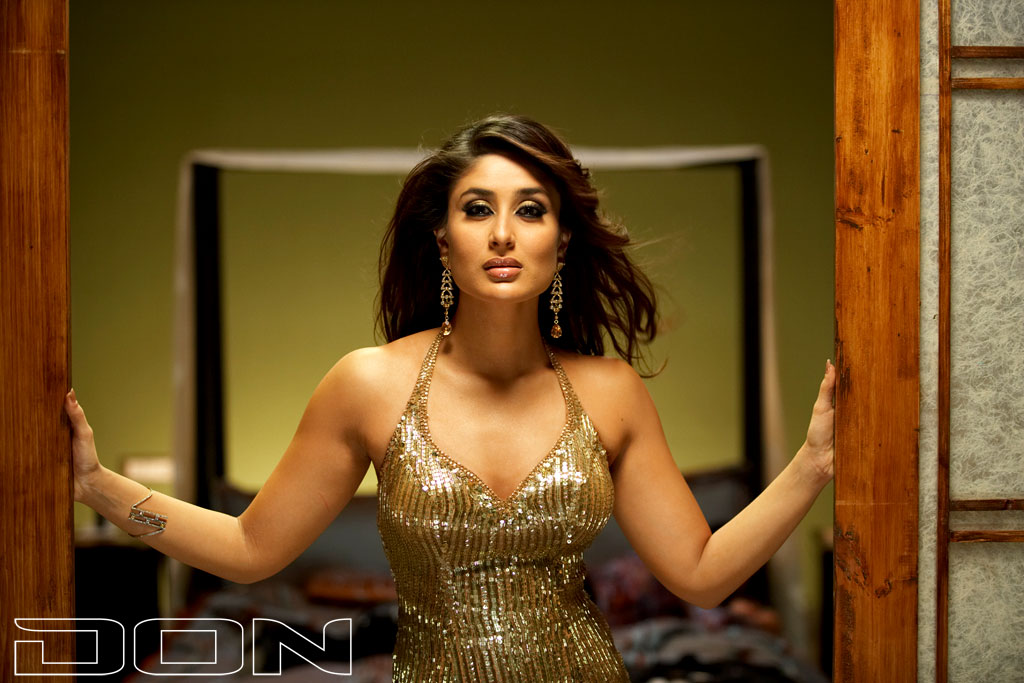
 Second thing of note - when Don spots Kamini (Kareena Kapoor) they are both in a nightclub in KL. The scene is incredibly reminiscent of the club scene from Dil Chahta Hai - lots of flashing strobe lights, a dance floor packed with clubbers, alcohol, and pulsating music....hmmm....that beat seems familiar.....hey wait a minute - it sounds like the one from Koi Kahe Kehta Rahe in the club scene in Dil Chahta Hai. Interesting way to build in a signature Mr. Akhtar...
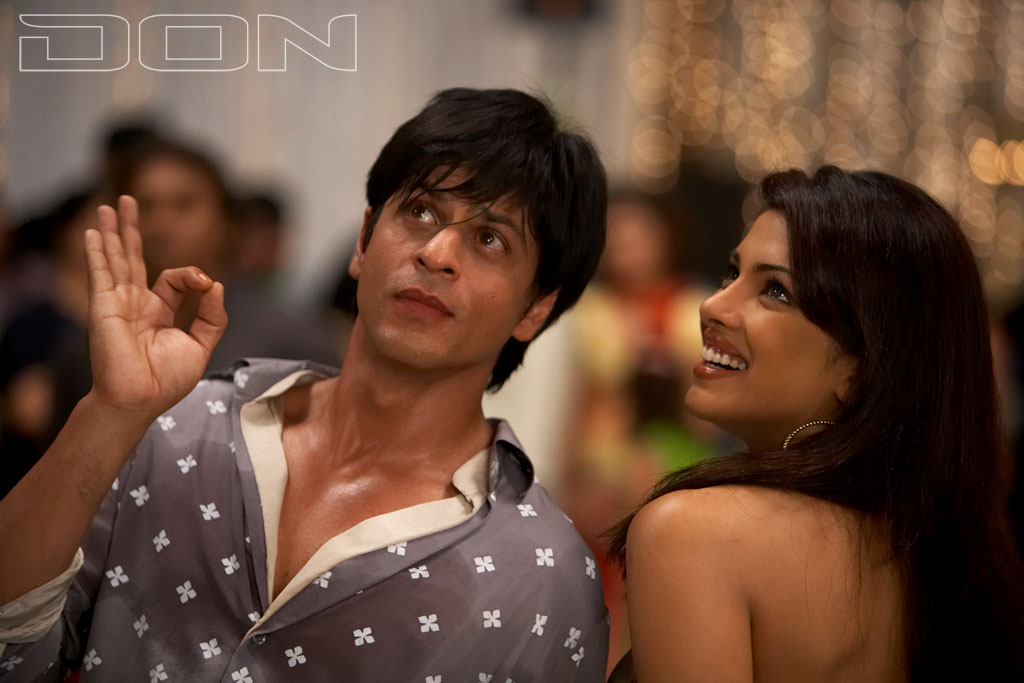 Khaike Paan Banaraswalla - this song made the original movie, and in many ways also cemented Amitabh Bachchan's fan following in his own home state of Uttar Pradesh. Sadly, while King Khan does his best to emulate a paan chewing rustic from the Gangetic plains, high on bhaang and also on the tambaaku in his beeda, this is where you miss the old Bachchan. Khan throws some fairly energetic moves, while Chopra does a good job as well, but you can't help but remember the original. Having said that, I had never thought this particular song would do well as a karaoke number, but at one point, half the audience was going, "Hai, Hai, Haaai" with Don when he sang about ek kanya kuvaanri & ek meethi kataari.
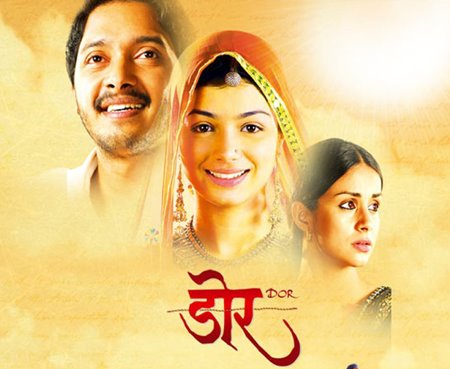 One of the smaller, lower budget movies of the year, Dor is the latest offering from Nagesh Kukonoor, Indian cinema's NRI engineer turned India-returned filmmaker. After giving us some seriously low budget films like Hyderabad Blues, Kukunoor's growing stature has given him more funding, while each successive film has shown his maturing into a talented filmmaker.
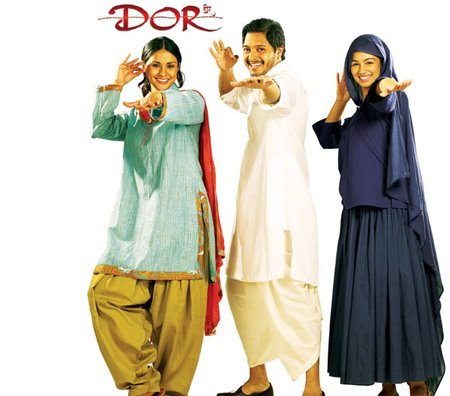 Kukunoor also manages to inject his story telling with a healthy dose of cross referencing to mainstream Bollywood, lending a unique intertextuality to Dor. Several references through dialogue, many of them to contemporary films like Munnabhai MBBS & Bunty aur Babli, and the use of Hindi film songs (You are my Soniya, Kajra Re) also help Kukunoor develop aspects to his characters that would have been challenging to flesh out otherwise. You can immediately recognise in Mira every small town girl that learnt the steps to famous songs, to be performed at family festivals in front of cousins and at wedding sangeets, while the Behroopiya's mouthing of filmi dialogues marks him out in five seconds as that small town performer who entertains in villages with his impersonations. Furthermore, this intertextuality is both a testimony to the over-arching influence of popular cinema in the lives of millions, as well as a fitting tribute to Bollywood. Kukunoor has done well in not going down the route of many "auteurs" who look down on their mainstream counterparts; on the contrary, he uses them intelligently to sustain the sparseness of his own narrative.
 But for me, none of this is anything more than an intellectual exercise.For me, as a non - Turk, non - European, perhaps some of the complexities in his writing are inaccesible. I am definitely impartial to most of the controversies surrounding his work. Pamuk became one of my favourite authors, and the reasons for that were simple. He opened my eyes to his beloved city, Istanbul.
 I read My Name is Red & Istanbul before I visited Istanbul. But Pamuk's writing had painted a glorious picture for me, had opened my eyes to the multifarious realities that make up that uber-city, had prepared me for the schizophrenia that was to confront me at every step. I learnt not to blink at the sight of a woman in a full chador, only her eyes visible, walk down Istaklal Caddesi and pass several open air cafes, their tables occupied by several gorgeous young women, blond, in low cut tops, chatting and smoking cigarettes. I learnt to expect Turks to look Caucasian, Arab, Persian. I learnt that the architecture in Istanbul was a glorious cacophony of different styles, the older Ottoman heritage clearly showing its Mongol ascendancy, while more recent constructions spoke of rococo & Baroque influences. I learnt that it was normal for people to live in Asia and work in Europe, and cross that great divide twice a day on their way to work.